Vertiv launches SmartIT, a pre-engineered platform for high-density AI racks
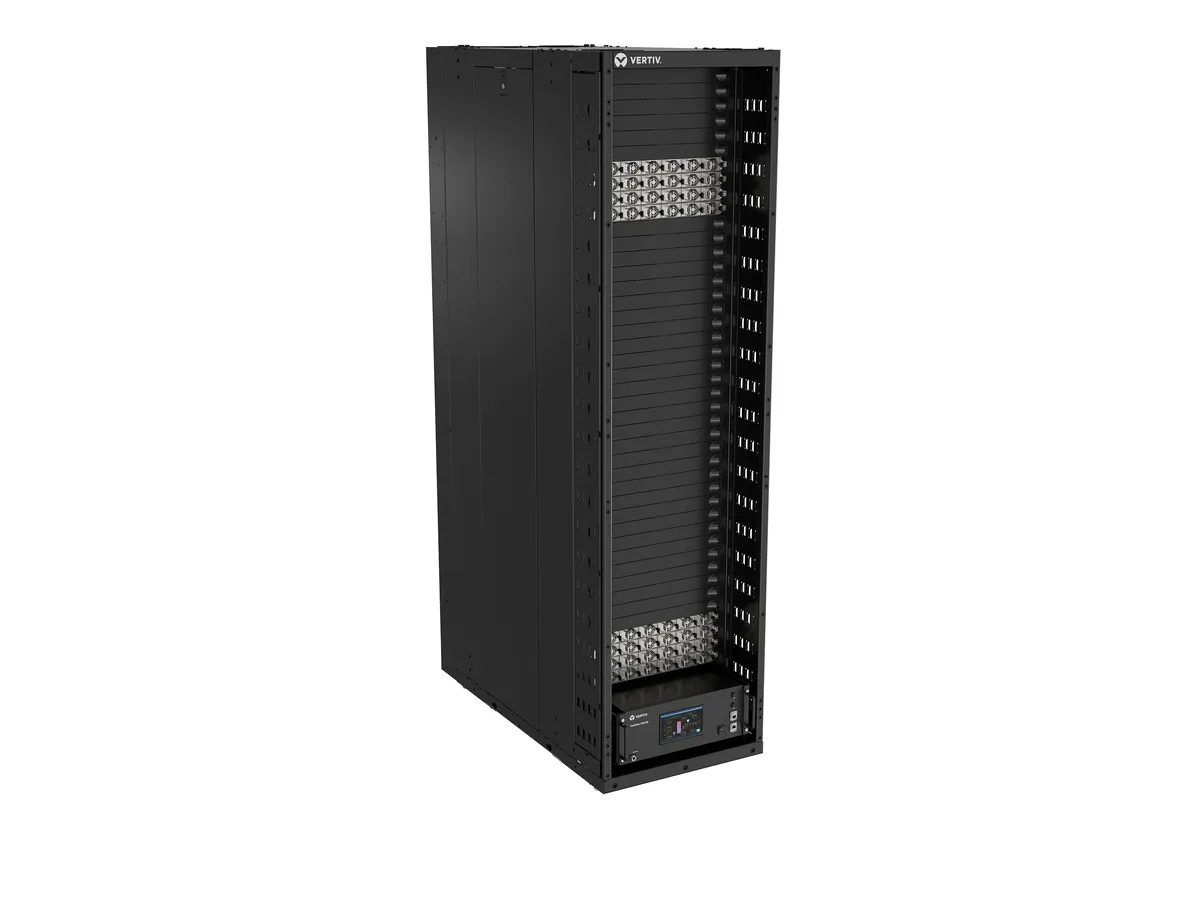
Vertiv Holdings Co. has introduced Vertiv SmartIT, a pre-engineered architecture that packages rack infrastructure, power, liquid cooling and monitoring into one factory-validated design for high-density AI deployments. According to the company, it is available now globally and targets enterprises, research institutions and colocation providers.
- Vertiv introduced SmartIT, a pre-engineered AI infrastructure platform based on NVIDIA MGX and OCP ORV3 architectures.
- It integrates rack, DC power, direct-to-chip liquid cooling, in-rack cooling distribution and monitoring in a factory-validated design.
- Supported systems include NVIDIA GB300 NVL72, Vera Rubin NVL72, DGX Rubin NVL8 and HGX Rubin NVL8.
- Vertiv says it is available now globally and scales from a single rack to multi-rack deployments.
- A SmartIT unit with an NVIDIA HGX Rubin NVL8 demo was shown at NVIDIA GTC Berlin in October.
What SmartIT includes
Vertiv SmartIT is based on NVIDIA MGX and Open Compute Project (OCP) ORV3 architectures. According to Vertiv, the solution integrates rack infrastructure, DC power conversion and distribution, direct-to-chip liquid cooling, in-rack cooling distribution and monitoring. These elements are integrated and validated at the factory before shipment, which Vertiv says reduces on-site integration complexity. The system then connects to the facility's power and cooling infrastructure.
The platform supports NVIDIA GB300 NVL72, NVIDIA Vera Rubin NVL72, NVIDIA DGX Rubin NVL8 and NVIDIA HGX Rubin NVL8. Vertiv says it was previously deployed with NVIDIA to support the NVIDIA DGX GB300. It is designed to scale from a single rack to multi-rack deployments within a common architecture.
Deployment problems Vertiv aims to address
The company lists several challenges the platform is meant to ease:
- Shorter timelines: factory validation replaces on-site integration, limiting commissioning to facility connections.
- Less vendor coordination: customers get a single order, one partner and one architecture spanning rack, power, cooling and monitoring.
- Existing spaces: brownfield enterprise facilities and Class A commercial buildings can support AI-class density without full reconstruction, according to Vertiv.
- Repeatable scaling: the same building block supports growth from one rack to many without redesign between phases.
- Visibility: integrated leak detection, automated response and continuous monitoring give visibility from rack to site, built in from day one rather than assembled from separate vendor tools.
Operations are supported by built-in monitoring, leak detection and support for Redfish, SNMP and Modbus. Vertiv Global Services handles deployment, commissioning and lifecycle management.
Fitting into a wider Vertiv architecture
SmartIT can be deployed as part of a broader Vertiv infrastructure setup. Vertiv SmartRun extends integration across the row, and Vertiv rack power distribution units (rPDU) provide power distribution and monitoring. Vertiv Unify offers integrated monitoring, analytics and controls across power and thermal infrastructure, including leak detection and coordinated response control. Together, the company says, these let customers move from individual SmartIT deployments to larger AI environments.
Vertiv showed a SmartIT unit with an NVIDIA HGX Rubin NVL8 demo at NVIDIA GTC Berlin in October. The demonstration was meant to show an integrated architecture supporting NVIDIA DGX Rubin NVL8 deployments, so customers can start at the right scale and expand as AI demand grows.
What it means for data center operators
Scott Armul, Chief Product and Technology Officer at Vertiv, said that "AI is fundamentally changing the demands placed on data center infrastructure, requiring closer coordination across power, cooling and IT systems to support increasingly complex workloads." He said SmartIT brings these disciplines together in a factory-validated architecture.
For operators, the pitch is a single validated building block instead of separately sourced power, cooling and monitoring systems. The source does not give pricing, capacity figures or delivery times, so the practical benefits will depend on how the platform performs in customer sites. Vertiv says the design works across existing enterprise facilities, new builds, commercial spaces, colocation and hyperscale environments without redesign.