Chongqing Forum Explores Smart Cars, Robots and Pandemic Prevention
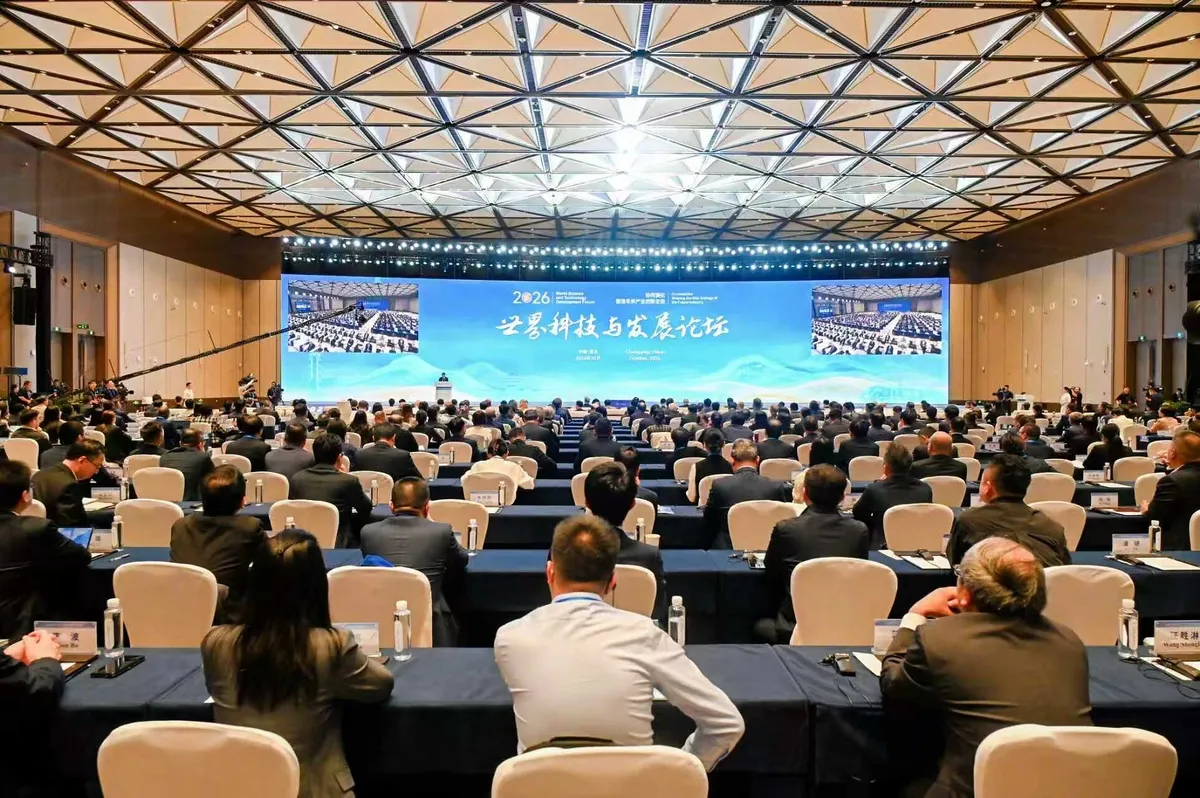
The 2026 World Science and Technology Development Forum opened in Chongqing on October 21, gathering around 800 participants to discuss how automotive technology, robotics and other advances could shape future industries. According to the organizers' report, the event runs through October 23.
- The 2026 World Science and Technology Development Forum opened in Chongqing on October 21 with around 800 participants.
- Changan Automobile Group's chairman said cars are evolving into "self-evolving intelligent car robots."
- Speakers discussed humanoid assistants, 6G-supported robots and a digital twin model for pandemic prevention.
- The Top 10 Science and Technology Foresights of 2026 and an intelligent sensing industry map were released.
- The forum runs through October 23 with 12 parallel forums.
Calls for breakthroughs and cooperation
Wang Guangqian, President of the China Association for Science and Technology, called for technological breakthroughs, closer integration of technological and industrial innovation, greener development and stronger technology governance. He emphasized that future industries connect science and technology with the economy.
Li Junhua, UN Under-Secretary-General for Economic and Social Affairs, described engineering as a bridge between scientific discovery and industrial practice. He stressed that achieving the UN's 2030 Sustainable Development Goals requires stronger international scientific cooperation and participation by all countries and communities.
Cars as robots, robots as assistants
Zhu Huarong, Chairman of China Changan Automobile Group, said cars were evolving from transportation tools into "self-evolving intelligent car robots." The automotive industry is increasingly integrating AI, chips, communications and big data, with applications extending into energy and urban governance.
In Chongqing, vehicle-road-cloud data integration supports traffic management. Vehicle-to-grid interaction and integrated energy systems could turn vehicles into mobile nodes in green energy networks.
David Lopez Perez, Professor at Universitat Politècnica de Valencia, Spain, outlined applications ranging from urban drones and industrial inspection robots to humanoid assistants for older adults. Robots must reason, plan and coordinate, supported by digital twins, intelligent systems and future 6G networks. Interoperability and standardization remain essential.
Digital twins against pandemics
Nils Stenseth, Member of Academia Europaea and Professor at the University of Oslo, described using air travel data to build a digital twin model exploring how to prevent local epidemics from becoming global pandemics. He highlighted multisource data, digital technologies and a strong global surveillance network as tools for addressing emerging pathogens.
The organizers said these examples underscored the importance of interdisciplinary, cross-sectoral and international cooperation in translating advanced technologies into practical solutions.
Outcomes and program
The opening ceremony released the Top 10 Science and Technology Foresights of 2026, covering areas including AI, brain-computer interfaces and space resource development. An intelligent sensing industry map and other outcomes were also presented.
The forum is being held in Chongqing for the first time since its launch in 2019. It features 12 parallel forums on intelligent sensing, AI-powered simulation, embodied intelligence, smart manufacturing, green energy and new-energy vehicles, among other fields.
For readers following AI and robotics, the program shows how these technologies are being discussed alongside energy, urban management and public health. The speakers repeatedly pointed to standards, data sharing and international cooperation as conditions for turning research into practical use.