Zhejiang Lab's 021 model aims to unify chemistry, genomics and astronomy data
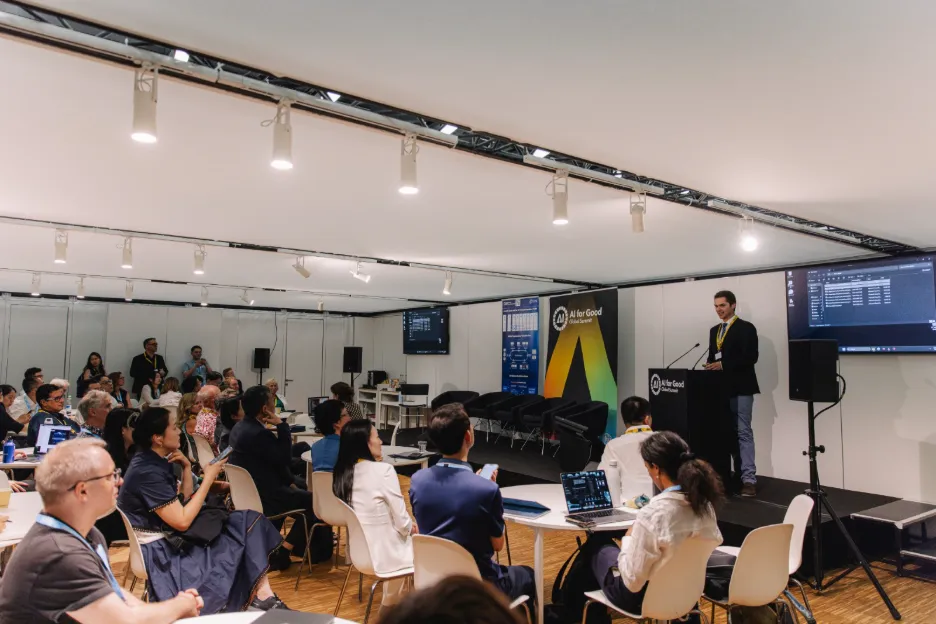
Zhejiang Lab presented its 021 Scientific Foundation Model at the AI for Good Global Summit 2026 as a single framework for scientific data that is usually analysed separately. The model covers text, code, mathematics, chemistry, astronomy, geoscience, life science and materials science, and the lab released base models with 32 billion and 236 billion parameters.
- Zhejiang Lab presented the 021 Scientific Foundation Model at the AI for Good Global Summit 2026, covering chemistry, life sciences, astronomy, mathematics and materials science.
- Base models with 32 billion and 236 billion parameters were released, using a unified tokeniser and a mixture-of-experts architecture.
- According to speakers, combining image and spectral data reached 83% precision in a gravitational lens search, versus 2% to 5% for the standard baseline.
- A chemistry model screened candidate refrigerants down to a shortlist of 60, and a genomics platform yielded 34 high-confidence therapeutic targets from one tumour patient's data.
- Participants stressed data access, standards and international cooperation as conditions for wider progress.
One representation for many kinds of data
Different sciences record observations in different forms: chemistry uses molecular formulas, genomics uses sequences, astronomy uses images and spectra, and geosciences use maps. According to the event report from ITU AI for Good, models trained on one of these forms rarely transfer to another. The workshop, organised with Zhejiang Lab and moderated by Anna Stepashkina, asked whether these scientific "languages" could share one AI framework.
Guirong Xue, Chief Engineer for Science Models at Zhejiang Lab, described two central design choices. The first is a unified tokeniser that converts each data type into a common representation before training. The second is a mixture-of-experts architecture, in which specific experts are activated for specific tasks while knowledge can still be shared across domains. The team released base models with 32 billion and 236 billion parameters. On a genomics benchmark, Xue reported that the unified model outperformed both specialised genomic models and larger general-purpose language models.
Narrowing search spaces in chemistry and genomics
Several presentations focused on helping researchers handle possibilities too numerous to examine by hand. Sebastian Viktor Pios of Zhejiang Lab presented a chemistry model built on the same foundation. According to Pios, it performed comparably to two leading commercial systems on molecular understanding and outperformed both on property prediction despite its smaller size. He described a collaboration with a Chinese chemical company in which the model screened candidate refrigerants down to a shortlist of 60 for further computational and experimental work.
Shiping Liu, Chief Scientist at BGI Research, described GenesLM, a human-genome foundation model trained on more than 60 complete human genomes, and TransGene, a joint text-and-sequence model developed with the Zhejiang Lab team. In a tumour patient case, 1.5 terabytes of multi-omics data yielded 34 high-confidence therapeutic targets. One of them is being taken forward by a Chinese group toward messenger-RNA and dendritic-cell-based therapies. The models were presented as tools for narrowing the options that need further computational, laboratory or clinical work.
Combining data in astronomy, mathematics and materials
Emma Tolley, Assistant Professor at EPFL, presented the One Astronomy foundation model, which combines image and spectral data to search for gravitational lenses. On a curated evaluation set, she reported a precision of 83% for the combined approach, against about 32% for images alone, 43% for spectra alone, and 2% to 5% for the standard convolutional-network baseline.
Jifeng Liu of the National Astronomical Observatories of the Chinese Academy of Sciences presented One Universe, an initiative that combines astronomical data, models, facilities and agent-based tools to widen access to research. He described a dentist who examined public astronomical data in his spare time and contributed to the discovery of what the team described as the early stages of an Earth-Moon-type system forming around a distant young star.
On verification, Lei Zhang of the National University of Singapore presented formal mathematical reasoning work built on the 021 base model. According to Zhang, a multi-agent proof system derived a formula in a day that had previously taken a doctoral student about a year. Stepashkina presented One Porous, an agent for designing porous materials. A structure it generated was 3D printed and tested experimentally. She reported that it was used in a satellite component, reducing its mass by approximately 10 percent and cutting the production cycle from three months to two weeks.
Open ecosystem, data access and cooperation
In opening remarks, Tong Weiling, Director General of the Zhejiang Provincial Department of Science and Technology, described Zhejiang Lab's Model Scope community as the largest open-source model community in China and the second largest in the world. She proposed four areas of international cooperation: joint research on shared scientific questions, cross-border data sharing and joint labelling, exchange of researchers and students, and shared governance of open-source science foundation models.
A roundtable moderated by Richard Chuchla, Co-chair of the GeoGPT Governance Committee, turned to data access. Susanne Pedersen of the IUCN said the organisation holds 76 years of biodiversity records and is working to make its data sets AI-ready. Tomasz Kacprzak of the University of Applied Sciences and Arts Northwestern Switzerland said AI applied to the same cosmological data has extracted approximately twice as much information as previous methods. Amal Kasry raised concerns about the concentration of AI training data and infrastructure in a limited number of countries and companies, and described UNESCO initiatives giving researchers in the Global South remote access to research facilities and high-performance computing.
What it means for scientific research
The workshop framed 021 as shared infrastructure through which scientific data, knowledge and methods could be connected, rather than simply one model for many tasks. The report says progress will depend on more than models: reliable data, access to computing resources, common standards, international cooperation and the judgment of scientists who understand the questions being asked. The discussion also covered open access, reproducibility, intellectual property and the need for domain experts to work closely with AI developers.
ITU AI for Good: One model across many sciences: Zhejiang Lab’s 021 Scientific Foundation Model