ZTE Targets AI Data Center Efficiency With 800V Power and Liquid Cooling
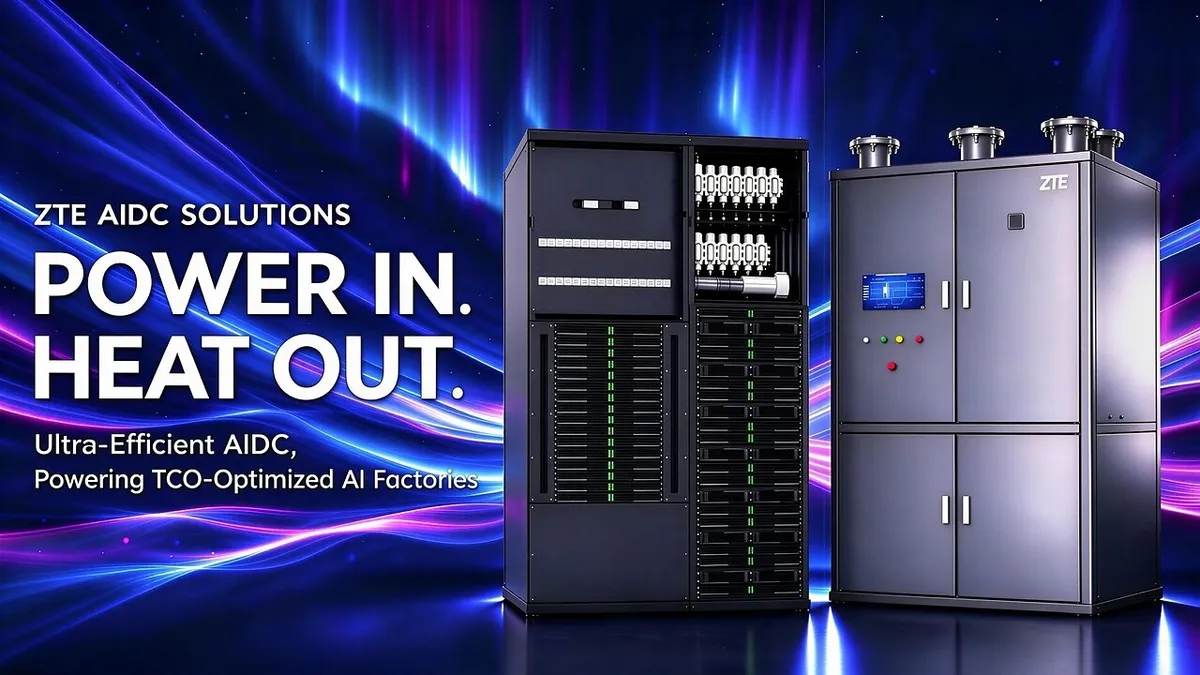
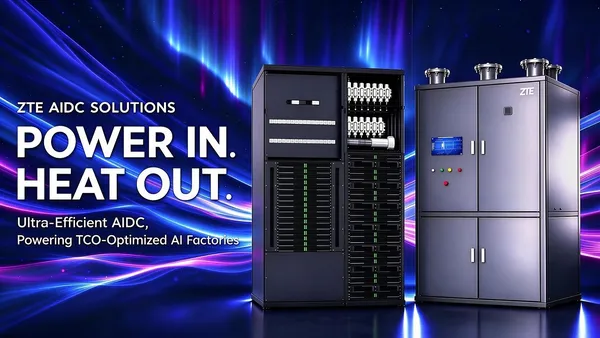
ZTE is positioning an 800V high-voltage DC system and a megawatt-level liquid cooling CDU as the foundation for more efficient AI data centers. The company says the systems address rising rack power demand, cooling limits and energy losses across traditional data center infrastructure.
- ZTE detailed an 800V high-voltage DC system for high-density AIDC power supply.
- Its liquid cooling CDU offers 1.5 MW of capacity per unit and can expand to 2.4 MW.
- The CDU provides claimed temperature control of ±0.5°C and pressure control of ±0.05 bar.
- ZTE reported a PUE of 1.15 at the Nanjing Binjiang Data Center.
- The company is combining power, cooling, storage and computing management in one AIDC approach.
AI infrastructure is pushing power and cooling limits
ZTE said the benchmark for AI data center infrastructure, or AIDC, is shifting from computing scale to computing efficiency as high-density GPU deployments increase electricity demand. Traditional data center racks typically consume 10, 20 kW, while AIDC racks can exceed 100 kW. High-end intelligent computing scenarios can reach 600 kW or even 1 MW, according to the company.
ZTE also said air cooling has an engineering limit of approximately 20, 30 kW per rack. As GPU heat density rises beyond that level, the company describes liquid cooling as a mainstream solution for keeping high-value computing systems operating at full load.
800V system aims to reduce power conversion losses
ZTE's 800V high-voltage DC system is designed to address losses in the multi-stage conversion chain between the transformer and the server. The system uses an efficient topology, DC/DC intelligent battery management and multiple application modes to provide what ZTE describes as high-density, high-efficiency, green and reliable DC power.
The company said the platform supports full-link management and system visibility, including fault recording, temperature measurement at key locations and selective protection simulation. Predictive maintenance covers module faults, system faults and battery lifespan.
Dual-standard compatibility allows the system to switch between ±400V and 800V. Its modular design supports capacity expansion as demand grows and is intended for centralized computing bases as well as distributed edge computing upgrades. ZTE said the system is aimed at operators, internet companies and professional computing power investors.
Liquid cooling CDU supports up to 2.4 MW
ZTE's cold plate liquid cooling CDU has a single-unit cooling capacity of 1.5 MW and can be expanded to 2.4 MW, with configurations of 2, 5 CDU cabinets. The company said auxiliary modules can be added as business requirements increase, reducing initial investment and later retrofit waste.
The 1500 kW CDU uses sensors measuring flow, pressure and temperature. ZTE reports temperature control of ±0.5°C and pressure control of ±0.05 bar. The system also includes health indicators, status visualization, N+X redundant hot backup and dual power feeds, supporting 7×24-hour uninterrupted operation, according to the company.
ZTE said the combination of its 800V power system and 1500 kW liquid cooling CDU can keep power usage effectiveness, or PUE, within 1.15. At the Nanjing Binjiang Data Center, the company reported a liquid-cooling integrated upgrade with power density of up to 60 kW and a PUE of only 1.15. ZTE also cited Karakoram-01 in Pakistan, which it described as the country's first and largest purpose-built, AI-ready data center campus, using cold plate liquid cooling, prefabricated power modules and smart busway.
ZTE presents infrastructure as a coordinated system
Beyond individual power and cooling products, ZTE said AIDC projects need computing power, electricity, heat management and operations to be planned together. Its approach combines source-grid-load-storage integration with 800V power, full-link liquid cooling, battery energy storage systems, iDCIM and iEMS management and control systems.
The company also described SuperPod AI computing servers developed with industry partners, along with AI training and inference optimization technologies intended to improve computing power utilization and match computing demand with electricity supply. Its green energy offering covers smart photovoltaic power stations, grid-side energy storage, AIDC energy storage and photovoltaic-storage microgrids.
For users and data center operators, the announcement points to an infrastructure strategy focused on handling higher rack densities while controlling power losses, cooling costs and operational complexity. ZTE's claims are based on its stated system specifications and cited deployment examples, rather than a general guarantee for every AIDC installation.
PR Newswire: ZTE Powers High Efficiency AIDC with Robust Energy Infrastructure