Abstracta Launches Quality Intelligence to Speed Up Bank Software Releases
Abstracta, an AI-powered quality engineering company, has introduced Quality Intelligence, a framework meant to help banks, fintechs and insurers understand the risk of every software change and decide on releases as fast as AI lets them build. The practice is delivered through Abstracta Intelligence, an enterprise AI platform built on the open-source agent harness Tero.
- Abstracta introduced Quality Intelligence, a practice for assessing the risk of every software change and making release decisions at AI speed.
- It is delivered through Abstracta Intelligence, an enterprise AI platform built on the open-source agent harness Tero, available on Microsoft Marketplace.
- Agents cover System Understanding, Change Impact, Risk Assessment, Release Readiness and Knowledge Capture, with a person signing off on each go/no-go decision.
- Abstracta claims a 40% reduction in production defects in under six months and regression cycles cut from days to about 30 minutes.
- Engagements begin with a 90-Day Quality Intelligence Framework assessment; Tero is free on GitHub.
The problem: building is faster than verifying
According to Abstracta, AI has changed how quickly teams build software, and writing code is no longer what slows delivery. The hard part is making sure the software has the quality the business needs, at the pace it needs it. More code means more changes, and each change can introduce risk. The company says organizations that speed up development while keeping the same validation and control mechanisms end up with a major bottleneck.
Abstracta argues the stakes are higher in banking, because a software error can affect money, personal data, or thousands of customers. The question for engineering leaders, in its words, is how to understand risk and make sound release decisions at the same speed they now build.
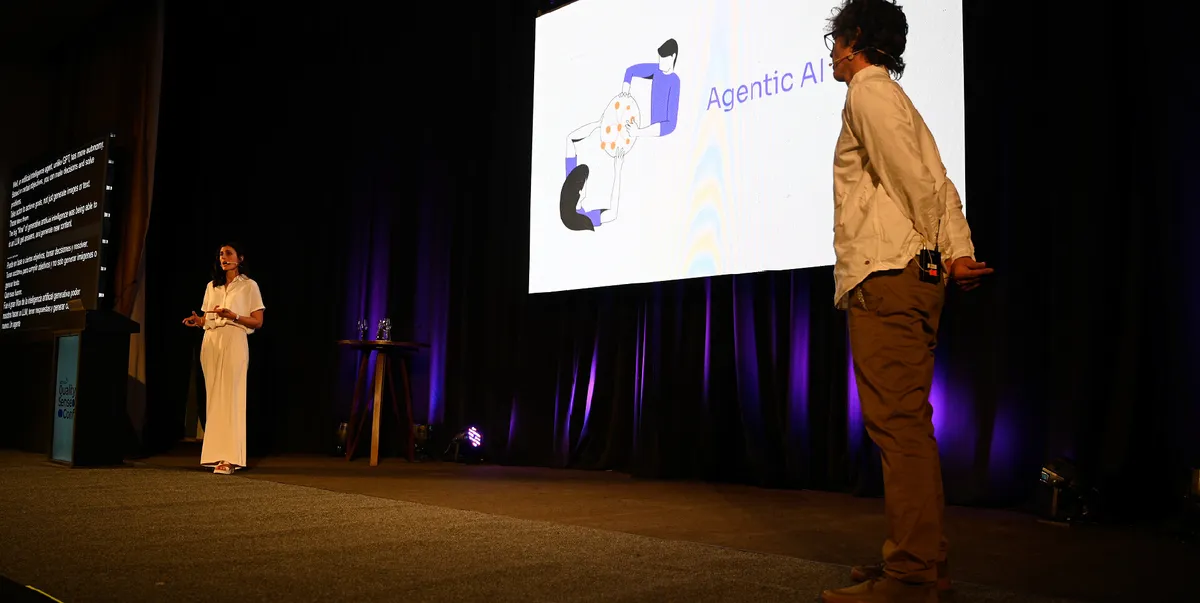
The company presented the vision and the first version of the Quality Intelligence Manifesto in the opening keynote at Quality Sense Conf 2026 in Montevideo, Uruguay. Co-CEO Sofía Palamarchuk delivered the presentation.
What Quality Intelligence means
In 2025, Abstracta named what it calls the Quality Intelligence Gap: the disconnect between what AI produces and what teams need to understand to make safe release decisions. The company says quality used to mean testing, building something and then checking whether it works, and that this is no longer enough when an organization ships hundreds or thousands of changes.
Quality Intelligence connects systems, context and human judgment. It uses what teams know about their software, from requirements, code and tests to incidents and production behavior, to continuously assess the risk of each change and whether there is enough evidence to ship.
Abstracta says the approach shares principles with the U.S. Department of the Treasury's Financial Services AI Risk Management Framework, released in February 2026: managing AI risk according to each institution's stage of adoption and embedding accountability into AI decisions. The company also offers a Quality Intelligence Maturity Model that places organizations on five stages, from exploration and individual adoption to AI-assisted release decisions.
Abstracta Intelligence and its agents
Abstracta Intelligence is the platform where the practice is applied. Its agents, built on Tero, connect to systems banks already run, from Jira and CI/CD pipelines to AS/400 and core banking platforms, and prepare the release decision. Tero is available on Microsoft Marketplace. The agents cover five areas:
- System Understanding: explains how a feature, flow or business rule works across docs, tickets, code and tests.
- Change Impact: shows what changed and which areas may be affected.
- Risk Assessment: flags risks based on history, defects, weak coverage and incidents.
- Release Readiness: summarizes the evidence for a go/no-go decision that a person signs off on.
- Knowledge Capture: turns expert knowledge into reusable, auditable context.
Testing Maturity, DORA metrics and Release Readiness dashboards give QA, engineering and leadership a shared baseline for each release. Audit trails, defined roles and human approval are meant to keep people accountable for every go/no-go call.
Track record and claimed results
Abstracta says it has spent nearly 20 years improving software quality in business-critical systems, including work with global banks such as BBVA and Santander. With Bantotal's R&D team and Microsoft's AI Co-Innovation Lab, it built a generative AI copilot to help teams understand a core banking system made up of hundreds of thousands of programs.
According to the company, its approach across engagements has delivered a 40% reduction in production defects in under six months, regression cycles cut from days to about 30 minutes, and more than 2,000 hours saved per month through AI agents built on Tero. These figures come from Abstracta itself.
Availability and what it means for banks
Abstracta Intelligence engagements start with the Abstracta 90-Day Quality Intelligence Framework, which defines what to prioritize, what changed, what evidence is missing, what impact AI is having, and what to scale. Tero is free and open source on GitHub, and organizations can contact Abstracta to schedule a 90-day Quality Intelligence assessment.
For banks and other operators of critical software, the pitch is that release decisions should rest on evidence rather than on testing alone, with people still accountable. Palamarchuk said: "the decision about what ships stays with the people responsible for it." The release does not include pricing for the platform.