Anyday Security Launches Free AI Exploit Catalog for Defenders
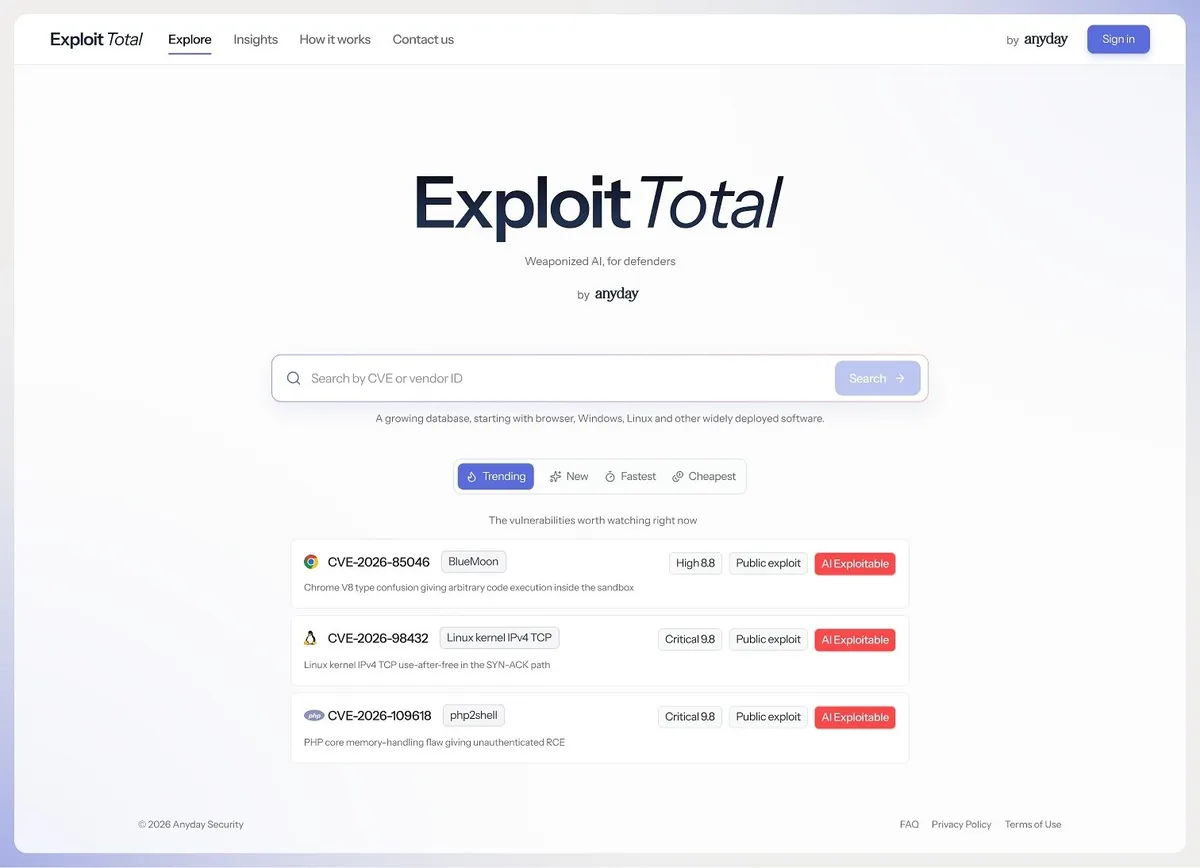
Anyday Security has launched ExploitTotal.ai, a free platform that shows which vulnerabilities open-weight AI models can exploit and provides verified users with downloadable proof-of-concept code for authorized testing. The catalog already contains more than 200 working AI-generated exploits.
- ExploitTotal.ai contains more than 200 working AI-generated exploits.
- Anyday Security says 72% had no previously public exploit.
- Verified users can download unweaponized PoCs for authorized testing.
- The catalog covers Windows, Linux, Chrome, Firefox and Edge.
- The platform is available now for free.
A catalog built around AI exploitability
ExploitTotal.ai is designed to help security teams assess whether systems are exposed after a vendor releases a patch. Anyday Security says its platform provides validated, compliant and actionable PoCs that defenders can use to test their environments and build detection rules.
Each vulnerability page provides a verdict on whether AI models can weaponize the vulnerability, along with the time and cost required to build an exploit and the model that produced the strongest result. Exploits receive a five-level rating, ranging from crashing the target program to taking full control of it. The pages also include severity information, whether a public exploit exists, and the model and date associated with each result.
Anyone can search the catalog for free. Signed-in users can view the full AI exploitability assessment, while verified users can download unweaponized PoCs. According to Anyday Security, these PoCs run against vulnerable code without a harmful payload and are intended for authorized security testing, research and defense.
Testing what attackers may be able to build
Anyday Security says it tested GLM-5.3 against more than 200 known vulnerabilities, including difficult targets in widely used browsers and operating systems. The model received only the information available to an attacker when a fix is announced: the vendor's public vulnerability description and the patch itself.
The company compared successful exploits with the U.S. National Vulnerability Database, CISA's catalog of known exploited vulnerabilities and public exploit repositories. It says 72% of the resulting exploits had never had a public exploit. In one demonstration, GLM-5.3 produced a complete, full-chain browser exploit in minutes for less than a dollar, according to Anyday Security.
ExploitTotal.ai currently covers widely used enterprise software including Windows, Linux, Chrome, Firefox and Edge. Anyday Security says it will update the catalog continuously as its automated system runs and new AI models are released.
Why the timing matters for security teams
Anyday Security's launch is based on the claim that defenders need to close the gap between patch availability and working exploitation. The company cites Anthropic's assessment that frontier AI models can build a working exploit within an hour of a patch's release. It also points to recent security incidents such as PHP2Shell, where attackers tried to exploit flaws before a patch was released.
The company cites Microsoft's 1,411 vulnerabilities fixed in its October 2026 Patch Tuesday, as well as Verizon's 2026 Data Breach Investigations Report, which found that organizations took a median of 43 days to remediate actively exploited vulnerabilities and fully remediated 26% of them. Google Threat Intelligence Group reported an average of 18 exploits per month in 2026, according to Anyday Security.
“AI has collapsed the distance between a vulnerability and an exploit,” Anyday Security CEO and co-founder Yonatan Gorfung said. The company says ExploitTotal.ai gives defenders access to exploit assessments and testing material so they can check whether their tools block a real attack, then write a detection rule or virtual patch when they do not.
ExploitTotal.ai is available now for free at exploittotal.ai. The platform's stated purpose is defensive, but its catalog also gives users a way to track how quickly AI exploit capabilities are advancing.