Arize ships hosted MCP server for AX, says CLI and skills still matter
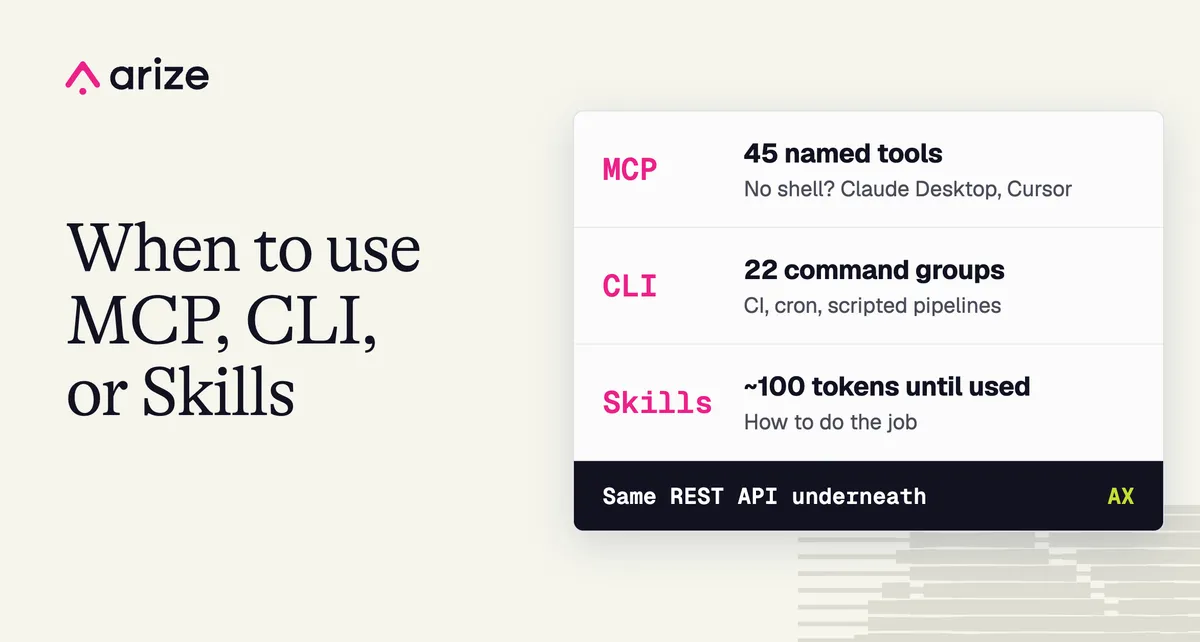
Arize AI has released a hosted MCP server for its AX platform, letting agents in Claude Code, Cursor and Claude Desktop query traces, experiments, evaluators and monitors without any local install. The company says the launch does not replace its CLI or its agent skills, and argues the right choice depends on where the agent runs and who is asking.
- Arize released a hosted MCP server for AX, usable from Claude Code, Cursor, Claude Desktop and other MCP clients.
- The server exposes 45 tools plus server_info across projects, traces, datasets, experiments, evaluators, monitors and prompts.
- Setup needs no install: point the client at one of three regional endpoints and pass an Arize API key as a bearer token.
- Arize says tool search in modern harnesses has largely removed the upfront context cost that made MCP expensive.
- Arize recommends MCP for shell-less clients and per-operation permissions, the CLI for scripts and CI, and skills to teach agents full workflows.
What the AX MCP server does
According to Arize, an agent connected to the new server can pull the ten slowest traces for a project and read the spans, diff two experiment runs to see which examples regressed, read the current version of an evaluator prompt, check which monitors are firing, and look up a dataset example. The user does not need to switch windows, learn the API or install the CLI.
The server is hosted, so there is nothing to install. Users point their client at one of three regional endpoints and pass their Arize API key as a bearer token. Arize's example configuration uses the URL https://api.arize.com/mcp with an Authorization header.
The server exposes 45 tools plus server_info, covering projects, traces, datasets, experiments, evaluators, monitors and prompts. Arize says each is a named operation with its own filters, such as list_projects, list_traces and get_experiment, rather than a generic search-and-execute pair. Setup instructions for each client are in the MCP docs.
MCP is one of three surfaces. Arize also offers the ax CLI, which has 22 command groups covering the full platform, and a set of skills installed with ax skills install. All three sit on the same REST API.
Why the context tax argument has faded
Arize's post starts with a reversal. Chief Product Officer Aparna Dhinakaran earlier wrote on X: “MCP = context tax. The future is CLI and files.” Arize says that was accurate at the time, because MCP tool definitions used to load into context at the start of every session.
The company cites community measurements putting a Claude Code session with five to ten servers installed at 50,000 to 67,000 tokens of overhead before the user typed anything. A setup combining GitHub, Slack, Sentry, Grafana and Splunk reportedly reached around 55,000 tokens in tool definitions alone. One benchmark put MCP at 4 to 32x the per-operation token cost of the equivalent CLI call. A CLI avoids this, Arize notes, because it costs roughly the command string, a few dozen tokens, and models already know tools such as git, docker, curl and jq.
What changed, according to Arize, is the harnesses. Claude Code, Cursor and Codex now use tool search: only the names of connected servers sit in context at startup, and full schemas load when the model looks for a tool. Arize also points to Anthropic's engineering write-up on code execution with MCP, where a Drive-to-Salesforce task dropped from roughly 150,000 tokens to 2,000 by having the agent write code against MCP servers. With the upfront cost mostly gone, Arize argues the choice between MCP and CLI should no longer come down to token math.
When to use MCP, CLI or skills
Arize says MCP is the only option that does not force a user into a shell for clients such as Claude Desktop, Cursor and Zed, which speak MCP natively. Its examples are a product manager in Claude Desktop asking which experiments regressed on hallucination this week, and a support engineer in Cursor pulling the last ten failed traces without leaving the editor.
The company also makes a governance case. An MCP server exposes a fixed set of named operations that a host can grant or deny individually, and the model never holds raw credentials in its context. Arize cites one comparison in which agents using structured tool manifests made 38% fewer invocation errors than agents composing free-form shell commands. It also notes that Anthropic's Thariq Shihipar said in September that MCPs are now better than CLIs for most integrations.
The CLI remains the better fit for scripted pipelines, chained commands and non-interactive environments such as CI, cron jobs, Lambda functions and Docker entrypoints. Arize's framework adds that if token cost is still a problem, users should first check that tool search is on, and move heavy workflows to code execution if needed. Most production agents use both, the company says, and names Claude Code, Cursor and Gemini CLI as examples.
The third layer is skills. A skill is a SKILL.md file plus optional scripts and references, loaded when a task matches. Arize says it costs roughly 100 tokens of context until invoked, because only the name and description load at startup. Where MCP gives an agent access to a live system, a skill teaches it how to do a task with that system. Arize's arize-experiment skill, for instance, encodes a workflow: verify the ax version and environment, resolve the space and project, list experiments with the right flags, then compare runs. The company says skills are built on top of CLI commands.
What it means for AX users
For teams already on Arize AX, the practical change is that non-terminal users and editor-based agents can now reach trace, experiment and monitor data directly. Developers who run agents in pipelines can keep using the CLI, and skills add procedural know-how on top of it. Arize also points to Arize Phoenix for those who prefer self-hosted, open source agent observability.
Arize AI: Introducing Arize AX MCP: When to use MCP, CLI, or skills