Arize AX Becomes Launch Partner for MongoDB's Atlas Agent Engine
Arize AI is a launch partner for MongoDB's Atlas Agent Engine, a new platform for building, deploying and governing AI agents in production. Arize AX supplies trace-level observability and evaluation for agents running on the platform.
- Arize AI is a launch partner for MongoDB's Atlas Agent Engine, a platform for building, deploying and governing production AI agents.
- Arize AX ingests traces from Agent Engine runs, showing model calls, retrieval steps, tool calls, latency and token usage at span level.
- The integration uses OpenTelemetry GenAI semantic conventions and OpenInference, so no custom instrumentation code is needed for runtimes emitting OTLP.
- Trace export is configured in the Agent Engine Traces page; Full content is currently the only content mode and sends prompts, completions and tool payloads.
What Atlas Agent Engine offers
According to Arize, Atlas Agent Engine is a governed foundation for building, deploying and operating AI agents in production. It is designed to work across models and frameworks, and enterprise teams can keep using their existing authentication and security tools. Arize says this lets organizations build on technologies they already trust without rebuilding their agent infrastructure.
MongoDB is launching the product with partners that help enterprises move from agent prototypes to production. Arize describes its own role as bringing trace-level observability and evaluation, so teams can understand each agent run, measure outcomes and execution paths, and improve agents before redeploying them.
Why traces matter for agents
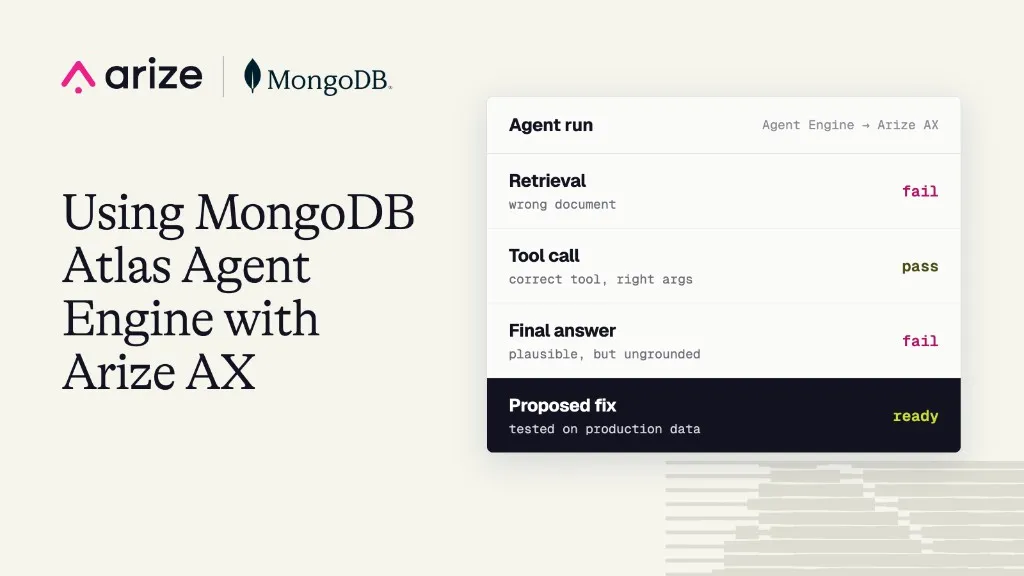
Arize argues that an agent can fail even when its final response looks plausible. It may retrieve the wrong document, call the wrong tool, repeat a step, or use an expensive model where a smaller one would work just as well. Finding such problems takes telemetry from the full execution path, not only the final output.
Arize AX ingests trace data from Agent Engine runs so teams can inspect the following at span level:
- model calls
- retrieval steps
- tool calls
- latency
- token usage
Agent graphs in Arize AX reconstruct the path that was actually executed, which helps show where behavior diverged from expectations.
Evaluation is the second part. Teams can run online evaluations against production traffic, score both the final output and the execution path, and send failures to annotation queues for review. Reviewed examples can become datasets for experiments, so a proposed change can be compared before redeployment. Arize AX also includes an agentic system called Signal, which automatically identifies failures and issues and then suggests fixes with a proposed pull request.
Open standards and setup
Arize AX natively ingests traces that follow the OpenTelemetry GenAI semantic conventions, as well as OpenInference. According to Arize, any agent runtime that emits OTLP on Agent Engine can send traces to Arize without custom instrumentation code. Because the integration rests on open standards, teams keep flexibility across frameworks, models and observability backends.
Connecting the two involves a few steps:
- In Arize, collect the Space ID, an API key and the model or project ID (model_id).
- In Agent Engine, create a project secret containing only the Arize API key.
- Open the Trace Export drawer from the Traces page and enable trace export.
- Choose the Arize preset, with the OTLP endpoint https://otlp.arize.com/v1/traces and the HTTP/protobuf protocol.
- Enter the space_id and model_id, reference the secret name, and set the auth header name to api_key.
- Under Delivery, set egress mode to Agent Engine + customer mirror (or Platform + customer mirror if the branding flag is off), content mode to Full content, and sampling to Always on.
Arize notes that Full content is the only content mode that works today, and that it sends prompts, completions and tool payloads. After saving, users run an agent invocation and confirm that spans appear in Arize under the chosen Space and model.
What it means for teams
Arize frames the combined workflow as continuous: build and deploy on Agent Engine, inspect and evaluate runs in Arize, test fixes against real production data, and redeploy with evidence. Arize says both products are neutral across frameworks and models, and that the integration gives joint customers a direct, supported path from the first run.
Jason Lopatecki, Co-Founder and CEO of Arize AI, said agents are moving from demos into production workflows, where reliability depends on both the context they act on and the ability to understand what happened at runtime. For teams already running agents on MongoDB, the integration adds a route to trace inspection and evaluation. Because Full content export sends prompts, completions and tool payloads, teams should consider that when enabling it.