Astera Labs Launches Aries 7, Its First PCIe 7 and Optical Portfolio
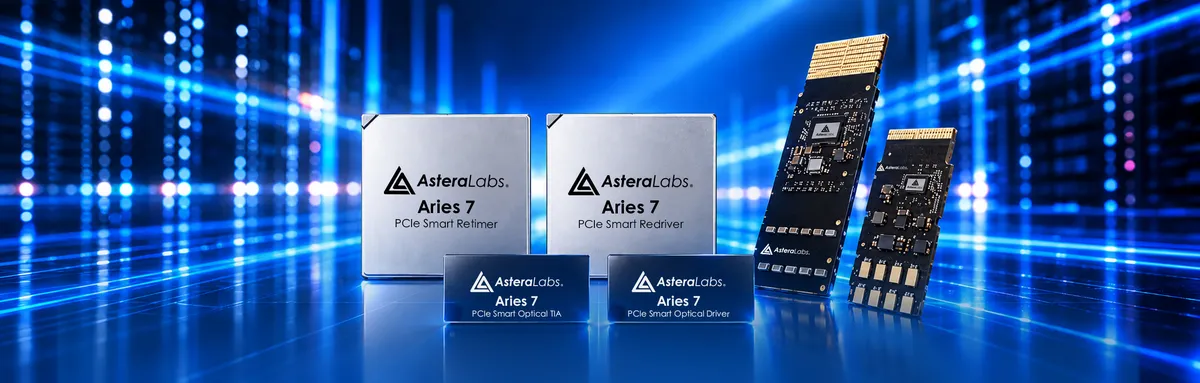
Astera Labs has announced Aries 7, which the company calls the industry's first and broadest PCIe 7 signal conditioning portfolio. It expands the copper product family and includes the company's first optical connectivity products.
- Astera Labs announced Aries 7, which it calls the industry's first and broadest PCIe 7 signal conditioning portfolio.
- The family includes Smart Retimers, Redrivers, Cable Modules, Optical Drivers and Optical TIAs, the last two being its first optical products.
- The optical devices target LPO and NPO applications and support PCIe 7 speeds up to 50+ meters.
- PCIe 7 channel loss budget grows only from 32 dB to 36 dB while Nyquist frequency doubles to 32 GHz.
- Aries Smart Redrivers are added as a lower-power complement to retimers, with Smart Swap pin-compatibility.
What Astera Labs is releasing
According to Astera Labs, the Aries 7 family covers Smart Retimers, Redrivers, Cable Modules, Optical Drivers and Optical TIAs. The company says these devices provide the long reach signal conditioning that PCIe 7 speeds demand in modern data center architectures.
The announcement comes from a blog post by Christopher Blackburn, Director, Solutions Architecture. He notes that Astera Labs shipped its first product, the Aries Smart Retimer for PCIe 4.0/5.0, on October 2, 2019. PCIe has since reached its seventh generation, which the company says brings new infrastructure challenges.
Why PCIe 7 is harder on signals
The post explains that PCIe 6 moved from NRZ to PAM4 signaling, which doubled maximum theoretical bandwidth for an x16 slot from 64 GB/s to 128 GB/s. PCIe 7 doubles that again. It keeps PAM4 and doubles the Nyquist frequency to 32 GHz.
The channel loss budget, however, has grown by only 4 dB, from 32 dB to 36 dB. Astera Labs argues that this makes PCIe 7 channels proportionally more constrained than PCIe 6 channels. In its view, ultra-low-loss PCB material, next-gen high-density connectors, and active copper or optical cabling are now non-negotiable.
The PCI-SIG specification also doubles the number of retimers allowed on a channel, from two to four. Astera Labs concludes that more channels will need signal conditioning, and that the majority of PCIe 7 channels will need some form of it.
Optical products for links beyond the rack
The company says copper alone cannot cover the reach needed as clusters grow at PCIe 7 speeds. PCIe is increasingly connecting across chassis and racks. Astera Labs describes a hybrid approach in which copper drives dense in-rack links and optics extend across racks.
The new Aries PCIe Smart Optical Drivers and Smart Optical TIAs are described as high-performance, low-power, high-density devices built for linear pluggable optics (LPO) and near-packaged optics (NPO) applications. They handle electrical-to-optical and optical-to-electrical conversion at PCIe 7 speeds up to 50+ meters. Astera Labs says it is working with multiple customers on larger accelerator clusters that use high-density NPO modules built with these parts.
For inter-rack links that copper can still close, the Aries PCIe Smart Cable Modules reach up to 3 meters for active copper cables and 6 meters for active electrical cables, at data rates of up to 128 GT/s. The company says its COSMOS real-time link intelligence ties the optical and copper products together for end-to-end link management.
The post also points to disaggregation, where racks hold only CPUs, NICs or SSDs. Astera Labs says this lengthens distances between devices and pushes more of the fabric toward signal-conditioned copper and optics.
Retimers and redrivers inside the rack
Within the rack, Astera Labs is adding Aries PCIe Smart Redrivers alongside its Smart Retimers. Retimers offer full signal regeneration and better margin recovery, but they draw more power. The company says redrivers can be the better choice for an emerging set of edge-case channels that need some conditioning but can be closed at lower power without full regeneration.
Both device types support Smart Swap pin-compatibility through the OCP Signal Conditioner Standard Footprint. The company says designers have been wary of redrivers in AI racks because they offer less signal visibility than retimers. It says the PCIe 7 Aries Smart Redrivers include telemetry and diagnostic features such as auto-adaptive EQ and eye monitoring through the COSMOS platform.
The post adds that some architects are using modular PCBs rather than internal cabling to connect layers in the rack, because board-based interconnect is easier to manufacture at scale. Astera Labs says this puts more pressure on signal conditioning silicon to keep longer, PCB-heavy channels viable.
What it means for data center designers
For builders of AI infrastructure, the announcement signals that PCIe 7 designs will lean on more signal conditioning, in both copper and optical form. Astera Labs says its portfolio now extends the PCIe fabric optically to the pod level. The source does not give pricing or availability for the new products.