ASUS launches UGen Arc Pro B70 with 32GB ECC memory for local AI
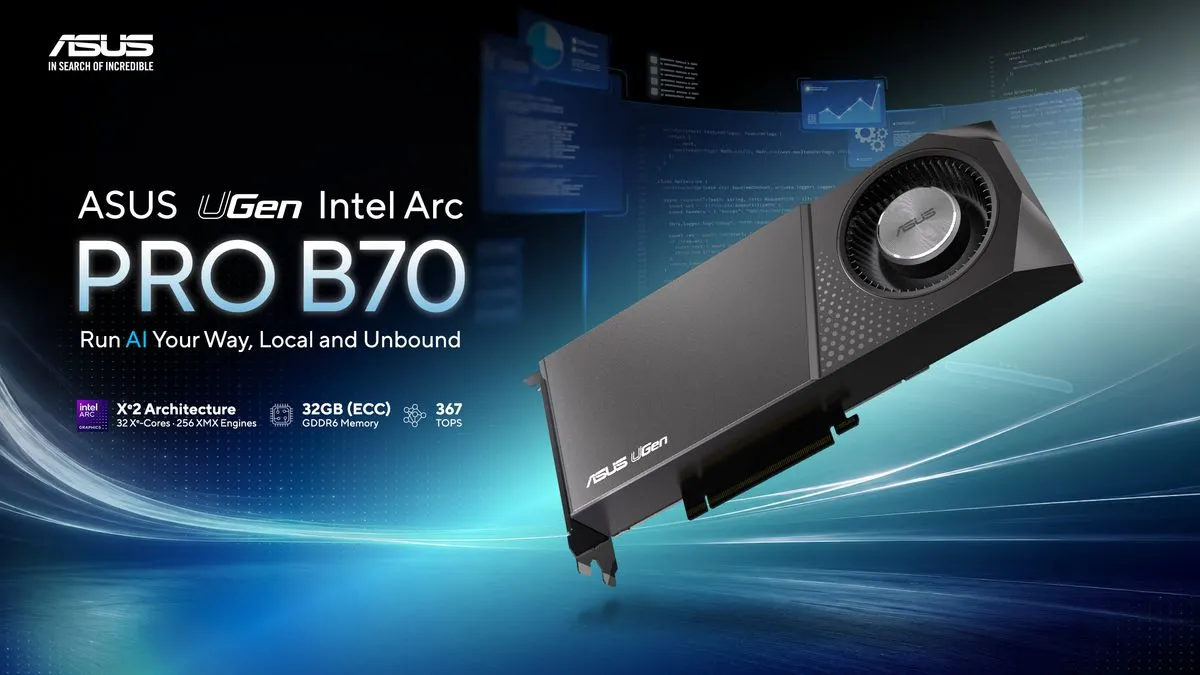
ASUS has announced the UGen Intel Arc Pro B70 32GB, a graphics card aimed at running large language models and multi-agent AI workflows locally. According to ASUS, the card pairs 32GB of GDDR6 ECC memory with an inference-optimized architecture and a power consumption of 310W.
- ASUS announced the UGen Intel Arc Pro B70 32GB with 32GB of GDDR6 ECC memory and 310W power consumption.
- Cards scale to 64GB in dual and 128GB in quad configurations.
- A single card enables up to a 128K-token context window with Llama 3.1 8B, according to ASUS.
- Dual-card setups ran 80B-class models at 43.4 tokens per second, ASUS says.
- The release gives no price or availability information.
Built for memory-hungry local AI
ASUS positions the UGen B70 as a response to what it calls the market's most pressing demand: ample VRAM at an accessible price. The company says LLMs and multi-agent AI workflows are moving from the cloud onto desktops and workstations, and that these workloads put heavy pressure on memory.
According to ASUS, long-context reasoning greatly inflates KV-cache usage, and multi-agent deployments run several models at once, which multiplies VRAM requirements. When VRAM runs short, data is offloaded to host memory, and ASUS states that inference performance can drop by up to 90%. The 32GB of ECC-protected GDDR6 is meant to keep demanding models entirely local.
A single card supports most models under 27 billion parameters, ASUS says, and enables a context window of up to 128K tokens with Llama 3.1 8B. Memory scales to 64GB in dual-card setups and 128GB in quad configurations, which the company links to the needs of SMBs and large enterprises.
Software support and verified models
ASUS describes the software stack around the card as broad and rapidly maturing. It lists the following:
- Intel LLM Scaler and vLLM XPU
- llama.cpp (SYCL and Vulkan)
- Ollama
- Intel OpenVINO and oneAPI
- PyTorch XPU
- ComfyUI for image generation
Verified models span Llama 3.1/3.2 (8B to 70B), Qwen 3.x, DeepSeek-R1 Distill (7B to 70B), Mistral and Mixtral, OpenAI gpt-oss (20B and 120B), Whisper-large-v3 and InternVL3.5. ASUS says dual-card configurations have been proven to run 80B-class models at 43.4 tokens per second.
The company also points to LLM Scaler's built-in INT4/FP8 online quantization, which it says removes the dependency on external CUDA-based quantization tools. According to ASUS, currently known ecosystem limitations do not affect near-term commercial deployment.
Three target groups and the agent computer idea
ASUS names three user segments for the card. For prosumers and independent AI developers, a single 32GB card is meant to break through the resource ceiling that mainstream 16GB cards impose on larger models. For small businesses and creative studios, dual-card 64GB setups support larger deployments while keeping sensitive data in-house.
For enterprise departmental AI teams, ASUS says multi-card 128GB systems dramatically reduce long-term costs compared with cloud APIs, while meeting data-compliance requirements in fields such as law, medicine, government and finance.
ASUS calls the UGen B70 the building block of an agent computer, a system designed from the ground up to run AI agents locally. The company describes its Agent Computer vision as powering AI choices across cloud, local and hybrid deployments.
What it means for buyers
The announcement is aimed at users who want to run models on their own hardware for privacy and cost reasons. If ASUS's claims hold in practice, a 32GB card at the entry level and up to 128GB across four cards would give small teams and enterprises a local alternative to cloud APIs. The press release does not state a price or an availability date, so the actual cost advantage cannot yet be judged.