Axelera AI ports a 3B robot model to its Europa card in a week with AI agents
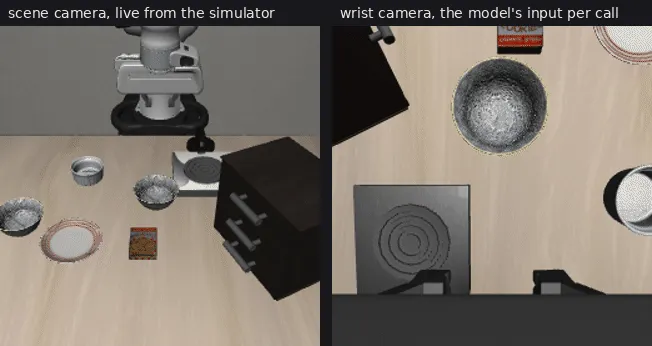
A product manager at Axelera AI, not an ML engineer, used AI coding agents and the company's AxScript language to port the 3-billion-parameter GR00T N1.7 vision-language-action model to a single Europa card in about a week. According to Axelera, an engineer then spent a day optimizing it to 66 ms per decision (15 Hz).
- GR00T N1.7, a 3B-parameter VLA, runs on a single Axelera Europa card with no accuracy loss versus PyTorch, according to Axelera.
- A product person ported it in about a week of part-time work using AI coding agents and AxScript, for around $500 in tokens.
- An engineer then reached 66 ms per decision (15 Hz); the host CPU took 19.2 seconds.
- Europa offers 200 GB/s of memory bandwidth versus 30 GB/s on Metis.
- LIBERO task success was 20 of 20 at every optimization stage.
A product person, AI agents and about $500 in tokens
Axelera AI says that bringing complex models to new accelerator hardware is usually slow. Many vendors offer only a model zoo and a black box compiler, so new model features can mean waiting months for compiler support. Others offer programmability, but according to the company only their own engineers can extract the performance. Axelera built AxeleraScript (AxScript) to offer both.
To test it, the author of the post ran GR00T N1.7, a 3-billion-parameter vision-language-action model (VLA), on a single Axelera AI Europa card. The model drives a simulated Panda arm through LIBERO tasks, with no accuracy loss versus the PyTorch reference, according to Axelera. The author describes the work as about a week of part-time effort, prompting the agent every 4-5 hours, and around $500 in tokens. It took place the same week Europa started shipping to customers.
The first working version reached about 200 ms per decision (5 Hz), with every transformer in the model on the card. An Axelera engineer then spent a day taking it to 66 ms (15 Hz), with the whole network, action head included, on the card.
Why GR00T is a demanding test
GR00T N1.7 combines two models. A Qwen3-VL backbone, made of a 24-block vision transformer and 16 decoder layers, reads two camera images and an instruction. A 32-block diffusion transformer, the action head, then denoises a chunk of 16 future robot actions in four flow-matching steps.
Axelera points to this as the shape generative AI at the edge is converging on: billions of weights, a transformer that runs many times per decision, and a hard real-time budget. On the test host's Intel Core i5-13500E CPU, one decision took 19.2 seconds.
From Metis to Europa
The author wrote a plan rather than kernels and ran coding agents against the Voyager SDK, with one rule: build the numerical oracle first. Each stage got a recorded reference from the real checkpoint, and each kernel had to reproduce it before the next was written. The agents used the SDK's own Qwen3-VL pipeline for the backbone and wrote the diffusion head themselves as two block kernels instantiated 32 times in one graph.
On the earlier Metis hardware, this took the policy call from 19,200 ms on the CPU to 870 ms, with feature cosine 0.9995 and end-to-end action cosine 0.9992 against PyTorch. Half a day of optimization, using documented schedule knobs and a graph that projects cross-attention keys and values once per call, brought it to 644 ms with no impact on task success rates.
The Europa port took a morning on the early-access SDK, using the same code customers get. Europa has eight in-memory-compute cores, 200 GB/s of memory bandwidth and 32 GiB on one card; Metis has 30 GB/s. The first port ran at 391 ms per call, which Axelera says is 1.6x faster than optimized Metis with no tuning.
A newer compiler, which the company says is soon to be released, plus splitting weights across two memory regions and batching both cameras in one dispatch, reached 274 ms. Reducing the diffusion head from 33 kernel dispatches per step to four, folding self-attention into the priming kernel and trimming graph inputs reached 199 ms. Against optimized Metis, Axelera cites close to 6x on decoder prefill (193 to 33 ms), almost 4x on the diffusion head (256 to 67 ms) and 3.2x on the full call. Against the host CPU, the call is 96x faster.
LIBERO task success stayed at 20 of 20 at every stage. Action cosine dipped from 0.9996 to 0.9965 in the final column because of the shorter compiled context, with no effect on the closed loop, according to the post.
Hiding the remaining latency
Even at 200 ms, a synchronous loop is visible: the arm executes eight steps, then holds while the next chunk is inferred. Axelera says the fix lay in the loop rather than model speed. GR00T N1.7's action head implements real-time chunking, which denoises the next chunk given the one still executing. The source text is cut off before the rest of the explanation.
What it means for Physical AI
The account is Axelera's own, and the results come from a simulated arm on a single test host. Still, it presents a case that a non-specialist steering coding agents against AxScript can bring a new transformer model to its hardware in days, and that Europa's memory bandwidth matters for real-time robot models. For teams building Physical AI, the company is positioning AxScript and Europa as a route to both programmability and performance without waiting on compiler releases.