Azure Content Understanding Adds Prebuilt Analyzers With Domain Knowledge for Documents
Microsoft is positioning the prebuilt analyzers in Azure Content Understanding as more than a schema: they package a maintained schema with learned knowledge of a document family. In a benchmark across 19 US tax-form categories, Microsoft says Azure Content Understanding 2.0 Preview with Advanced Contextualization beat both the 1.0 GA version and Azure Document Intelligence on mean F1.
- Microsoft says Azure Content Understanding prebuilt analyzers package a maintained schema with learned knowledge of a document family.
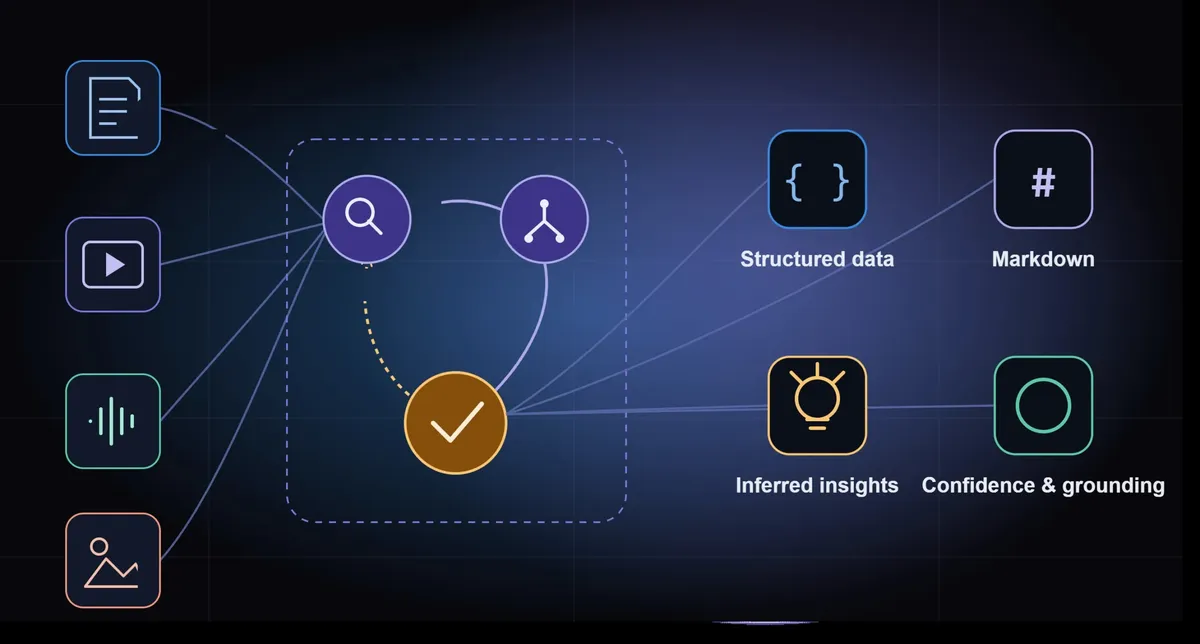
- Supported fields return a normalized value, a confidence score and grounding to the source span, page and coordinates.
- Composed analyzers for procurement, US tax and US mortgage intake classify and route documents before extraction.
- On 19 US tax-form categories, the 2.0 Preview scored 99.32% mean F1 versus 97.41% for 1.0 GA and 96.71% for Azure Document Intelligence.
- Microsoft says modeled cost fell 51% against 1.0 GA, to $8 per 1,000 pages, and stresses these are estimates.
Why a schema alone is not enough
According to Microsoft, extracting text is only the starting point for many intelligent document processing and agentic workflows. Applications need to capture a document's structure and implicit business meaning so that agents and downstream systems can act on it accurately.
A schema defines the output contract: field names, types, required properties, nested objects and allowed values. But Microsoft points out its limits. A schema can require totalAmount to be a number, yet it cannot reveal whether a minus sign was dropped, a date was read with the wrong locale, or a value came from the wrong line item. A result can satisfy the schema and still cause costly business errors.
Custom analyzers let developers describe each field in natural language, which Microsoft calls a flexible zero-shot starting point. For specialized workloads, teams may still need to test representative documents, add labeled examples and refine field definitions. The platform streamlines that work but does not eliminate it, the company says.
What a prebuilt analyzer returns
A domain-specific prebuilt analyzer bundles a maintained schema with knowledge of how fields are expressed, where they tend to appear, how related values are associated and which ambiguities commonly cause errors. Microsoft says it builds these analyzers from representative examples for each supported document family, covering variations across regions, layouts and business scenarios.
For supported fields, a prebuilt analyzer can return three things:
- Value: the typed, structured result, with supported dates and numbers normalized to a canonical format.
- Confidence: a score that can inform straight-through processing or human-review thresholds.
- Grounding: the source span, page and coordinates that tie the result to evidence in the document.
In an accounts-payable workflow, the prebuilt-invoice analyzer extracts P.O. numbers and itemized amounts with confidence scores and grounding. The workflow can then check results against business rules, highlight the source of a disputed value and send uncertain results to a reviewer.
Microsoft describes several cases where domain knowledge matters. An invoice may contain a subtotal, tax, an invoice total and an outstanding balance, and the requested amount is easy to confuse with another total. If OCR substitutes a period for a thousands-separating comma, $1,000 may be read as $1.000, and parsing that as a decimal changes the value by a factor of 1,000. On a W-2, the prebuilt analyzer separates the employer's name and address in box c even when the text spans multiple lines. On a Czech invoice, a simpler tool may struggle to tell Číslo účtu (account number) from IČO (ID number) in the customer block.
Composed solutions for mixed document sets
The catalog also includes composed solutions for procurement, US tax and US mortgage intake. These combine classification and routing with specialized extraction. An application sends each document to a family-level analyzer, which classifies the document's segments and routes them to the right extractor and schema. Microsoft gives the example of a mortgage intake service submitting files to the prebuilt-mortgage.us analyzer instead of relying on filenames or maintaining its own form classifier.
The tax-form benchmark
Microsoft says Advanced Contextualization is its latest approach to applying this domain knowledge economically at runtime, balancing quality, cost and latency. It evaluated its latest prebuilt tax analyzers across 19 US tax-form categories, comparing Azure Document Intelligence, Azure Content Understanding 1.0 GA and Azure Content Understanding 2.0 Preview with Advanced Contextualization. The figures below are equal-weight means of the 19 category values.
- Azure Document Intelligence: 96.71% mean F1, $10 mean modeled cost per 1,000 pages, latency index 4.4.
- Azure Content Understanding 1.0 GA: 97.41% mean F1, $16.23, latency index 10.
- Azure Content Understanding 2.0 Preview: 99.32% mean F1, $8, latency index 4.9.
Against 1.0 GA, the 2.0 Preview improved mean F1 by 1.91 percentage points, cut mean modeled cost by 51% and lowered mean latency by 51%. Against Azure Document Intelligence, its mean F1 was 2.61 percentage points higher and modeled cost was 20% lower, while mean latency was 10% higher. By category, the 2.0 Preview had higher F1 than 1.0 GA in 17 categories, was faster in 18 and had lower modeled cost in all 19.
What it means for developers
Microsoft's pitch is that developers can start from a maintained baseline instead of collecting document variations, labeling common fields and developing extraction conventions themselves. They can then concentrate on which fields matter, which business rules apply and which cases need review.
The company cautions that the cost figures are modeled benchmark estimates. Actual cost depends on the applicable content-extraction and contextualization meters, Foundry model usage and current rates, and it advises using the API's usage values with current pricing guidance to estimate a workload's cost. The 2.0 results also refer to a preview version.
Microsoft Foundry: Azure Content Understanding Prebuilt Analyzers: packaging domain knowledge for document AI