Blacksmith raises $66M Series C at $1B valuation as AI code strains CI
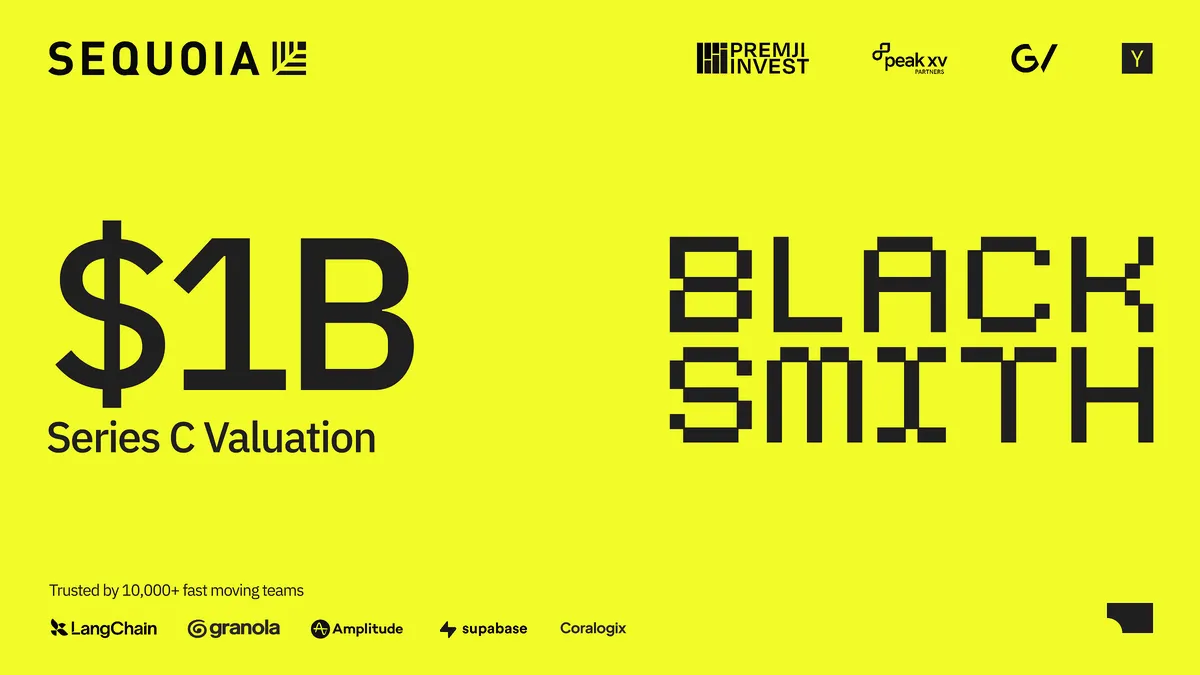
Blacksmith, an infrastructure platform for building and testing code, has raised a $66M Series C led by Sequoia Capital at a $1 billion valuation. According to the company, its annual recurring revenue has grown 17x since January as AI coding agents push far more code through testing pipelines.
- Blacksmith raised a $66M Series C led by Sequoia Capital at a $1 billion valuation, bringing total funding to $125 million.
- According to the company, ARR has grown 17x since January and weekly CI jobs rose from 5 million to more than 90 million.
- Blacksmith claims CI jobs run twice as fast and at 60% lower cost on average.
- More than 10,000 companies use the platform, which manages nearly 10 MW of compute and aims to grow it at least 5x in 2027.
Funding and investors
Blacksmith announced the round on Oct. 21, 2026. Premji Invest joined, along with existing investors Peak XV Partners, GV and Y Combinator. The round brings the company's total funding to $125 million. According to Blacksmith, the money will go toward growing its team and expanding its compute footprint.
The company was founded in 2024 by Aditya "JP" Jayaprakash, Aayush Shah and Aditya Maru, who met as undergraduates at the University of Waterloo. Shah and Maru were early engineers at Cockroach Labs, and Jayaprakash was an engineer at Faire. Blacksmith says it is hiring engineers in New York and San Francisco.
The bottleneck: validating code, not writing it
Blacksmith's pitch rests on a shift in software development. With AI coding agents producing a large and growing share of code, the company argues the burden has moved from writing code to validating it. Every change must still be built and tested before it can be merged, a step known as continuous integration, or CI.
According to the company, most firms run CI on general-purpose cloud infrastructure that was never designed for it. As developers push more code, teams face longer waits for compute, slower builds on older-generation CPUs, and a constant struggle between over- and under-provisioning. Blacksmith cites a report that Anthropic's own CI volume grew 25x in six months as Claude took over most of its code output.
"Since Claude Code took off in March, almost every conversation we've had with a large engineering team has started the same way," said Jayaprakash, who is co-founder and CEO. He said developers who once pushed three or four pull requests a day are now pushing orders of magnitude more, and their CI infrastructure cannot keep up.
What Blacksmith says it delivers
CI is a highly variable workload, the company says, with a single customer's demand regularly jumping from zero to tens of thousands of CPUs and back. Blacksmith says it designed its infrastructure stack to absorb such spikes routinely. Customers switch with a one-line change to their workflow file and no longer provision, scale or maintain CI infrastructure.
According to Blacksmith, developers see CI jobs complete twice as fast and at 60% lower cost on average, with zero operational overhead. Since January, weekly CI jobs on the platform have grown from 5 million to more than 90 million.
- More than 10,000 companies run CI on Blacksmith, including Ashby, Granola, Handshake and LangChain.
- The company manages nearly 10 MW of compute across data centers in the United States and Europe.
- It is on track to grow that footprint at least 5x in 2027.
Customer and investor views
Joaquin Borggio, Infrastructure Engineer at LangChain, said Blacksmith "has significantly reduced the burden of managing our CI runners while cutting our runner costs by roughly 40%." He added that this does not account for saved engineering time.
Isaiah Boone, Partner at Sequoia Capital, pointed to the team's "deep systems expertise and speed of execution." He said Sequoia believes the foundation gives Blacksmith "room to build much more as the demands of software development change."
For engineering teams, the announcement signals that investors see CI capacity as a growing constraint as AI-generated code increases. The performance and cost figures are Blacksmith's own claims, with one customer, LangChain, reporting a roughly 40% cut in runner costs.