CMU Opens Robotics Innovation Center With FieldAI, Fujitsu and Underwater Labs

Carnegie Mellon University has opened its Robotics Innovation Center (RIC), a 150,000-square-foot facility in Pittsburgh's Hazelwood neighborhood where university researchers work next to industry partners. According to CMU, more than 50 labs and working groups will test robots on land, underground, in the air and underwater.
- CMU's 150,000-square-foot Robotics Innovation Center in Pittsburgh's Hazelwood neighborhood will host more than 50 labs and working groups.
- FieldAI, valued at $2 billion, was the first corporate tenant, and Fujitsu is creating a Physical AI Research Center at the RIC.
- The site has a 50,000-square-foot indoor testing floor, a 1.5-acre outdoor area and a 75,000-gallon underwater tank.
- Tenants and projects include Aquatonomy for underwater inspection and SteelEagle for autonomous drone software.
A building designed to link research and industry
The RIC sits on the banks of the Monongahela River and was opened in February, when Pennsylvania Governor Josh Shapiro helped cut the ribbon. CMU says the center was designed to connect research with commercial ventures by housing university teams next to industry partners.
The facility complements CMU's National Robotics Engineering Center, which the university describes as the world's largest robotics research and development organization. It is also next to Mill 19, a 265,000-square-foot manufacturing research hub that is home to the Manufacturing Futures Institute and the Catalyst Connection workforce training center. The University of Pittsburgh is building BioForge, a $250 million biomanufacturing facility, nearby.
Martial Hebert, dean and University Professor of Robotics in the School of Computer Science, said the RIC offers researchers "new opportunities to develop and test robotics, automation and physical AI in the real world." He named agriculture, manufacturing, search and rescue and exploration among the challenges to be tackled.
FieldAI and Fujitsu move in
Several companies and projects have already moved in. The largest is FieldAI, which develops autonomous robots for unstructured environments. It became the RIC's inaugural corporate tenant in February. According to the article, the company is valued at $2 billion, has more than 200 employees in the U.S., and deploys its robots in eight industries, including construction, energy, manufacturing, logistics and security. It was founded by a team from NASA's Jet Propulsion Laboratory and is based in California.
Sebastian Scherer, a research professor in the Robotics Institute, is a director at FieldAI and manager of its Pittsburgh offices, which will house 10 employees. He said students will get "a front-row seat to the engineering challenges of scaling AI for the field."
Fujitsu Limited, a Japanese technology company, has announced a partnership with CMU to create a new Physical AI Research Center at the RIC. CMU researchers will work with Fujitsu scientists, engineers and technicians on physical AI systems for real-world challenges. David Lindlbauer, an assistant professor in the Human-Computer Interaction Institute, has a joint project with Fujitsu on human behavior simulation for robotics.
Testing space indoors, outdoors and underwater
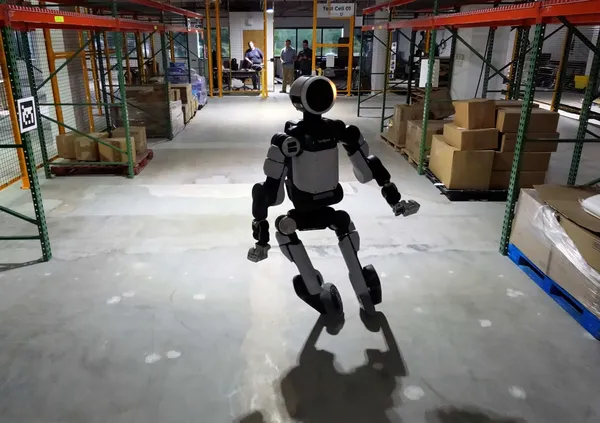
The RIC includes a 50,000-square-foot indoor robot testing floor and a 1.5-acre outdoor testing area. CMU also partnered with OptiTrack, described as the world's largest motion capture provider, to equip an indoor studio and the outdoor drone cage with motion capture systems. According to the article, the system tracks motion with sub-millimeter precision using infrared dots, which lets FieldAI map and recreate human motion.
For underwater work, the center has a 75,000-gallon water tank that is 10 feet deep and painted black to simulate darkness. Its concrete walls are engineered to absorb sonar acoustics rather than reflect them. Michael Kaess, a professor in the Robotics Institute, uses the tank to test autonomous underwater vehicles (AUVs). The undergraduate TartanAUV team, which competes in the annual RoboSub competition sponsored by the U.S. Office of Naval Research, also uses it.
Kaess has launched a startup, Aquatonomy, to commercialize AUVs that create 3D maps of underwater surfaces and inspect infrastructure such as dams, bridge pilings and locks. His research is funded by sources including the U.S. Navy and Army, the National Science Foundation and the Department of Energy. Because GPS does not work underwater, his vehicles combine acoustic sensors, odometry, inertial sensors and Doppler velocity sensors. Kaess said 10% of the nation's locks are in the Pittsburgh region.
Drones and what the center means for researchers
SteelEagle, a research project led by Mahadev Satyanarayanan, the Jaime Carbonell University Professor of Computer Science, also uses the RIC as its testing ground. The project is developing software that can turn commercial drones into fully autonomous flying vehicles.
For researchers and students, the setup puts lab work, real-world test areas and commercial teams under one roof. Scherer said having FieldAI in the building lets CMU see "exactly how our foundational research translates into commercial applications." For companies, the center offers varied environments to test robots working in unstructured settings.
CMU School of Computer Science: Inside CMU's Robotics Innovation Center