New book argues physical AI must scale with people, not without them
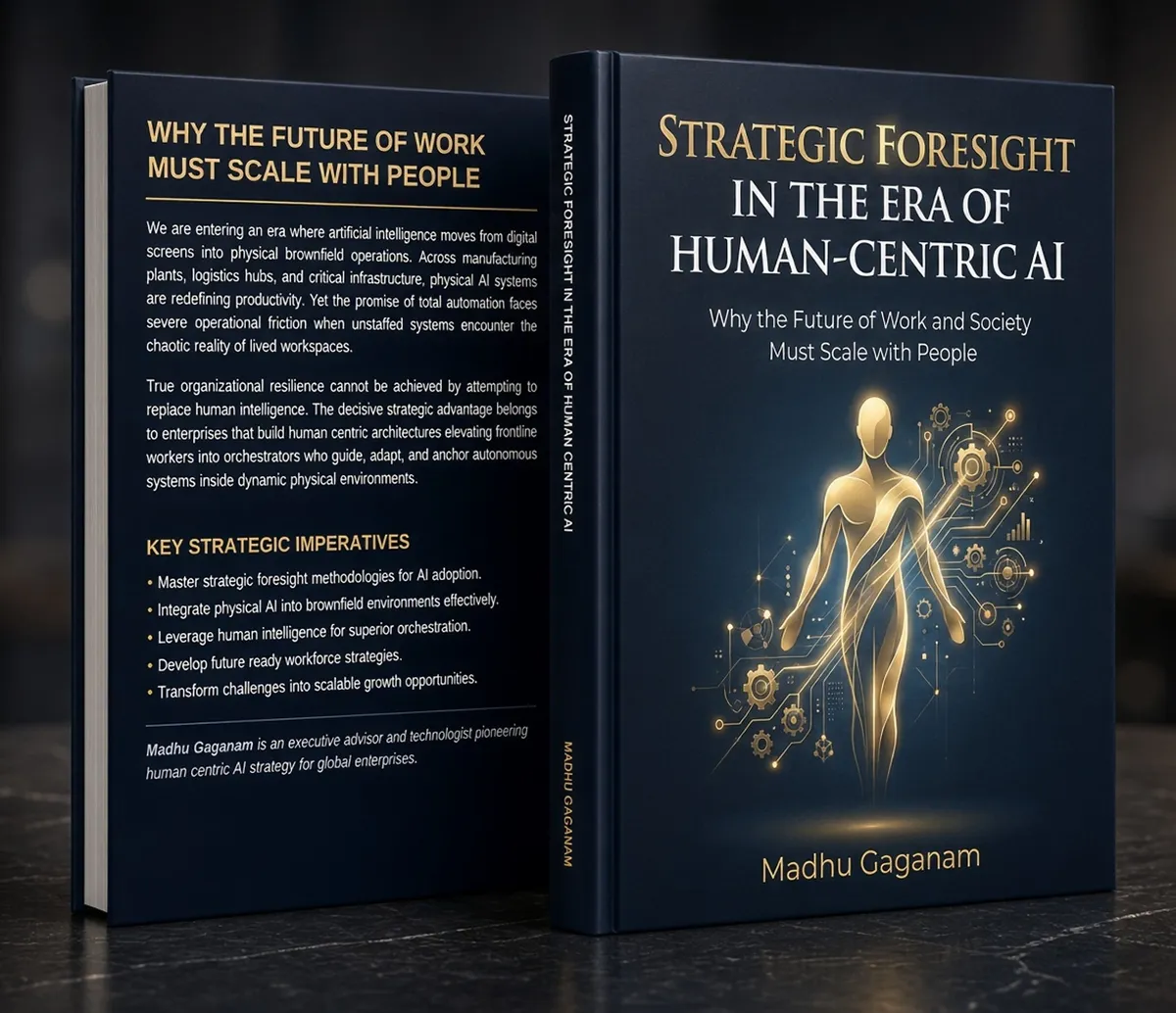
CogniEdge.ai, an advisory and R&D firm focused on Physical AI and Human Robot collaboration, has published "Strategic Foresight in the Era of Human Centric AI: Why the Future of Work and Society Must Scale with People". Written by founder Madhu Gaganam, the book argues that enterprise software playbooks break down when AI moves into shared physical environments.
- CogniEdge.ai founder Madhu Gaganam published "Strategic Foresight in the Era of Human Centric AI".
- The book argues enterprise software playbooks fracture when AI enters shared physical environments.
- Its takeaways cover digital twin limits, edge override rights, event audits, kinetic risk and thermodynamic ceilings.
- Hardcover and paperback are available now via Amazon and IngramSpark; eBook and audiobook are planned for December 15, 2026.
A warning for leaders of physical operations
According to the company, the book offers a roadmap for leading physical operations in the age of embodied autonomy. Its central claim is that as artificial intelligence moves from digital screens into shared physical spaces, traditional enterprise software playbooks are fracturing against physical reality.
The release argues that enterprise modernization has long assumed logic built for software could govern machines that move. In the book's framing, wear, heat, legacy equipment and people in the path are not software bugs. They are, as the text puts it, "the site." Organizations that try to scale by emptying the floor, the release says, spend heavily on autonomous fleets and then find no one left with the authority to move them when the floor disagrees with the plan.
What the book covers
The book is designed for executive decision makers and, according to the release, centers on three operational takeaways:
- A test for digital playbooks: an evaluation of why software models trained in pristine digital twins stumble on live floors.
- Usable authority and working overrides: halting institutional memory loss through digital apprenticeship and placing real time override rights directly at the edge.
- Physical liability and energy limits: establishing event audits, managing kinetic risk and designing within thermodynamic ceilings.
Taken together, the themes point to a view that authority, accountability and physical constraints need to be designed into autonomous systems, rather than added after deployment.
Endorsements and the author
The release includes two endorsements. John Vickers, Director of the Digital Twin Core Facility at Louisiana State University, said Gaganam "delivers a reality check on the friction, legacy complexity, and human dynamics of live facilities." He added that the author "makes a compelling case that true scale requires elevating human judgment into orchestration rather than engineering people out of the loop."
Paulo de Tarso M. Gomes, a supply chain and manufacturing practitioner and former Vice President at Schneider Electric, said: "The book confronts us with fact based arguments that help us navigate AI and adopt it in the physical world."
Gaganam advises industrial leaders on physical AI and operating design. He works at the boundary of Information Technology and Operational Technology, aligning human centric orchestration with automated systems. According to the release, he has over twenty years of experience across Gartner, Rockwell Automation, Dell and NXP Semiconductors, is an active IEEE Robotics and Automation Society member and is a top ranked thought leader on Thinkers360.
Availability and what it means for readers
The book is distributed globally through Amazon and IngramSpark. Hardcover and paperback editions are available now, while an eBook and audiobook are planned for December 15, 2026. The release was reissued as a correction: the title in Gomes's quote attribution was edited and the media contact phone number was updated.
For operations and technology leaders weighing autonomous fleets, the book positions itself as a decision framework built around a single choice: scale autonomy by removing people, or scale it by giving human judgment real authority over the machines. The source does not include independent evaluation of the book's claims, so its arguments reflect the author's and the endorsers' views.
PR Newswire: /C O R R E C T I O N - Cogniedge.ai/