Confluent Unveils Streamhouse Architecture and Lightning Tables for AI Agents

Confluent, an IBM company, has introduced the Streamhouse, a data architecture meant to give AI agents, applications and analytics a governed, current view of the business. To support it, the company made Lightning Tables generally available on AWS, completing the five pillars of its Data Streaming Platform.
- Confluent, an IBM company, introduced the Streamhouse architecture on November 4, 2026 to keep business context current for AI agents, applications and analytics.
- Query becomes the fifth pillar of the Data Streaming Platform, alongside Stream, Connect, Process and Govern.
- Lightning Tables is generally available on AWS and offers SQL and API access to live Kafka data.
- Confluent internal testing shows about 100 milliseconds to serving, 10-100 milliseconds query latency and 1,000+ queries per second.
- Accenture and Extend are cited as customers using a Streamhouse architecture.
What Confluent announced
Confluent announced new capabilities for building a Streamhouse on November 4, 2026. The company describes it as a new type of data architecture that keeps business context current as AI agents and other systems make decisions and take action. According to Confluent, the architecture continuously captures, processes, governs and serves the current state of a business.
The release adds Query to the Data Streaming Platform (DSP) as its fifth pillar, next to Stream, Connect, Process and Govern. Confluent says this makes the DSP a complete and unified platform for building a Streamhouse. The company also states that it sits at the center of IBM's data strategy, combining real-time data streaming with IBM's integration, governance and AI capabilities across hybrid environments.
The problem the Streamhouse targets
Confluent argues that data lakes, warehouses and lakehouses were built primarily with reporting or other batch jobs in mind. As AI agents take on more enterprise work, they must decide using information spread across systems that update at different times. If those systems disagree about the current state of the business, agents can act on outdated or conflicting information, and those actions can carry into other workflows.
The company gives an illustrative example of an airline handling a canceled flight. Flight operations track where the aircraft is, scheduling tracks when it will depart, and reservations tracks which seats are available. Because these update at different times, an autonomous rebooking agent could build an itinerary that looks valid in each system but fails in practice, for instance when a seat is available but the aircraft cannot arrive in time for the passenger's connection.
With a Streamhouse, each change, such as a new aircraft location, a delayed departure or a booked seat, flows into a continuous stream of events. Those updates are combined into current business context that rebooking agents, customer-service teams and applications can check together before offering a new itinerary.
Three principles and five pillars
Confluent says a Streamhouse rests on three principles: current, mission-critical and decentralized. It keeps business context continuously updated, is engineered to production service levels, and meets data where it lives without requiring consolidation first. It is designed to work alongside existing data warehouses and lakehouses, adding a real-time operational layer.
At the core of the DSP is Apache Kafka, which captures and streams business events. Confluent notes that Kafka alone leaves teams to assemble everything else needed to turn events into current context. The five pillars are:
- Stream: built on Apache Kafka and the Kora engine, with sub-millisecond latency in Confluent internal testing. The company says actual latency varies by configuration and workload.
- Connect: 150+ fully managed and custom connectors, plus new hybrid connector management.
- Process: uses Apache Flink to combine and enrich data close to the source, with added batch execution to initialize streaming workloads from existing data.
- Govern: lineage, catalog, quality, encryption, schema and access-control capabilities.
- Query: serves current context through Tableflow for lakehouses and warehouses, the Real-Time Context Engine for AI agents via the Model Context Protocol (MCP), and Lightning Tables for applications.
Lightning Tables on Confluent Cloud
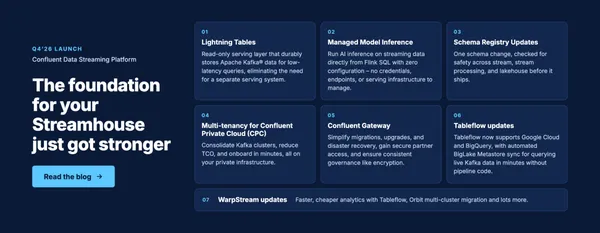
Lightning Tables is generally available on AWS. Confluent describes it as a read-only serving layer that durably stores Apache Kafka data and materializes it into tables, keeping them current as changes arise. Applications get low-latency SQL and API access to the current state of the business, which the company says reduces the need to copy data into a separate database.
In Confluent internal testing, the company reports approximately 100 milliseconds from new data creation to serving, query latency of 10-100 milliseconds and throughput of 1,000+ queries per second. Other listed features include:
- A fully managed serving layer without separate ETL pipelines, databases or caches.
- Querying through SQL and a direct API.
- Schemas, lineage and access policies applied from capture through serving.
- Schema evolution management to help prevent breaks in downstream applications.
- A feature store for computing features in Flink and storing them for machine learning, including real-time personalization.
Customer reports and what it means
Confluent cites two customers. Accenture, which operates across more than 120 countries, says its move to a Streamhouse architecture powered by Confluent decouples data producers from consumers. Thomas Mahaffey, SAI Chief Data Strategist at Accenture, said the foundation "has dropped our time-to-insight from months to days" and supports AI for the company's 800,000 employees.
Extend, an AI-native commerce platform, says it runs a 100% serverless Streamhouse architecture on Confluent Cloud. Jonathan Kropp, its Director of AI and Architecture, said the setup "turns Kafka into our operational source of truth" and lets downstream microservices consume and query real-time data.
For enterprises building agent-based systems, the announcement positions streaming data as a shared source of current context rather than a feed copied into separate stores. The performance figures come from Confluent's own testing, so results in production will depend on configuration and workload. Lightning Tables availability is currently stated for AWS only.