Microsoft: Grounding and Confidence Cut Insurer's Document Review Load by Nearly 50%
Microsoft says a large insurance organization cut its human review burden by nearly 50% using Azure Content Understanding's grounding and confidence features. In a Foundry blog post, the company also reports 75% faster form onboarding compared to previous solutions.
- Microsoft says an insurer cut human review burden by nearly 50% and sped up form onboarding by 75% with Content Understanding.
- Grounding links extracted values to supporting evidence in the document; Microsoft says deeper integration cut inference token use by up to 28%.
- Confidence scores come from a separate, shared model, not the LLM's own certainty, and improved by up to 14% in AUROC.
- Customers calibrate thresholds against their own human-verified documents rather than retraining the model.
- The insurer still had people check every field; confidence labels only prioritized review.
What the insurer achieved
According to Microsoft, the insurer worked with the company's Forward Deployed Engineering team to decide which extracted values most needed human attention. The solution used Content Understanding's classification, extraction, grounding and confidence capabilities. Microsoft reports nearly a 50% reduction in human review burden and 75% faster form onboarding compared to previous solutions.
The company attributes these outcomes to 97%+ page-level classification accuracy and routing based on confidence and grounding, which focused reviewers on the results most likely to contain errors. Microsoft stresses that the result did not come from a single threshold. It came from understanding what confidence scores mean and calibrating them against real, representative documents.
Grounding and confidence explained
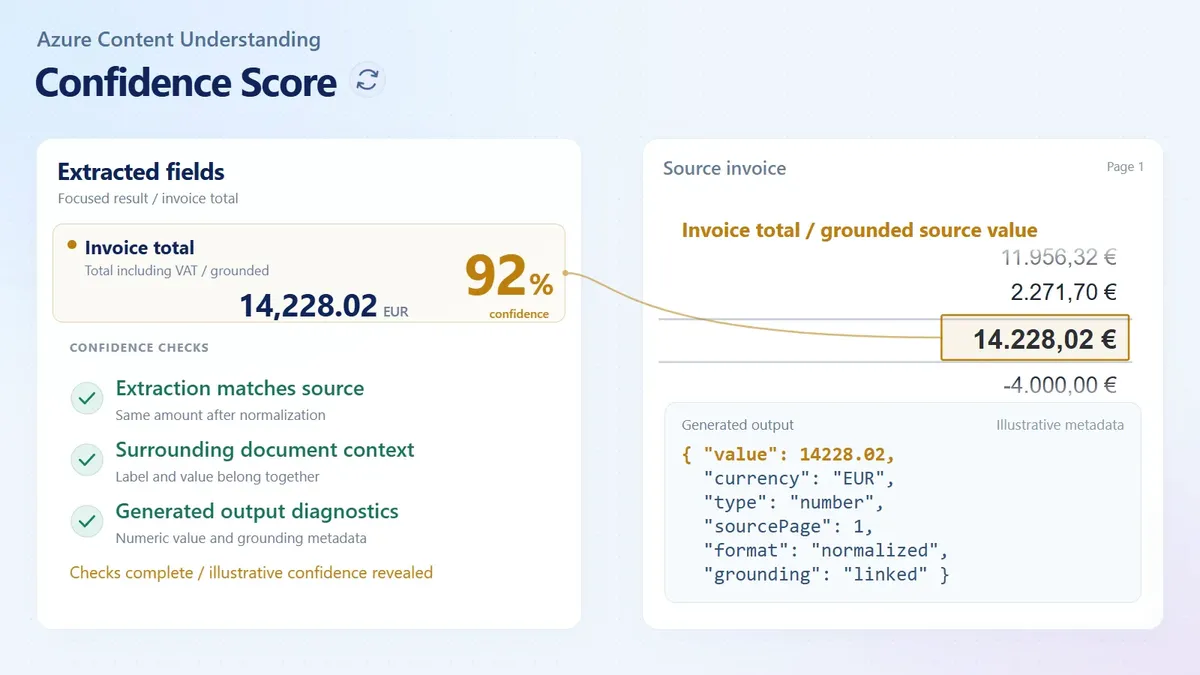
Grounding links an extracted value back to the content in the document that supports it. If the service returns an Invoice Total of $14,228.02, for example, grounding points to the supporting evidence. Microsoft says this lets applications show evidence to reviewers, validate a value together with its evidence, and keep an audit trail back to the source page. In its latest release, the company says it merged grounding deeper into the extraction flow, which cut average inference token usage by up to 28% and improved accuracy.
A confidence score is a learned estimate of how reliable a specific field result is, with a value between 0 and 1 for supported fields. Microsoft says its latest refresh improved confidence score accuracy, measured by AUROC, by up to 14%.
The company is explicit that the score is not the language model reporting how sure it feels, noting that LLMs are notoriously overconfident. Instead, a separate confidence model looks at signals such as:
- the document and the grounded evidence, including where and how the value appears on the page;
- the field and the result, including field type, position in the schema and the predicted value;
- labeled examples, where available;
- diagnostic information from the extraction itself, such as signs of ambiguity.
The score reflects context. According to Microsoft, the same value can receive a different score as a top-level field than inside a table or object.
A shared model, calibrated by customers
Microsoft says the confidence model is trained on Microsoft-curated data, not customer data. It is a shared, service-level model, so customers do not train a separate one for each analyzer, and Microsoft updates it periodically. Customers instead evaluate its scores against checked examples from their own workflow and choose thresholds that meet their business goals.
The company describes the score mainly as a ranking signal for risk: lower-scoring results should hold a much larger share of errors. Since teams cannot review everything, the score indicates where to look first.
How the insurer's workflow was built
Content Understanding first classified and segmented incoming pages by form type. Each in-scope segment then went to a form-type-specific classifier to identify its version, followed by the matching field-extraction analyzer. To manage a large document catalog, classification was split across multiple analyzers in two tiers, with segmentation enabled only in the first.
Microsoft notes that Content Understanding v1 does not return confidence scores for classifications, so all classifications still required human review. Where a valid calibration existed for the document type and extraction configuration, field-level confidence rules populated priority labels in the human-in-the-loop review tool. Other results stayed in standard review.
Because insurance data is sensitive, people still checked every field. The labels directed attention rather than authorizing straight-through processing. Microsoft says less sensitive workflows could use the same calibrated rules to send unflagged values straight through.
Start with documents, not the score
The first of the three steps Microsoft describes is to look at extraction accuracy across document types before setting any threshold. Quality can vary by form version, such as a 2024 tax form versus a 2026 version that adds a field or changes a table, and by source, since some vendors send clean documents while others send dense or scanned ones.
Microsoft advises breaking human-checked results down by form or document family, version and source, and calibrating on real, representative production documents with human-verified answers. It warns that calibration applies only to the document types, sources, analyzer configuration, field schema and underlying extraction model evaluated, and is not a portable guarantee for other documents.
Microsoft Foundry: From extraction to action: Using grounding and confidence to build reliable document workflows