CoreWeave Direct-to-Expert puts customers in a channel with its engineers
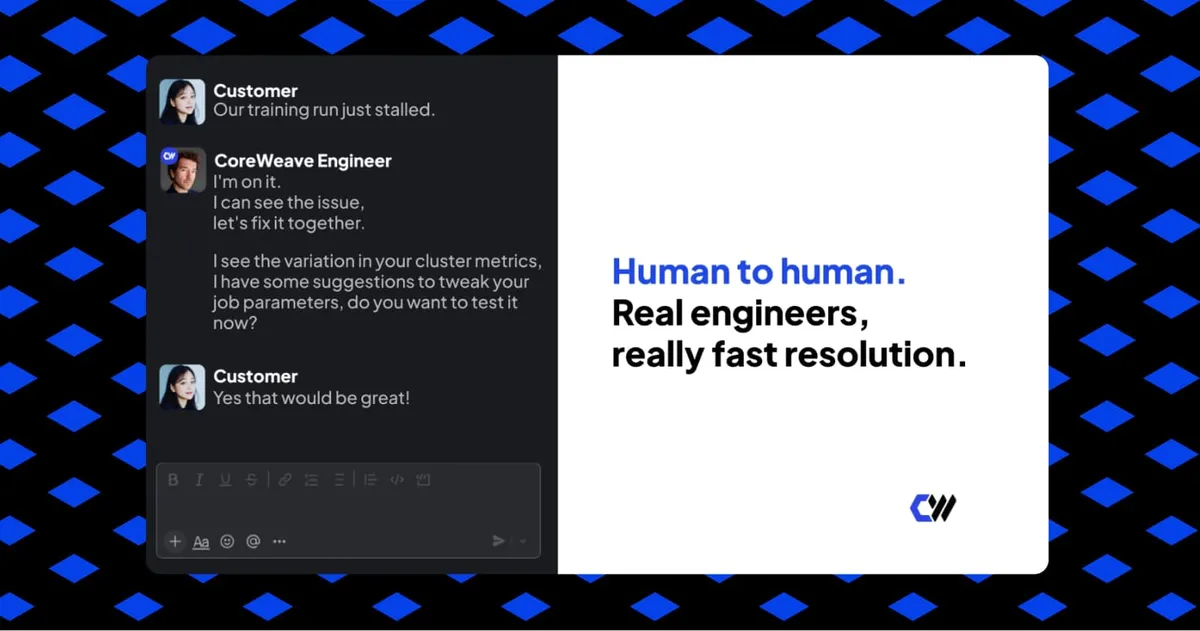
CoreWeave has introduced Direct-to-Expert, a support model that places customers in a shared channel with the engineers who built CoreWeave Cloud. According to the company, a human responds in minutes and brings in the engineer who owns the affected layer, who stays on the problem until it is resolved.
- CoreWeave Direct-to-Expert connects customers to the engineers who built CoreWeave Cloud through a shared channel.
- According to CoreWeave, a human responds in minutes and the owning engineer stays on the issue until it is resolved.
- Most engagements begin in CoreWeave ARENA, where teams test real workloads; access starts with an ARENA Pass request.
- CoreWeave says 9 of the 10 leading foundation model providers rely on it.
- Physical AI Field Engineering embeds engineers with automotive, aerospace or mechanical backgrounds.
How Direct-to-Expert works
CoreWeave says running a training cluster and keeping an inference fleet healthy under real traffic are different jobs, and many teams must handle both without in-house expertise. When a job fails, the company notes, the failure does not show where the problem sits, and an investigation has to cross storage, networking and the scheduler while the fleet sits idle.
Direct-to-Expert runs in a channel shared with the customer's team. A customer posts a problem, a human replies within minutes and pulls in the engineer responsible for the relevant layer. That engineer remains on the case through resolution, so nobody has to re-explain the environment to a newcomer. CoreWeave says the engineers are cross-trained across the stack, which is why the first person to respond is usually the one who resolves the issue.
The company also says it has worked this way with frontier labs since the first frontier models were trained, and now applies the same approach to enterprises. CoreWeave states that 9 of the 10 leading foundation model providers rely on it.
Starting in CoreWeave ARENA, before production
The engagement usually begins before any incident. For most teams it starts in CoreWeave ARENA, which CoreWeave describes as a structured lab where customers run their real models and pipelines on production AI infrastructure, with CoreWeave engineers alongside. The environment also includes CoreWeave Forge, the company's connected developer platform. The aim is to gather performance, cost and operational evidence before scaling.
CoreWeave says it has run hundreds of tests, and some end with the company telling a team that its workload does not need what it asked for. To start, a team requests an ARENA Pass, gets qualified and is matched with an expert who scopes the run around its workload.
IBM's Brian Belgodere, Senior Technical Staff Member, said the company's sandbox workloads were "bursty, unpredictable" and did not fit a standard capacity plan. According to him, CoreWeave engineers helped shape the design around IBM's requirements, including how sandboxes would scale and how to absorb concurrent bursts, and matched it to IBM's existing network and access setup.
Onboarding, migration and a human first
CoreWeave argues that the gap between signing for capacity and running a production pipeline is filled with scheduler configuration, storage layout, checkpointing strategy and workload tuning. It says the engineer who sized a cluster in ARENA runs the onboarding with the customer, plans the migration off legacy infrastructure and stays through cutover. Months later, that is still the person to reach in the channel.
Peter Salanki, CTO at CoreWeave, put the cross-team argument this way: a storage bottleneck can show up as an NCCL timeout, so the engineers who own storage, networking and scheduling sit in the same channel as the customer at the same time.
CoreWeave acknowledges that support is being automated across the industry and says that makes sense for questions with known answers. For AI workloads it argues a person is needed, for example when a training run dies 40 hours in. It also points to CoreWeave Mission Control, which it says sees down to the silicon and across every link between nodes, repairs faults without a ticket and knows how comparable jobs perform, so ordinary variance is not mistaken for a regression. Engineers start from that live data rather than a ticket description.
Sam Braun, Member of Technical Staff at Cohere, said that having the CoreWeave engineer already in the thread saved "many hours of debugging and investigation" on runs the company could not afford to lose.
Physical AI and what it means for customers
For physical AI, robotics and simulation-heavy work, CoreWeave says infrastructure engineers handle the scheduler, storage and networking layer so domain specialists can stay on the model or simulation. Through Physical AI Field Engineering, engineers with automotive, aerospace or mechanical backgrounds embed with customer teams.
For customers, the pitch is a single point of contact with deep platform knowledge, available from the evaluation stage through production, in the channels they already use. How well it performs in practice will depend on response times and outcomes that CoreWeave has not published beyond the testimonials in its announcement.