CoreWeave Launches Physical AI Launchables for One-Command Robotics Runs
CoreWeave has introduced Physical AI Launchables, a catalog of tested, ready-to-run Templates for robotics and autonomous vehicle engineers. According to the company, a team can pick a Template, change the settings that matter and run it with one command.
- CoreWeave Physical AI Launchables is a catalog of tested Templates that run with one command.
- Launch coverage: NVIDIA Isaac Sim, CARLA, MuJoCo, NVIDIA AlpaSim and NVIDIA Cosmos 3, plus Cosmos Data Factory agentic skills.
- Settings are changed with name=value pairs, and Template code can be edited in plain text.
- Skills ship with every Template and work with Claude Code, Codex and other coding agents.
- Partners include Cadence, Convergent Science, Encord, nTop, PhysicsX and Voxel51.
What the catalog covers
CoreWeave says robotics and autonomous vehicle (AV) engineers lose time before a run, when someone has to stand up the environment, wire the storage and wait on the scheduler. Physical AI Launchables is meant to remove that work. CoreWeave engineers built and tested each Template, so the environment is already in place whether or not a team has run the workload before.
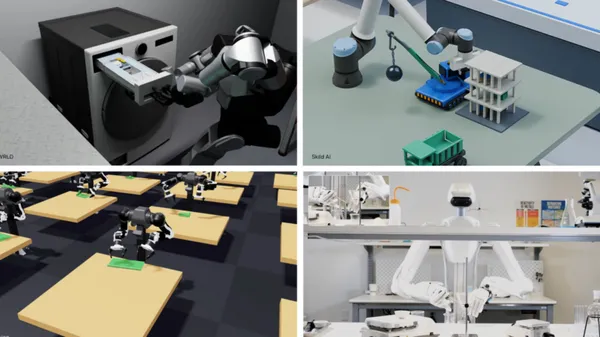
At launch, the catalog covers NVIDIA Isaac Sim, CARLA, MuJoCo, NVIDIA AlpaSim and NVIDIA Cosmos 3. It also includes the new NVIDIA Cosmos Data Factory agentic skills for generative-AI data augmentation across video, image and text, as well as auto-labeling, data curation and retrieval. According to CoreWeave, more Cosmos Data Factory workflows are coming soon as Templates. Voxel51 FiftyOne, an open-source tool for building datasets and computer vision models, is listed as coming soon.
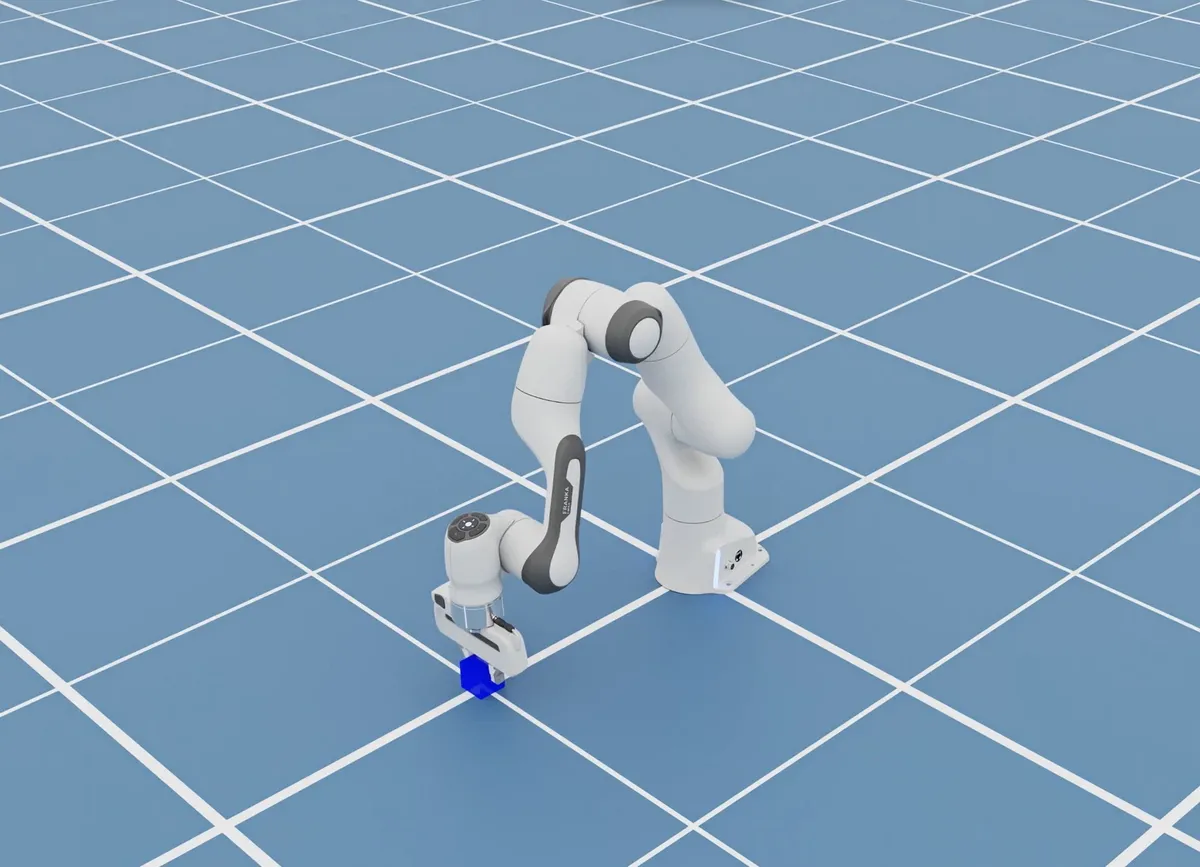
- Isaac Sim: Franka-pick-place, Scene-sdg, Vehicle-dynamics and Warehouse-actors, plus a blank Template.
- CARLA: Scenario-matrix, which runs driving scenarios across a matrix with video.
- MuJoCo: Playground-rl-sweep for GPU-parallel reinforcement learning on MuJoCo Warp, and Kitchen-pick-place with RoboCasa.
- AlpaSim: Closed-loop-driving, which evaluates the NVIDIA Alpamayo driving model in closed loop over reconstructed real scenes.
- Cosmos 3: Scenario-generation, text-to-video of rare or costly scenarios using Cosmos 3 Nano.
Every tool also ships a blank Template: the tested environment with the workload left to the user.
How Templates are adjusted and run
Each Template declares what it needs and what it returns, so engineers can judge whether it fits before running it. Settings are changed by passing name=value pairs on the command line, for example to adjust scenarios, duration, parallelism or which model is under test, and the Template can then be pointed at the team's own data. For deeper changes, users can edit the Template's application code directly in plain text.
CoreWeave gave an Isaac Sim example: variations off one baseline, such as camera viewpoint, warm lighting, a heavier payload of 250g or a UR10e robot embodiment, each hand-edited and launched in about 30 seconds, with nothing scripted.
The company lists several built-in behaviors. Where the workload permits, Templates finish CPU-only preparation and post-processing before GPU execution begins and release capacity once the GPU stage ends. Each Template declares its own resource and concurrency limits so parallel runs do not compete. Reports, metrics, media and diagnostics come back through the same interface.
CoreWeave says the software inside the Templates is not its own: it integrates tools teams already chose, and it runs the infrastructure, observability and CoreWeave Forge layers underneath.
Support for coding agents and partner tools
The release also targets agent-driven work. CoreWeave notes that NVIDIA publishes reference AI agent skills for its physical AI software, built to run on any cloud. Physical AI Launchables ships its own skills on top, tuned for CoreWeave's cloud. They arrive with every Template and work with Claude Code, Codex and other coding AI agents. According to CoreWeave, every operation is documented and every response is machine-readable, so a script or agent can launch a run, watch it and retrieve results. People and agents work through the same visible workflow, so changes an agent made can be inspected and traced.
For teams that prefer their own tools, CoreWeave says it is working with software providers so their products run on CoreWeave while the interface stays theirs. Named partners are Cadence, Convergent Science, Encord, nTop, PhysicsX and Voxel51. Encord co-founder and CEO Eric Landau said the combination makes it "easier for teams to work with multimodal data and advance their AI model development." Voxel51 co-founder and CEO Brian Moore said it helps developers "accelerate the data flywheel."
What it means for engineering teams
For robotics and AV teams, the pitch is less setup work before each experiment and more time on results. Teams can start from the Template closest to their task, such as pick-and-place with episode video, a forklift-and-pallet scene producing labeled synthetic data, or driving scenarios swept across a matrix. CoreWeave invites teams to describe what they want to run and says it will point them to a fitting Template and bring in engineers who have already run it, whether for a sustained program on reserved capacity or a single burst job. The source gives no pricing or availability details beyond the launch catalog.