CoreWeave details cooling, network and software upgrades for Vera Rubin NVL72
CoreWeave says it became the first cloud provider to validate and successfully run diagnostics on NVIDIA Vera Rubin NVL72. In a technical blog post, the company describes the cooling, rack management, networking and software changes it built for the rack-scale system.
- CoreWeave says it was first among cloud providers to validate and run diagnostics on NVIDIA Vera Rubin NVL72.
- Valvey, a patent-pending valve assembly, makes per-rack liquid cooling software-controlled and allows single-rack servicing.
- Racky, the rack manager, works with Valvey and RLCC to treat each rack as a managed cloud resource.
- Customers can pick InfiniBand or RoCE Ethernet; the RoCE design gives 1.6 Tb/s per GPU and supports over 120K GPUs.
- LOTA storage acceleration and topology-aware CKS scheduling are aimed at keeping GPUs busy.
First validation and the hardware behind it
According to CoreWeave, the milestone came earlier this month. In January, the company had announced it would be among the first cloud providers to deploy the NVIDIA Vera Rubin platform, which joins NVIDIA Ada Lovelace, Hopper and Blackwell platforms on CoreWeave. The company notes that each new generation means re-engineering power, cooling, networking and software from the rack up.
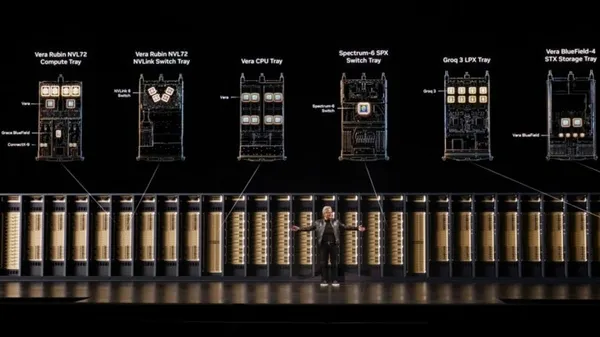
NVIDIA Vera Rubin NVL72 combines 72 Rubin GPUs, 36 Vera CPUs, ConnectX-9 SuperNICs and BlueField-4 DPUs. It scales up with the NVIDIA NVLink 6 switch and scales out with NVIDIA Quantum-X800 InfiniBand and Spectrum-X Ethernet. The post says the system delivers AI training with one-fourth the GPUs and AI inference at one-tenth the cost per million tokens versus NVIDIA Blackwell.
Craig Falls, Head of Quantitative Research at Jane Street, is quoted in the post. He says CoreWeave has delivered on power and reliability across Hopper and Blackwell, and that this gives the firm confidence to partner on Vera Rubin. CoreWeave also states that 9 out of the 10 leading foundation model providers rely on it today.
Software-defined cooling and rack control
Two components of CoreWeave Mission Control handle the physical side of the rack. Valvey is a patent-pending, programmable per-rack liquid-cooling valve assembly. According to CoreWeave, it monitors and controls flow rate, temperature, pressure and leak detection, and every cooling decision runs through it. Optimization, rack isolation for maintenance and emergency shutdowns happen automatically, without manual intervention.
The company says this matters where several racks share a remote CDU. Valvey enables per-rack isolation, so one rack can be serviced or drained without disrupting neighboring racks on the same loop. CoreWeave argues this contains failures faster and raises goodput as a fleet grows.
Racky is the Mission Control rack manager. It sits at the top of the rack, aggregates power, cooling and environmental sensors, and exposes a unified management interface to the wider CoreWeave infrastructure. Together with Valvey and the Rack LifeCycle Controller (RLCC), it forms the rack-scale control stack: Valvey executes cooling actions, RLCC orchestrates workflows, and Racky is the per-rack control point. CoreWeave says this lets it treat each Vera Rubin rack as a managed cloud resource rather than a custom one-off installation.
Networking: liquid-cooled Ethernet and a choice of fabrics
CoreWeave says it is one of the first cloud providers to deploy the 100% liquid-cooled NVIDIA Spectrum-X SN6600 Ethernet Switch. The switch offers 102.4 Tb/s of total switching capacity across 128 ports of up to 800 Gb/s, built on NVIDIA's Spectrum-6 architecture. It serves as the scale-out fabric that links individual NVL72 racks into one cluster. CoreWeave pairs it with Racky and Valvey to control power and cooling around the switch.
Customers can choose between NVIDIA Quantum-X800 InfiniBand and Spectrum-X Ethernet with RDMA over Converged Ethernet (RoCE). Both are fully non-blocking and expose the same RDMA device interface to workloads running in Kubernetes or SUNK, so the user experience stays consistent. InfiniBand remains the default for most deployments, while customers with larger-scale needs may prefer RoCE.
For RoCE, CoreWeave builds a multi-rail, multi-plane fabric. Each GPU is served by a ConnectX-9 module supporting up to 800 Gb/s per port, giving 1.6 Tb/s of backend bandwidth per GPU. The topology scales by adding spine switches per plane and supports configurations of over 120K GPUs, according to the company.
Storage and orchestration, and what it means for customers
On the software side, CoreWeave says it unifies scheduling, capacity management and observability in a single operational plane. CoreWeave AI Object Storage supports Local Object Transport Accelerator (LOTA), a rack-local acceleration layer between remote object storage and the GPU fabric. By staging training data inside the cluster, LOTA is meant to remove I/O bottlenecks that leave GPUs waiting on data.
CoreWeave Kubernetes Service (CKS) uses topology-aware orchestration to place workloads within high-bandwidth NVLink domains where possible. The company says this minimizes cross-fabric communication and maximizes distributed AI performance.
For customers, the pitch is less operational burden. CoreWeave says its aim is higher MFU, greater goodput and longer MTTF, so teams can focus on building models rather than managing infrastructure. The post does not give pricing or general availability dates.
CoreWeave: A Deep Dive on CoreWeave Innovations for NVIDIA Vera Rubin NVL72