Databricks launches ai_decide, a fast decision function for governed data
Databricks has launched ai_decide, a new AI Function that turns unstructured text into structured decisions over governed data. According to Databricks, it returns results in a fraction of a second and is faster and cheaper than LLMs on similar tasks. It is available in Beta.
- Databricks launched ai_decide, a new AI Function that turns unstructured text into structured decisions.
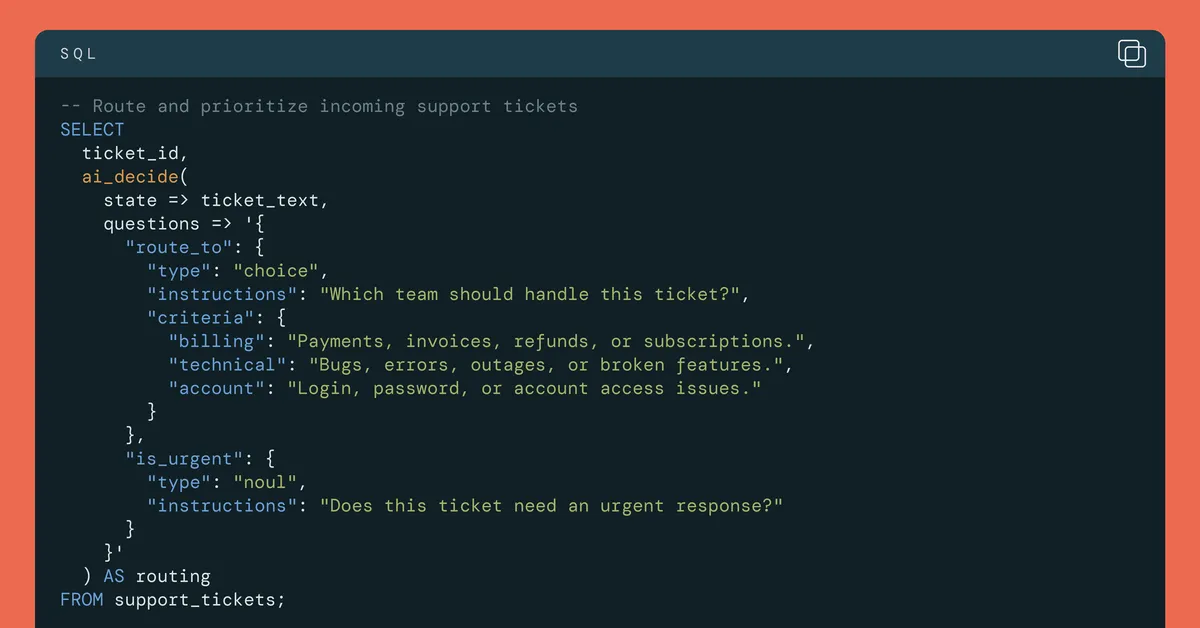
- It returns a probability, a choice from named criteria, or a score on an ordered scale for each question.
- According to Databricks, it has lower latency and cost than LLMs on similar tasks.
- It is available in Beta via SQL for batch scale and a REST API for real-time use.
- It is directly compatible with the TypeSafe AI API, according to Databricks.
A decision model instead of a text generator
Databricks says many teams use LLMs for tasks that need neither complex reasoning nor text generation. Typical questions include which category a support ticket belongs to, whether a document needs human review, or which model should handle a given prompt. These decisions drive high-scale enterprise workflows, from processing millions of documents to controlling real-time app logic.
The company argues that using LLMs for such small, structured decisions means paying for extra latency and cost, which compounds at enterprise scale. ai_decide is built on a decision model, a category the blog post illustrates with TypeSafe AI's Jev. Instead of generating text, such a model takes unstructured input and a set of questions and returns decisions and their probabilities directly.
How ai_decide works
ai_decide evaluates one or more questions against a piece of text. For each question, it returns one of three things: a probability, a choice from named criteria, or a score on an ordered scale. Databricks says that because the function is optimized for decisions, it delivers lower latency and cost than an LLM on similar tasks.
The function can be called from SQL to make structured decisions at scale on data, or through a REST API for real-time applications and agents. For teams already building with the TypeSafe AI API, Databricks says ai_decide is directly compatible.
Use cases Databricks highlights
- Customer reviews: tag each review with its primary issue and whether the customer wants to return the product, in one SQL query. The tags can then be aggregated by product and month to track recurring complaints.
- Prompt routing: a software company with an AI assistant can use ai_decide to determine a prompt's reasoning level and difficulty, then route the request to a model with a fitting cost and capability.
- Judging AI answers: an online retailer can use ai_decide as a judge to check whether an AI support assistant's answer follows its refund policy and to score how completely it addresses the customer's request.
- Real-time actions: Databricks built a live Snake demo on Databricks Apps. On every tick, the app sends the current board to ai_decide and asks which direction the snake should move next.
Databricks says the same loop could sit behind decisions such as which tool an agent calls, which branch to take, or which action comes next.
Open-weight models and what it means
Beyond the managed function, Databricks notes a broad and growing ecosystem of open-weight decision models. According to the company, any of them can be served and run directly in SQL on Databricks, and it points to a recent open-Jev walkthrough.
For teams with large volumes of unstructured data, the pitch is a cheaper and faster path for classification, scoring and routing tasks that do not need an LLM's text generation. The function is in Beta, and documentation is available for both the SQL and REST API routes. The source does not give pricing or specific performance figures.
Databricks: Introducing ai_decide: make fast decisions on your governed data