Databricks Opens Document Intelligence to Real-Time Apps and Agents
Databricks has made its Document Intelligence REST APIs for parsing, classification and extraction generally available, so applications and agents can process documents the moment they arrive. A fourth API, for routing decisions, is launching in beta.
- Databricks' Document Intelligence REST APIs for parsing, classification and extraction are now Generally Available.
- The decisions REST API (ai_decide), aimed at document routing, is launched in beta.
- The APIs can be called from applications such as Databricks Apps or from custom agents built on Agent Bricks.
- ai_extract and ai_classify offer optional citations, rationales and confidence scores so outputs can be checked against the source.
- Databricks frames the release as a way to replace manual document reading and batch delays with real-time processing.
From batch pipelines to synchronous calls
Document workflows have traditionally relied on asynchronous batch pipelines, according to Databricks. That design delays the operational context needed for immediate downstream decisions, particularly in interactive or human-in-the-loop settings.
Databricks says its enterprise customers receive millions of documents every day, and that these unstructured files hold critical context about operations, customers and finances. The company describes a common bottleneck: before the data inside a document can be used for analytics or decisions, someone has to read it and pull out what matters. Its examples include a legal team member hunting for the parties, effective date and renewal terms in a contract, an accounts payable specialist locating the vendor, PO number and total on an invoice, and an insurance adjuster reading a stack of attachments just to decide where a claim should go. According to Databricks, costs and delays grow as incoming document volume rises.
Four APIs, two release stages
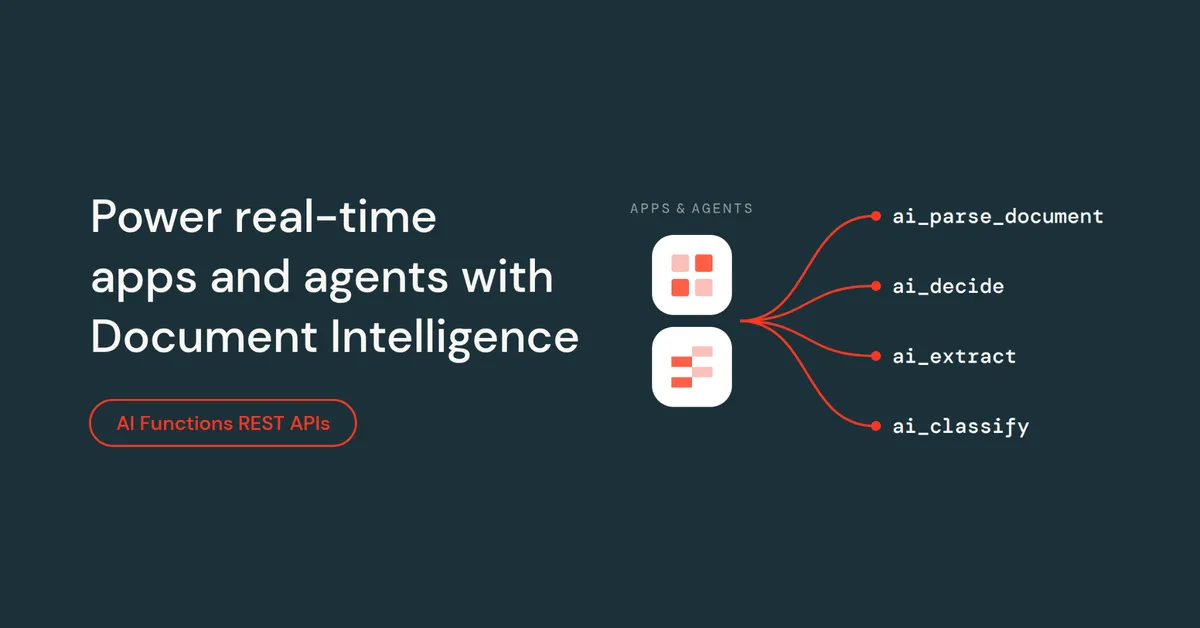
The Document Intelligence REST APIs for parsing, classification and extraction are now Generally Available. The decisions REST API, which Databricks describes as well suited to document routing, is in beta. Developers can call them from an application or agent when a file is uploaded.
- ai_parse_document reads the file, converts tables and figures into structured text, and calculates citation bounding boxes for downstream processing.
- ai_decide uses the document's content to choose what happens next, such as routing it to a workflow or flagging it for review.
- ai_extract pulls specified fields into a structured result, with optional citations and confidence scores so humans or agents can check values against the source.
- ai_classify assigns labels to the document or extracted entities using a business taxonomy, with optional rationales and confidence scores.
A contract intake example in Databricks Apps
Databricks outlines a contract intake flow built with Databricks Apps. A lawyer uploads an agreement and opens a review form with the key terms already filled in. The steps run as follows:
- ai_parse_document turns the file into structured content that the app can save for other uses.
- ai_classify identifies whether the agreement is an NDA, MSA, or statement of work, so the app knows which form to show.
- ai_extract pulls out the parties, effective date, renewal terms and notice period, with citations that let the lawyer check each value against the source.
- The lawyer corrects or approves the fields, and the app writes the reviewed record and source reference to Delta.
The APIs are not limited to interactive apps. Databricks says they can also be called from a custom agent built on Agent Bricks when the agent needs to understand or analyze incoming documents before its next decision.
Getting started and what it means
Users can open Genie Code in their Databricks workspace and describe the workflow they want to build. They can also work directly from the REST API reference and the guides for parsing, classification and extraction. The Agent Bricks UI, available from the Agents page in a workspace, lets users try parsing, extraction and classification interactively.
For teams that handle high volumes of contracts, invoices or claims, the release means document understanding can sit inside the application where the work already happens, rather than in a separate batch job. The inclusion of citations and confidence scores is aimed at keeping a human or agent able to verify extracted values against the original document before acting on them.
Databricks: Power real-time applications and agents with Document Intelligence