Databricks Makes Its Case for Open-Weight Models in the Enterprise
Databricks argues that open-weight AI models have caught up with frontier models on benchmarks at lower cost, and that enterprises should run both through one governed gateway. In a blog post, its field engineers say customers are moving away from reliance on a single frontier provider.
- Databricks says open-weight models now benchmark comparably to top frontier models at lower cost.
- Average unique models per Databricks customer rose from 4.2 to 7.1 since January, with roughly 40% open-weight.
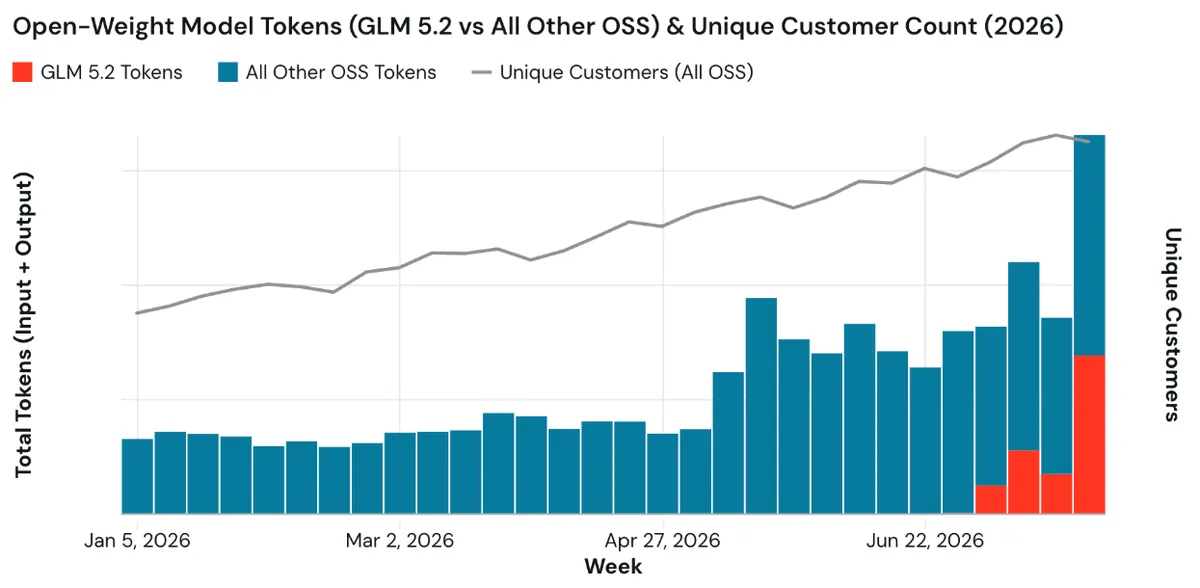
- GLM 5.2 made up about 40% of open-weight tokens on Unity Gateway one month after its mid-July launch.
- Unity Gateway offers smart routing, fallback chains, spend caps and unified governance across model providers.
- Models on the gateway, including GLM 5.3, can run in Codex and OpenCode via OpenAI-compatible endpoints.
Seven pressures changing enterprise AI strategy
According to the Databricks field engineers who wrote the post, companies spent two years standardizing on single frontier model providers and are now reevaluating that approach. They list seven pressures behind the shift.
- Returns: AI budgets have outpaced revenue and cost savings, which creates a need for better unit economics.
- Shifting rankings: the top intelligence ranking has changed hands 20+ times since May 2023, according to the post, which makes single-provider architectures harder to adjust.
- Guardrails: frontier model guardrails can refuse legitimate work such as analyzing live malware. Databricks says Hugging Face responders hit this limit with real attack logs and exploit payloads, then ran the analysis on the open-weight model GLM 5.2 instead.
- Data retention: some frontier providers have deviated from zero-data-retention policies. Databricks points to a 30-day minimum retention introduced with Anthropic's frontier tier, which could force changes for firms whose compliance rules assume nothing is stored.
- Governance: customers want searchable records of model inputs, outputs, errors and agent actions, plus centralized controls to protect sensitive data and intellectual property.
- The harness: in Databricks' own benchmark, the same model scored 61.7% in one harness, 48.1% in another and 38.4% bare. The company concludes that evaluations should test the model and harness together.
- Open-weight progress: the top open-weight models now benchmark at a level comparable to top frontier models at a lower cost, which Databricks says was not true eighteen months ago.
Why Databricks favors open-weight models
Databricks describes three advantages. The first is what it calls commoditized intelligence: open-weight options now offer parity with top frontier models at a fraction of the cost, which it says allows a better return on AI deployments. The second is data sovereignty. Hosting models on infrastructure a company controls gives teams authority over compliance, security and data retention, and reduces the risk of non-compliant changes later. The third is operational autonomy, meaning teams can run workloads that frontier guardrails may inhibit, such as cybersecurity response.
The post includes a cost leaderboard chart from DeepSWE that compares some top open-weight models with proprietary equivalents. Databricks notes the comparison is filtered at the authors' discretion.
One gateway for open-weight, frontier and external models
The practical side of the pitch is Unity Gateway, which serves open-weight and frontier models through a unified API with centralized governance. Teams can switch models through configuration or smart routing rather than code changes. Databricks says the average number of unique models used per customer has risen from 4.2 to 7.1 since January, and that roughly 40% of those models were open-weight.
On speed, Databricks says it uses tailored inference engines and optimized kernels on frontier GPUs. It cites Artificial Analysis, which measured an end-to-end response time of 9.1 seconds for GLM 5.3 (max) on Databricks, including input processing, reasoning and generation. The post says this compares favorably with top-tier managed endpoints.
The governance features listed include:
- Smart routing that sends sessions to the cost-efficient model for the task, so routine work moves off frontier models.
- Fallback chains that reroute automatically when a model hits rate limits or a provider has an outage.
- Budgets with spend caps by user, team or use case, with severity from soft warnings to strict policies that reroute sessions to cheaper models.
- Central governance for tools and skills, including registration of External MCP servers that run through managed proxies and are audited centrally.
- Connections to external providers such as Amazon Bedrock and Azure AI Foundry, routed through the same governance layer.
Usage is shifting, and Databricks is buying GPUs
Databricks says GLM 5.2 coincided with a sharp rise in open-weight usage on Unity Gateway. After it became available in mid-July, one month later it already accounted for about 40% of open-weight tokens used on the platform. Because growth in the number of customers stayed relatively consistent, the company reads this as existing customers moving more AI traffic to open-weight models. It adds that GLM 5.3 and Kimi K3 give customers further open-weight options to evaluate.
To meet that demand, Databricks announced a $3 billion fundraising round in July. CEO Ali Ghodsi told CNBC the raise is partly about securing GPU capacity to host open models. "We are running out of GPUs everywhere... Japan, Korea, U.S., and India, so we just needed to get a lot of these, and that requires a lot of funding," he said, as quoted in the post.
Developers can also keep their preferred tools. As of late July, models served on Unity Gateway, including GLM 5.3, can run inside provider coding harnesses such as Codex and OpenCode, with more harnesses rolling out. The gateway exposes OpenAI-compatible endpoints per harness, so Databricks says setup is a config change.
What it means for enterprise buyers
The post is a vendor's argument, and its benchmark and usage figures come from Databricks or sources it selected. Within those limits, the message to enterprises is clear: avoid tying systems to one provider, test models together with their harnesses, and keep a governance layer that lets models change without weakening controls. Databricks says companies want to cut costs without losing productivity gains, keep operational freedom and adopt new models quickly, and it positions Unity Gateway as the architecture for doing that.
Databricks: The Enterprise Case for Open-Weight Models on Databricks