Databricks Shows How Genie Ontology Runs Its Weekly Product Reviews
Databricks has published a walkthrough of how its own product managers use Genie One and Genie Ontology to run a weekly review of Genie adoption. According to the company, Genie Ontology gives the agent business context that general-purpose AI agents lack, so answers rest on trusted, governed sources.
- Databricks says Genie Ontology gives Genie a continuously updated understanding of business definitions, rules, relationships and trusted sources.
- OntoRank ranks context by authority using certification, usage and authorship signals.
- The Databricks product team uses Genie One for weekly adoption reviews, trend forecasts and executive review preparation.
- Genie is permission-aware and only uses data the user can access through Unity Catalog and connected sources.
- Conversations can be scheduled or turned into shareable Genie Agents.
The problem: missing enterprise context
Databricks argues that general-purpose AI agents are good at searching the web, reasoning and writing code, but often give incorrect answers about a company's own business. In the company's words, the problem is not the model's intelligence but the missing enterprise context: which tables are authoritative, what business rules apply, and who the trusted experts are. That knowledge is spread across dashboards, queries, documents, applications and people, and it keeps changing.
Genie Ontology is meant to give Genie a continuously updated understanding of this institutional knowledge, including business definitions, rules, relationships and trusted sources. According to Databricks, it starts with core concepts that teams govern and certify in Unity Catalog. It then extends to the wider organization by adding learned knowledge from dashboards, documents, queries, notebooks and connected applications.
A ranking system called OntoRank orders this context by authority, using signals such as certification, usage and authorship. This lets Genie ground its answers in the most trusted and relevant sources for each question.
How the product team uses it
The example is the product team's weekly review of Genie One user adoption. The PM asks Genie to build the review from the team's standardized template, which lives in a Google Doc, with the goal of finding hotspots that need attention. Databricks says the task is harder than it looks: users work across web, desktop, mobile, Slack and Teams, some dashboards are authoritative while others are stale, and relevant context sits in Google Docs, Jira and Slack.
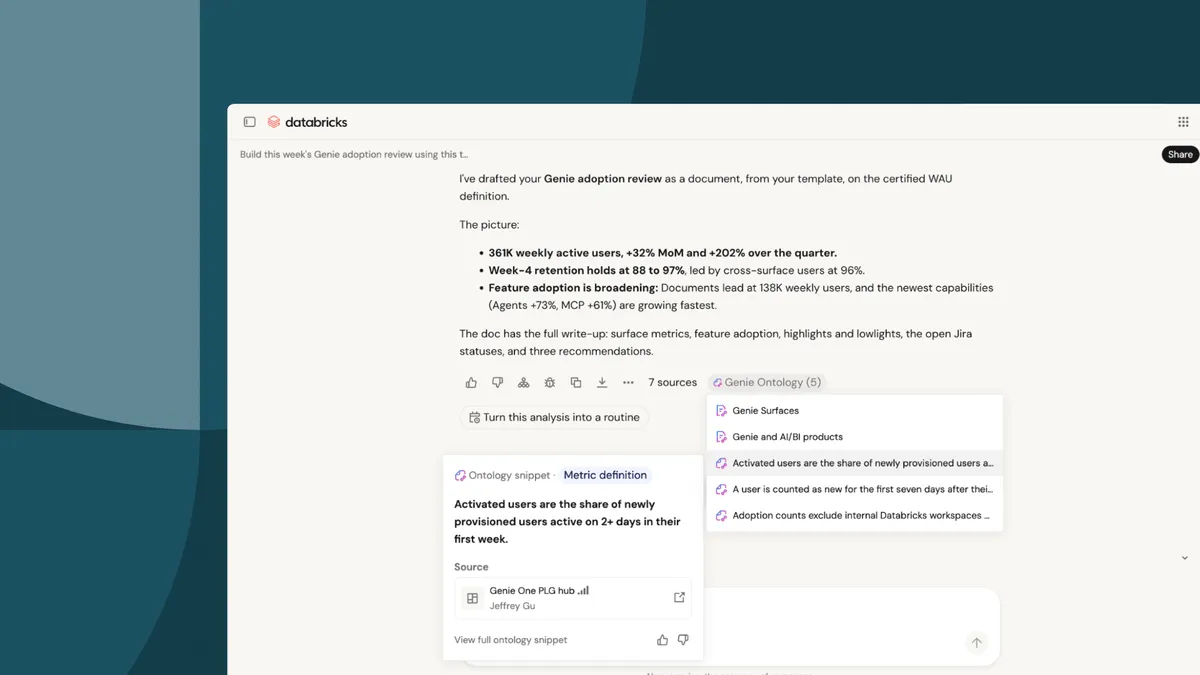
The thinking trace shows Genie Ontology at work. Genie starts with relevant data assets such as dashboards, agents and tables, then looks at curated Pages, and finally at ontology snippets pulled from dashboards, notebooks and SQL queries. It found the certified weekly active users metric view, described as a governed KPI that the whole company defines consistently. Genie then used MCP to search live Google Drive documents and Jira tickets, and ran SQL against usage tables.
Databricks says a general-purpose agent has to compensate for not understanding the business by crawling schemas, sampling tables and running repeated queries, which costs time and tokens and can still lead to the wrong source. Genie Ontology instead supplies business context before and during reasoning. The context is permission-aware, so Genie only uses data and knowledge the user is authorized to access through Unity Catalog and connected sources.
Citations, follow-ups and forecasting
The PM can open citations to see what Genie used. These included metric views (certified KPIs with one governed definition) and pages (governed wikis in Unity Catalog). Genie favors human-certified assets before exploring on its own. Because not every concept can be curated by hand, ontology snippets cover facts Genie has learned and evaluated automatically. Each snippet shows its full definition, origin, author and an authority score powered by OntoRank, and users can check the author's profile for the domains they work across.
When the PM asked why new users spiked in recent months, Genie handled the investigation that would otherwise require querying usage tables and digging through roadmap docs, Jira tickets and Slack threads. Forecasting is built into Genie One, so the PM asked it to forecast the trend and flag accounts to watch, instead of filing a request with the data science team and waiting days.
Scheduling and shareable agents
The PM then put the adoption review on a schedule and turned the conversation into a Genie Agent. According to Databricks, this gives the team and leadership an expert coworker that can answer follow-up questions and support action on Genie's performance, building on the data sources from the conversation and earlier conversations on the topic. The post's summary also lists custom skills, scheduled tasks, shareable agents and MCP writes to external tools among Genie One's capabilities.
Databricks says the PM prepared an executive-ready review, investigated and forecast emerging trends, started a follow-up ticket and built a reusable agent. The company attributes this to Genie understanding the business through Genie Ontology, computing results rather than just reciting docs, and enforcing organizational governance. It invites customers to try the approach on their own data and share feedback as it shapes the roadmap, and points to an on-demand session titled Closing the AI Context Gap.
Databricks: How Genie Ontology powers product development at Databricks