Databricks Claims Lakehouse Now Beats Warehouses on SQL Speed and Cost
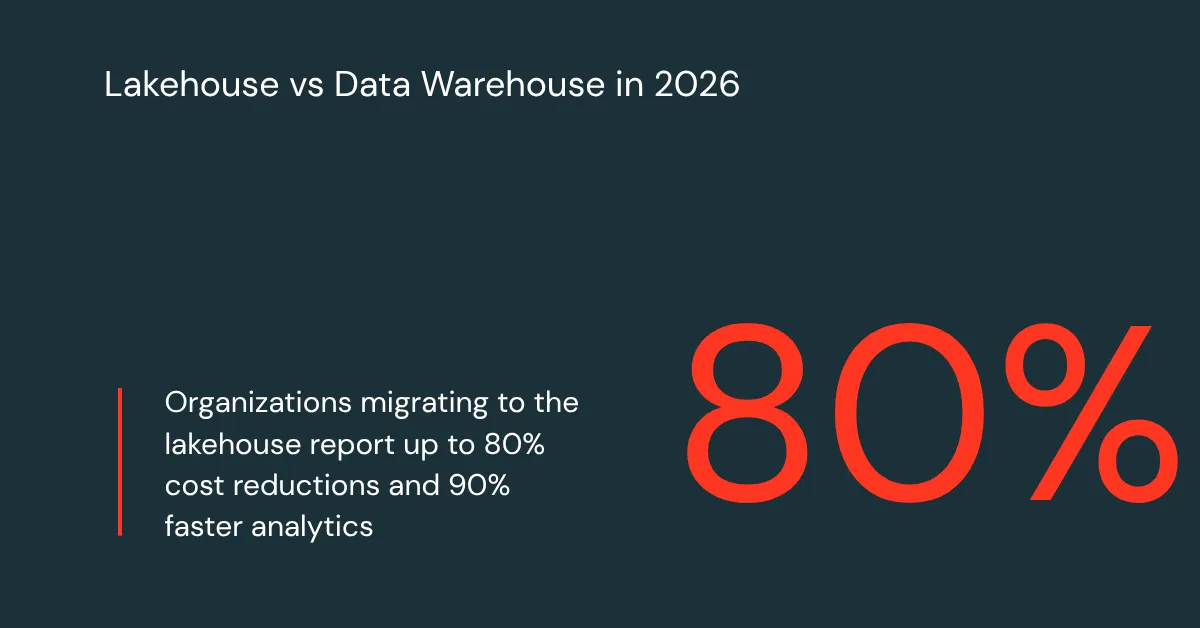
Databricks argues that the lakehouse has overtaken the traditional data warehouse, citing a 77% SQL performance gain since 2022 and customer migrations that cut costs and speed up analytics. The company's blog post combines benchmark claims, customer results and an architectural comparison, while conceding the warehouse still has strengths.
- Databricks says its production SQL workload mix was 77% faster in late 2024 than in 2022, roughly a 4x gain in its Performance Index.
- Lumen Technologies reported a 90% query performance improvement after migrating 133 TB to the lakehouse.
- Customers cite cost reductions between 25% and 75%, including AXA Japan at 60% and Nationwide at 29%.
- Lakehouse//RT is reported to reach as low as 10 ms and up to 12,000 queries per second.
- Databricks argues the lakehouse also covers AI agents, unstructured data, streaming and open formats on one governed platform.
SQL performance: the main objection answered
According to Databricks, the most common objection to the lakehouse has been SQL performance, and in 2026 the answer is that it can match a warehouse for dashboards. The company reported that its production SQL workload mix was 77% faster in late 2024 than its 2022 baseline, which it describes as roughly a 4x improvement in the Databricks Performance Index.
Databricks says the index is derived from billions of production queries across BI, ETL and data exploration workloads, rather than a single synthetic benchmark. The gains came from the Photon vectorized execution engine, query planning, caching, predictive optimization, join algorithms and concurrency management. Over a recent five-month measurement period, BI improved approximately 14%, data exploration 13% and ETL 9%.
For latency-sensitive workloads, Databricks points to Lakehouse//RT, a serverless SQL warehouse for analytical reads. The company reports latency as low as 10 ms and up to 12,000 queries per second. It queries governed lakehouse tables directly, which Databricks says removes the need for a separate OLAP serving copy, CDC pipeline or synchronization layer.
Customer results and migration speed
Databricks leans on production results from customers. Lumen Technologies migrated 133 TB of telecom data from Cloudera/on-premises to the Databricks Lakehouse and measured a 90% query performance improvement, with queries that took hours finishing in minutes. Lumen also cut compute costs by 30-40% using Lakehouse Serverless, and the migration took 9 months, on time and on budget. Trek Bicycle reported 80-90% faster retail analytics and moved from one daily refresh to three.
Cost figures in the post include:
- AXA Japan: 60% warehouse cost reduction and 70% lower ETL costs.
- Posti: 30% reduction in data-landscape costs.
- Nationwide: 29% overall cost reduction and 33% lower idle-compute costs.
- Vivriti Capital: 25-30% lower TCO after moving from Amazon Redshift, in about 8 weeks.
Thomas International reported a 40% increase in development productivity after moving from Snowflake. IndusInd Bank migrated 1.5 PB across 44 business areas in 15 months, against an original estimate of 2.5 years.
Databricks credits its Lakebridge tool, which automates assessment, transpilation and reconciliation across Snowflake, Oracle, Teradata, Redshift, BigQuery and SQL Server. Its Migration Agent uses AI agents to translate SQL scripts across dialects, converting up to 300 files per batch. The company says these tools do not remove the need for human validation but reduce manual effort.
Beyond SQL: the architectural case
Databricks says matching SQL performance was only a prerequisite, and lists five areas where it argues warehouses fall short.
- AI and ML: Agents need governed access to tables, documents, embeddings and real-time signals. Databricks says Unity Gateway extends governance to the AI runtime, including which models agents can call, prompt logging, rate limits and MCP servers and tools.
- Unstructured data: Structured tables, JSON, documents and vector embeddings sit in open formats on cloud object storage under one governance model.
- No data copying: SQL, Spark, streaming, Python and ML jobs read from the same Delta Lake or Apache Iceberg tables.
- Streaming and batch: Streaming ingestion makes data queryable in seconds rather than hours, according to the company.
- Open formats: Unity Catalog offers an open, multi-engine catalog layer with Apache 2.0 licensing, and UniForm generates Iceberg-compatible metadata from Delta tables.
The post cites Gartner on a shift toward an "analytical control plane" and Deloitte's 2026 finding that only about one in five companies had a mature governance model for autonomous AI agents.
What it means for buyers
The post is vendor marketing, and the performance and cost figures are customer-reported or company-reported rather than independently verified. Databricks itself says it wants to be direct about where the warehouse still has strengths, and the post ends with a section on where the warehouse still wins, though that part is not covered in the text provided.
For organizations weighing a move, the argument is that a single governed platform can serve analysts, engineers, ML models and AI agents, and that shorter migration timelines lower the barrier to switching. Teams whose workload is only analysts writing SQL against clean tables, which Databricks acknowledges the warehouse long handled well, may weigh the case differently.
Databricks: The lakehouse is a better data warehouse: 2026 benchmarks and proof