Databricks unveils MemCurrent, a persistent memory system for production agents
Databricks has introduced MemCurrent, a persistent memory architecture for production agents that now powers the new Agent Bricks Memory and Genie. According to the company, on its internal benchmark MemCurrent triples the agent's pass rate compared with no memory, while using 31% fewer tokens and running 26% faster.
- Databricks introduced MemCurrent, a persistent memory architecture that now powers Agent Bricks Memory and Genie.
- It combines plugin, tool and offline pipeline memory, with an offline "dreaming" step that consolidates memory.
- On the internal benchmark, pass rate rose from 22.3% to 68.4% with 1.35x faster and 1.44x cheaper runs, per Databricks.
- On open-source benchmarks it averaged 88.1%, close to full context at 87.8%, with about 12x fewer input tokens.
Why memory is hard to get right
Databricks frames the problem as a trade-off. Building an enterprise agent is easy to start, but running one in production forces developers to balance quality, meaning good answers on long-tail tasks, against efficiency, meaning cost and latency at scale. Many techniques improve one side at the expense of the other.
Memory, the company argues, can help on both. Agents can carry over user preferences, prior corrections, metric definitions and successful workflows, which in principle improves accuracy, reduces repeated errors and avoids unnecessary rediscovery. But Databricks stresses that more history is not necessarily better memory. Feeding in every past interaction is costly and can bring in stale, conflicting or irrelevant context. The central questions are what to keep, how to maintain it and how to measure usefulness.
How MemCurrent works
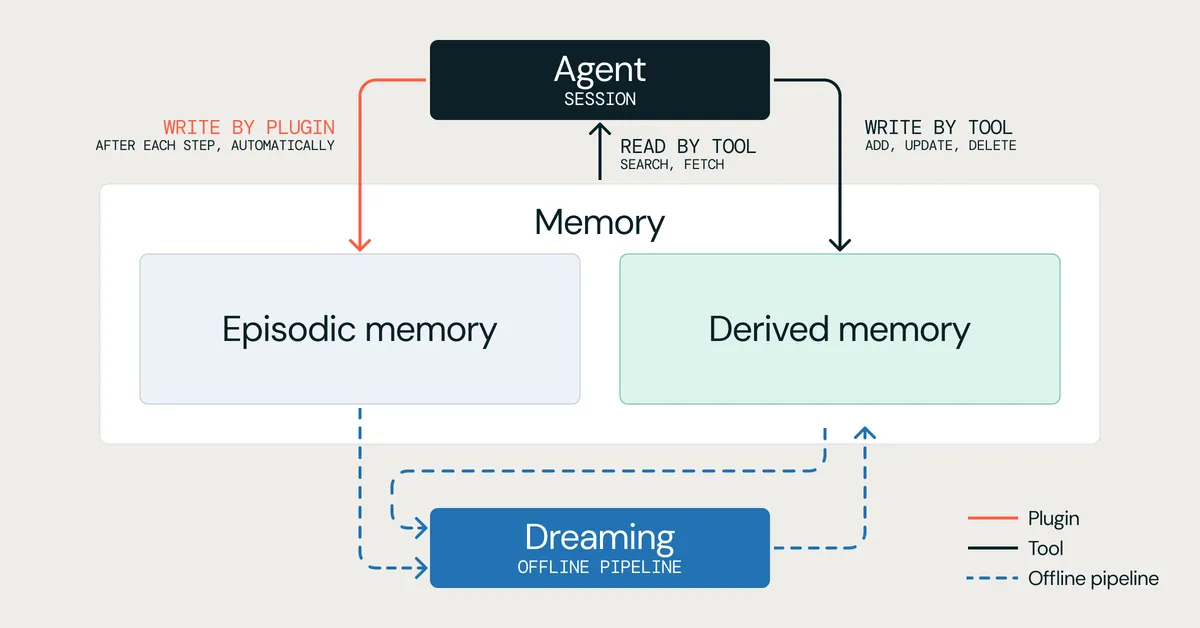
Databricks describes three ways to connect memory to an agent: as a plugin that reads and writes at fixed points, as tools the agent calls itself, or as an offline pipeline that updates memory in the background. Each has drawbacks. Plugins and tools take effect immediately but add runtime cost and latency, while a pipeline is cheaper at runtime but updates arrive with a delay. MemCurrent uses all three, each where it fits best.
The system holds two kinds of memory:
- Episodic memory stores raw session traces. It is append-only, and a plugin logs each step as a session runs.
- Derived memory holds distilled learnings as files in a structured knowledge base, topped by an auto-generated memory.md index that describes the file structure. It is a mutable table that simulates a hierarchical file system.
Both live in a production-grade database built to scale to many users with low-latency responses. Explicit requests, such as "Never write scripts in the /tmp dir", are handled by agent tools named add_memory, update_memory and delete_memory. An offline "dreaming" pipeline captures the rest, distilling implicit learnings from each new session. It also splits oversized files, merges duplicates and resolves conflicts.
Reading happens in layers. A plugin injects the memory index at session start, and during the session the agent can call search_memory to get top matches or fetch_memory to retrieve a full entry by session ID or file path.
Benchmarks and results
Databricks tested on three open-source benchmarks, LoCoMo, LongMemEval and ConvoMem, which check whether an agent can recall facts from synthetic conversations. It also built an Internal Memory Benchmark from real Genie conversations. The team started from more than 12K sessions, mined 3K candidates with memory-worthy signals and drafted follow-up questions with scoring rubrics. An adversarial judge checked each case against 7 criteria, and after manual review the benchmark contains 114 test cases, 29 users and 2,233 history sessions. Cases span 5 memory types and 11 scenarios. Databricks says it differs from existing benchmarks by focusing on enterprise work, testing whether memory feeds actions rather than just answers, and offering diversity.
On the open-source benchmarks, the company compared MemCurrent with Mem0, PropMem and OpenClaw memory using the same underlying LLM. According to Databricks, MemCurrent scored highest among memory backends on all three. On average it reached 88.1%, on par with the full-context baseline at 87.8%, while using about 12x fewer input tokens per question (8.4K versus 103K). On the two benchmarks with the longest histories it beat full context.
On the internal benchmark, run inside Genie, MemCurrent posted a 68.4% pass rate, the lowest latency (252s) and the lowest token usage (418K) among the backends. That closes over 80% of the gap between no memory (22.3%) and gold injection (78.6%), where only the correct memories are placed in context. Mem0 reached 43.9% with higher latency and cost. Against no memory, Databricks says MemCurrent is 1.35x faster and 1.44x cheaper. The internal runs used Claude Opus 4.6 as the agent model and GPT 5.6 sol as the memory model.
What it means for users
For teams using Agent Bricks Memory or Genie, MemCurrent is the layer behind the memory features. Databricks' own figures suggest that a selective, maintained memory can deliver better answers at lower cost than either no memory or stuffing full history into the prompt. These results come from the company's internal benchmark and its own evaluation setup, so they have not been independently verified.
Databricks: MemCurrent: Designing Persistent Memory for Production Agents