Datadog brings RUM crash reporting to native C and C++ apps
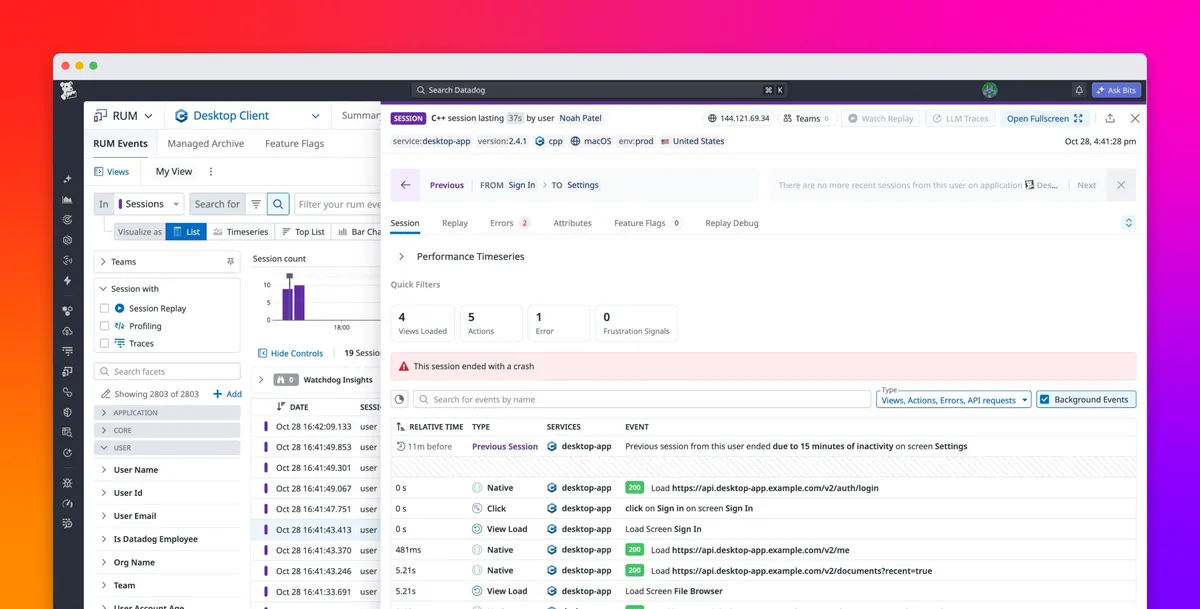
Datadog has extended its Real User Monitoring (RUM) to native C and C++ applications through a new C++ SDK for Windows, macOS and Linux. According to Datadog, the SDK collects crash diagnostics, tracks errors and captures instrumented user activity, so teams can troubleshoot failures within the user sessions where they happened.
- Datadog's C++ SDK extends RUM to native C and C++ apps on Windows, macOS and Linux.
- Two crash handlers: an in-process one needing C++17, and an out-of-process one based on Crashpad.
- Crash reports carry RUM context such as the session and last active view, and feed into Error Tracking.
- Developers define views, actions, resources, operations and long tasks themselves, as the SDK is not tied to a UI framework.
- The SDK sends data directly to Datadog without the Datadog Agent on user devices.
Crash reporting with two handler options
Datadog says a stack trace alone shows the affected code but not what the user was doing before a crash, or whether other users hit the same problem. The new SDK is meant to close that gap by linking crashes to RUM sessions.
On Linux and macOS, the SDK captures signals such as SIGSEGV (segmentation faults) and SIGABRT (aborts). On Windows, it captures unhandled structured exceptions. The resulting crash reports include stack traces. Once developers upload their debug symbols, symbolication translates stack trace addresses into human-readable function names and source locations.
The SDK offers two crash handlers:
- In-process handler: requires only C++17 and no additional executable. It captures the crashing thread's stack trace and uploads the crash report the next time the application launches.
- Out-of-process handler: uses Crashpad, the open source crash reporting system that Chromium uses. It runs as a separate crashpad_handler process, so it can capture failures such as stack overflows and heap corruption that the in-process handler may miss. It also captures stack traces from all threads and uploads reports immediately.
Both handlers report RUM errors enriched with the latest RUM context at the time of the crash, including the session and last active view.
Error Tracking and session context
Crashes can be investigated in Error Tracking, which groups related failures into issues. According to Datadog, this helps teams identify recurring crashes, distinguish isolated failures from widespread ones, and prioritize by user and session impact. The RUM session timeline also shows the user actions, view loads and network requests that preceded a crash.
The SDK also lets developers report handled errors that do not terminate the application, for example a failure to deserialize a saved file or an unexpected response while a native client processes data. Linking these to RUM sessions makes it possible to investigate problems that affect users even when the app keeps running.
Because the SDK is not tied to a particular UI framework, developers define the events that reflect how users interact with their application. The SDK associates them with RUM sessions. Datadog lists these event types:
- Views: application screens or states, such as a document editor, settings page or file browser
- Actions: user interactions, such as selecting a file, clicking a button or starting an export
- Resources: network requests and their outcomes, including timeouts and other failures
- Operations: multistep workflows, such as opening a document, authenticating a user or uploading a file
- Long tasks: stalls that block the main thread for an extended period
In Datadog's example, a user fails to open a document. The team can see the view the user was on, the action that started the workflow and any related resource failures, while RUM operations can track whether the document opens and how long it takes to load.
Integration and what it means for native developers
The SDK provides a C++ API for codebases targeting C++17 or later, plus a C99-compliant C API. Both work with native build environments, including CMake-based projects. The C API can also be wrapped in foreign function interface (FFI) bindings to instrument applications written in other languages and runtimes.
The SDK sends RUM data directly to Datadog without requiring the Datadog Agent on each user's device. Datadog gives the example of a PC game instrumented to capture views, user actions, errors and operations such as loading a level or connecting to a game server, with failures investigated in RUM without a plugin specific to the game engine. Tracking-consent controls let teams manage local storage and uploads of RUM data based on each user's consent preferences.
For teams shipping desktop software or games, the release means native crashes can be reviewed alongside session data in the same platform used for other RUM monitoring. Datadog points to its C++ SDK setup documentation and the open source C++ SDK on GitHub for getting started, and offers a free 14-day trial to new customers.
Datadog: Monitor C and C++ applications with Datadog RUM