Daytona Tests AI Agents Across Linux, macOS and Windows
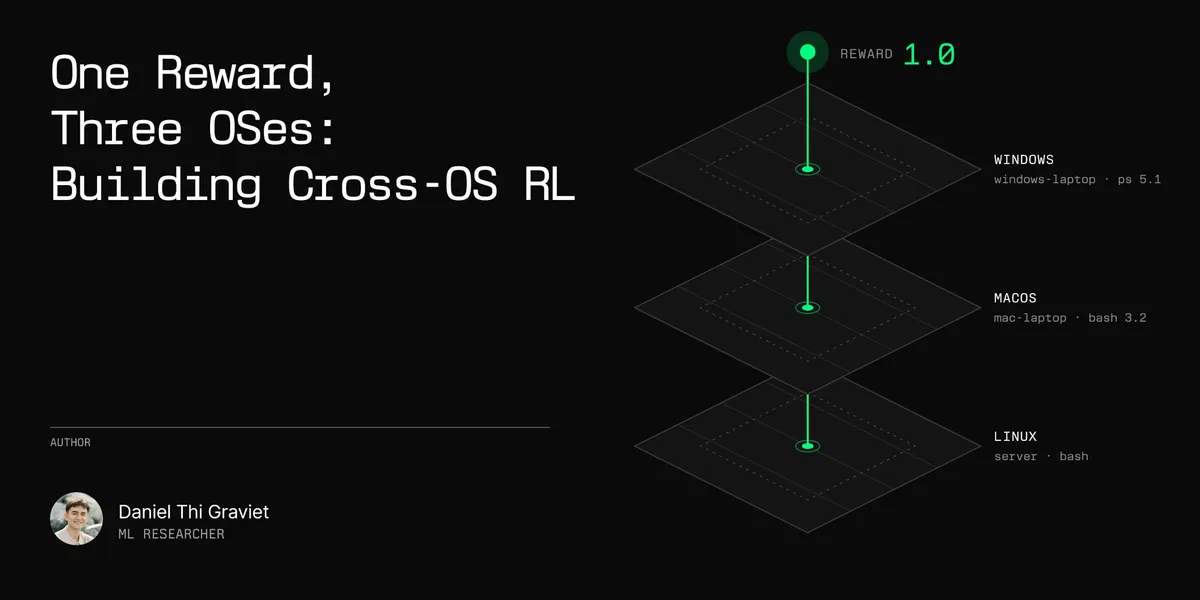
Daytona has introduced a reinforcement learning environment that tests AI agents across Linux, macOS and Windows through a single API. Its Fleet Migration task found that both DeepSeek models struggled with Windows, exposing gaps that Linux-only benchmarks can miss.
- Daytona’s Fleet Migration task spans Linux, macOS and Windows.
- Agents must update clients for gzip compression and API rate limiting.
- DeepSeek Pro succeeded in 77% of runs, versus 42% for DeepSeek Flash.
- Every observed failure involved the Windows environment.
- OpenEnv provides the training and evaluation interface.
One task across three operating systems
Most coding-agent benchmarks run in Linux containers because they are inexpensive, reproducible and easy to evaluate, according to Daytona. The company argues that this setup does not reflect many enterprise workflows, where teams may work across different operating systems, shells, schedulers and execution environments.
Daytona’s Fleet Migration environment gives an agent a single problem spanning three machines: a Linux server, a macOS laptop and a Windows laptop. The server runs an upgraded check-in API, while both laptops use outdated clients. The agent must update the clients so the fleet continues working without losing its existing check-in history.
Each episode provisions three independent Daytona sandboxes. The agent can investigate and modify them with exec, read_file and write_file, with a budget of 60 operations.
The same API contract requires different fixes
The server’s API introduces two breaking changes. Requests must use gzip compression with Content-Encoding: gzip, and devices making more than two check-ins within 15 seconds receive HTTP 429 with a Retry-After header.
The macOS client runs in Bash 3.2 and is scheduled through launchd as root. Because Bash variables cannot safely hold arbitrary binary data, the agent must write the request to a temporary file, compress it with gzip and send it with curl --data-binary.
The Windows client runs in PowerShell 5.1 and is launched by Windows Task Scheduler as SYSTEM. Since that environment lacks an equivalent built-in gzip command, the agent must use .NET’s System.IO.Compression.GZipStream and pass the compressed bytes to Invoke-RestMethod.
Daytona integrated Fleet Migration with OpenEnv, which provides a standardized interface for agent training and evaluation. At submission, the grader triggers each laptop through its native scheduler rather than simply checking whether the scripts work when run manually.
Windows exposed the main weakness
Daytona evaluated DeepSeek Pro and DeepSeek Flash across 25 runs, using OpenRouter to serve both models. DeepSeek Pro repaired the fleet in 10 of 13 attempts, or 77%, while DeepSeek Flash succeeded in 5 of 12 attempts, or 42%.
According to Daytona, every observed failure involved Windows. Neither model failed on the Linux server or macOS laptop. DeepSeek Flash frequently tried Unix commands in PowerShell or struggled with Windows-specific gzip APIs, exhausting its operation budget without submitting in four runs. Other failures came from verifying the Windows script manually instead of confirming that it worked through Task Scheduler under the SYSTEM account.
The difference also appeared in tool usage. DeepSeek Flash used about 222,000 prompt tokens and 34 exec calls per run, compared with about 53,000 prompt tokens and 10 exec calls for DeepSeek Pro. Daytona presents the results as evidence that cross-OS environments can test both an agent’s ability to understand a change and its ability to execute and verify that change under realistic operating-system constraints.
Daytona: One Reward, Three OSes: Building Cross-OS RL