Deepgram Extends Nova-3 Medical Speech Model to 10 Languages
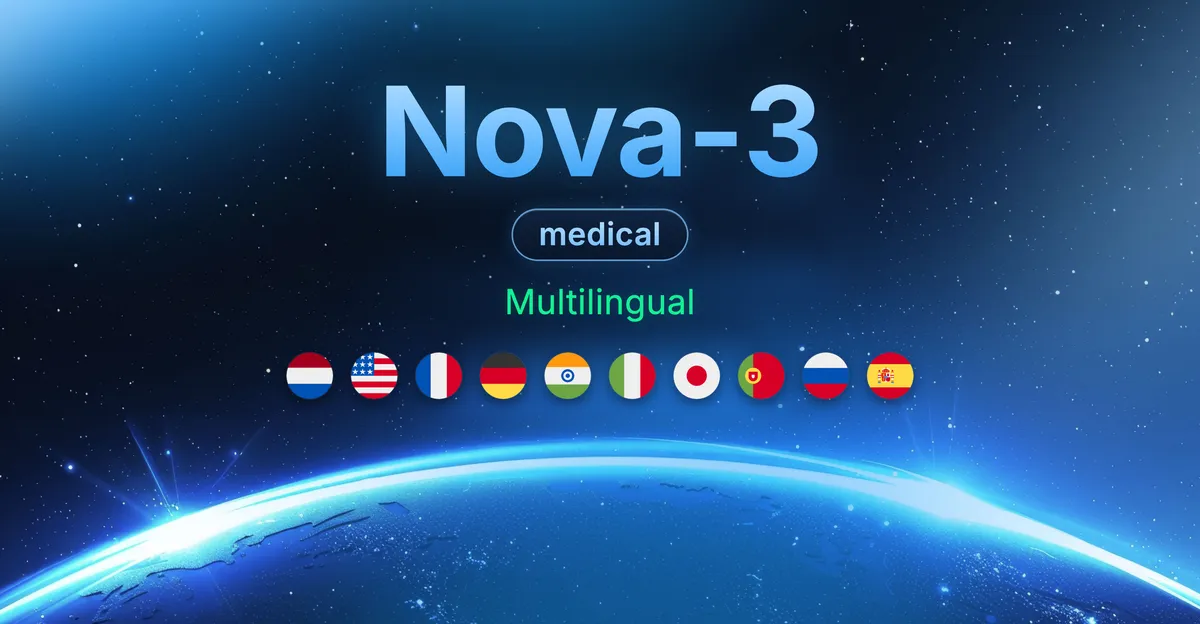
Deepgram has launched Nova-3 Medical Multilingual, a medical-specialized speech recognition model for Dutch, English, French, German, Hindi, Italian, Japanese, Portuguese, Russian and Spanish. According to the company, it cuts word error rate by 25% in batch transcription compared with its general-purpose multilingual model.
- Deepgram's Nova-3 Medical Multilingual covers Dutch, English, French, German, Hindi, Italian, Japanese, Portuguese, Russian and Spanish.
- Against Nova-3 Multilingual, batch WER fell from 6.62% to 4.96% and streaming WER from 8.32% to 5.86%, per Deepgram.
- Entity error rate dropped 37% in batch and 40% in streaming, with dose errors down 64% in batch.
- Deepgram reports the lowest average batch WER versus ElevenLabs Scribe v2 Medical, Scribe v2 and Microsoft MAI 1.5.
- Available now via the Deepgram API using model=nova-3-medical&language=multi, and for self-hosted deployments.
One model for 10 languages, with code switching
Nova-3 Medical, which Deepgram launched in 2025, was built on the idea that medical speech needs a model trained on the language of medicine. The new version extends that approach beyond English. It works in both batch and streaming modes and includes automatic code switching between supported languages.
Deepgram argues that supporting a language is not the same as supporting medicine in that language. A general multilingual model can transcribe a conversation and still miss the drug name, the dose or the diagnosis that downstream systems depend on. The company points to examples such as a patient describing chest pain in Madrid, a clinician in Munich changing a metformin dose from 500 to 850 milligrams, and a family member switching between Hindi and English during intake.
Developers select the model with a single setting: model=nova-3-medical&language=multi. The model detects the spoken language and follows the conversation when speakers switch, so the language does not need to be known before the audio arrives.
What Deepgram's benchmarks show
Deepgram compared Nova-3 Medical Multilingual with its general-purpose Nova-3 Multilingual on more than 115 hours of curated medical audio across all 10 languages, averaging the results. In batch transcription, average word error rate (WER) fell from 6.62% to 4.96%, a 25% reduction. In streaming, it fell from 8.32% to 5.86%, a 30% reduction.
WER was significantly lower in 8 of 10 languages in batch and 9 of 10 in streaming. The largest batch improvements came in Russian, Spanish and Hindi, at 58%, 32% and 30%. English, which already had a dedicated Nova-3 Medical model, was essentially flat.
Deepgram also tracks entity error rate (EER), because WER treats every word equally. Missing "the" and missing "metformin" each count as one error, though their impact differs sharply. EER focuses on conditions, drugs, doses, dates, numbers and names. According to the company, EER dropped from 14.46% to 9.11% in batch (a 37% reduction) and from 16.31% to 9.78% in streaming (a 40% reduction).
- Doses: 64% fewer errors in batch, 81% fewer in streaming
- Conditions: 43% fewer errors in batch
- Medical processes: 41% fewer errors in batch
- Drugs: 31% fewer errors in batch
Comparison with other providers
Deepgram also ran other speech recognition models through their APIs on the same medical dataset. Among models evaluated in all 10 languages, Nova-3 Medical Multilingual posted the lowest average batch WER, according to the company:
- Nova-3 Medical Multilingual: 4.96%
- ElevenLabs Scribe v2 Medical: 5.49%
- ElevenLabs Scribe v2: 5.58%
- Microsoft MAI 1.5: 7.80%
The model had the lowest WER in 7 of the 10 individual languages. Deepgram acknowledges that no model wins every language, its own included, and says it reports results across the full set because an application serving patients in five languages needs accuracy in all five.
In streaming, the model averaged 5.86% WER and 9.78% EER across the 10 languages. Deepgram says it recorded the lowest WER in every language against the competing streaming models evaluated for each one.
Use cases and availability
Deepgram names three workloads that real-time accuracy supports. Ambient documentation captures a visit as it happens so note drafts reflect the medications, doses and conditions discussed. Healthcare voice agents handling scheduling, refills and intake need the drug name and dose right before taking the next step. Dictation lets clinicians work in their own language and switch when a conversation requires it, without changing models.
Nova-3 Medical Multilingual is available now through the Deepgram API, on both pre-recorded and streaming requests. It is also offered for self-hosted deployments, which customers can request through their Deepgram account representative.
For teams building healthcare applications for multilingual patient populations, the release means one model can cover several languages without dropping medical specialization. The figures come from Deepgram's own evaluation, so results on other datasets may differ.