Digital Science acquires Jenni AI, an academic writing tool with 8 million users
Digital Science has acquired Jenni AI, an AI research and writing platform that the company says is used by more than 8 million students and researchers in 189 countries. Jenni AI will be connected to Dimensions, Digital Science's database of 171 million research publications, so that the sources users find and cite are grounded in the published research record.
- Digital Science has acquired Jenni AI, which it says is used by more than 8 million students and researchers in 189 countries.
- Jenni AI will be connected to Dimensions, a database of 171 million research publications, to ground sources and citations.
- Jenni AI remains a standalone product with the same team, pricing and subscription plans.
- A September 2026 Oxford University Press survey found 74% of more than 2,600 researchers are unsure which AI uses to disclose.
- Jenni AI joins Overleaf, Papers AI and ReadCube in Digital Science's portfolio.
What Jenni AI does and what changes
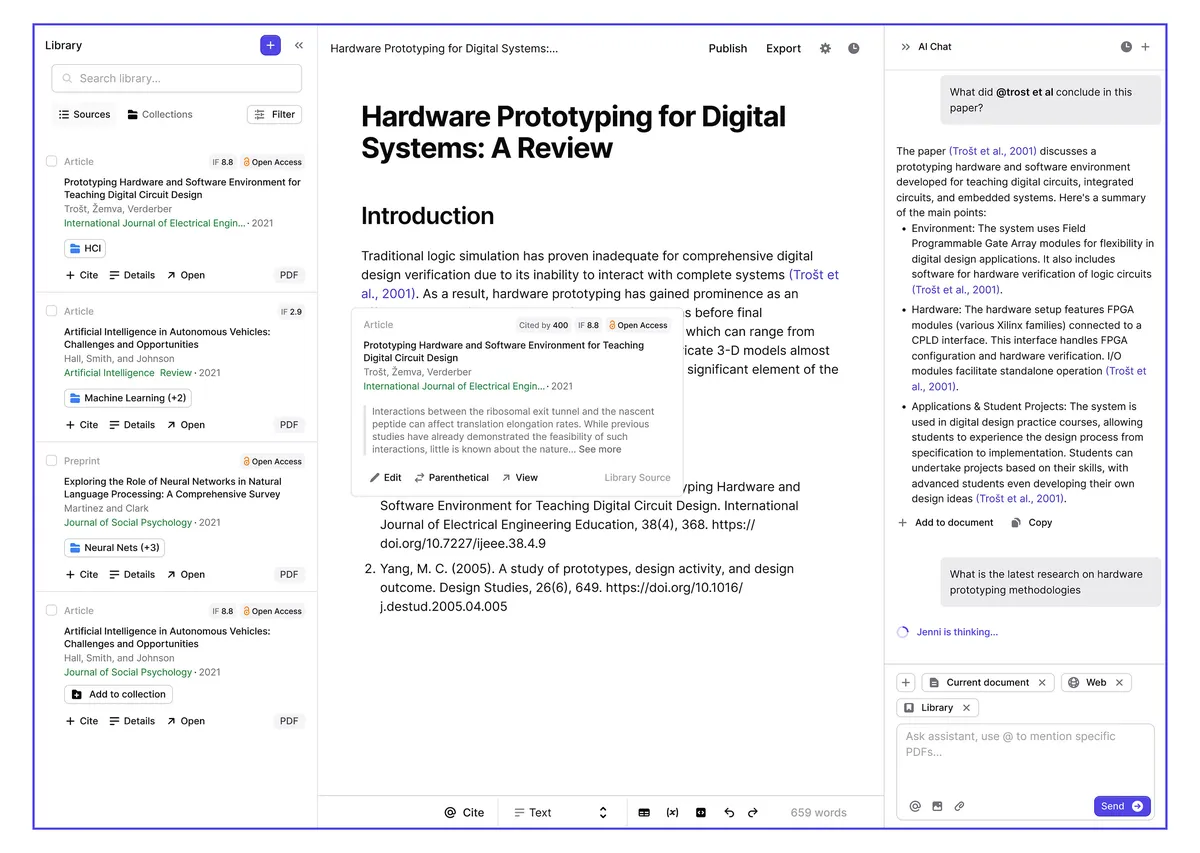
Jenni AI is built for academic work. According to the announcement, users can upload papers or import their reference libraries, explore their chosen sources, draft and refine their writing, and check citations against the original material. The company describes the experience as feeling as intuitive as a general-purpose AI tool while being designed around the demands of research.
Over the coming months, Jenni AI will incorporate Digital Science's research data, starting with the Dimensions database. It will also use Dimensions' full-text search capabilities to help researchers discover, understand and cite scholarly literature more effectively.
Jenni AI will continue as a standalone product under its own name, with the same team, pricing and subscription plans.
The citation problem
The announcement points to a weakness of general-purpose AI tools: they can generate references that do not exist, which also makes it harder to show where a researcher's own work begins and ends. It cites a September 2026 Oxford University Press survey of more than 2,600 researchers. According to that survey, 74% are unsure which uses of AI they should disclose, and 48% say they have not fully disclosed their use.
Stephen Leicht, CEO of Digital Science, said researchers already use AI routinely, but "What they can't get from a general-purpose tool is a citation that has been checked against the actual paper." He said that inside Digital Science, every source Jenni AI suggests can be verified against Dimensions and its 171 million publications.
Fit with Digital Science's portfolio
Jenni AI joins Overleaf, Papers AI and ReadCube among Digital Science's research tools. Overleaf is described as the leading platform for collaborative LaTeX writing, ReadCube provides AI-powered reference management, and Papers AI brings data, analysis and writing together.
Digital Science says the deal extends its support for researchers across the whole research journey, from the first idea to data-heavy research and publication. It also strengthens the company's direct relationships with PhD and master's students at the start of their careers.
Jenni AI was founded by David Park and Henry Mao in 2020. Park, now CEO of Jenni AI, said the company started with the belief that "the future is written with AI, not by AI."
What it means for users
For existing Jenni AI users, the announcement promises continuity: the same product name, team, pricing and plans. The practical change is expected to come through the planned integration with Dimensions, which should tie suggested sources and citations to a large database of published research. The announcement does not give a timeline beyond the coming months, and no financial terms of the acquisition were disclosed.