Document Crunch adds construction drawings to its AI risk review
Document Crunch, a Trimble company, has extended its CrunchAI risk intelligence to construction drawings, so contractors can search and query drawings, contracts and specifications together. According to the company, the feature is now available to all users.
- Document Crunch, a Trimble company, added construction drawing review to its CrunchAI risk intelligence.
- Teams can query drawings, contracts and specifications together to find scope gaps and conflicting requirements.
- Answers include source-linked citations, and findings can feed standardized preconstruction reviews.
- The feature is available now to all Document Crunch users within existing workflows.
What the new capability does
Document Crunch announced project-level risk intelligence capabilities that let contractors review construction drawings alongside contracts, specifications and other project documents. Using its CrunchAI technology, project teams can search and query across full document sets at the same time to identify scope gaps, conflicting requirements and potential risks.
Josh Levy, co-founder of Document Crunch and vice president of risk and compliance solutions at Trimble, described the problem this way: "Construction teams work across hundreds of drawing sheets, specifications, contracts and other project documents, and significant risks emerge when information across these documents doesn't align." He said AI-assisted review gives preconstruction teams a comprehensive view of project requirements, so conflicts and gaps can be found "while there is still time to clarify, price or resolve them."
How CrunchAI handles drawing sets
According to the company, general-purpose AI models can struggle with large, text-dense drawing sheets and lack the project context needed to connect requirements across document sets. That makes it harder to reliably surface conflicts and gaps between them.
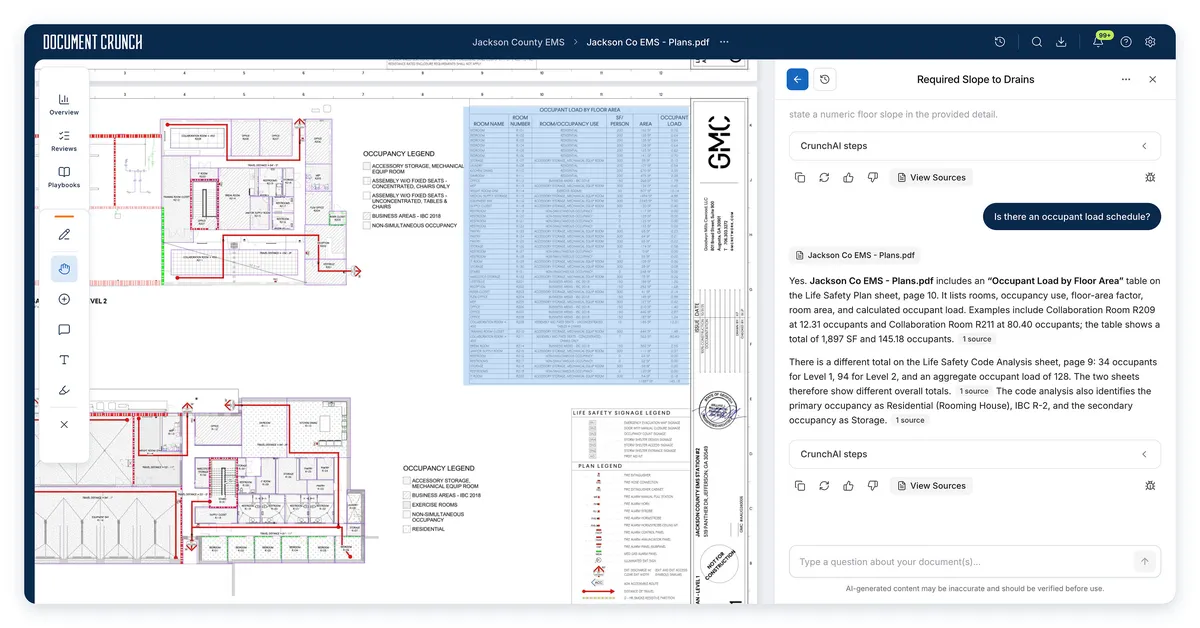
Document Crunch says CrunchAI is purpose-built for construction. It extracts and indexes text from drawing sets, including notes, allowances and scope-defining language spread across hundreds of sheets. Teams use a chat interface to ask questions across drawings, contracts and specifications together. They can verify answers through source-linked citations and apply the findings in standardized preconstruction reviews and workflows.
The company says CrunchAI combines proprietary pre- and post-processing with agentic optimization to produce answers tailored to construction workflows. The work happens in a shared project environment with enterprise-grade security and functionality, where teams can collaborate on identified issues, track work and see how risks are being addressed. Issues can be moved into repeatable reviews, with follow-up and resolution workflows assigned.
Use cases and customer example
Document Crunch lists four ways teams can use drawing analysis in the broader project context:
- Improve bid set quality: automatically verify sheet indexes, identify missing sheets or spec sections and flag discipline discrepancies earlier in preconstruction.
- Find conflicts across project documents: review drawings with contracts and specifications to surface conflicting requirements, scope gaps and unclear responsibilities.
- Standardize preconstruction review: apply the same company checks across drawing sets and related documents so risks are reviewed consistently across teams.
- Give the build a stronger start: resolve more requirements and scope questions before award so fewer preventable issues carry into execution.
Kristen Ortiz, vice president of project controls at Hill & Wilkinson, gave an example from a renovation project. "We had to redo some plumbing, but the drawings didn't show that we would also need to cut concrete and backfill," she said. "Document Crunch caught those additional requirements, helping our team identify work that might otherwise have been overlooked."
Availability and what it means for contractors
The construction drawings review is now available to all Document Crunch users. Teams can use it within their existing Document Crunch workflows, so it does not require a separate process.
For contractors, the change brings drawings into the same review as contracts and specifications, where requirements across document types are checked together. Trimble and Document Crunch position this as a way to catch conflicts and scope gaps before award, when they can still be clarified or priced, rather than after they turn into rework, unplanned cost or disputes.