Thierry Ehrmann releases French edition of AI-dialogue book amid Goncourt row
thierry Ehrmann, founder of Artprice, has made the full French text of his book "Dialogue Between a Thinker and AI" freely available, according to a press release dated 15 October 2026. The release ties the move to a global dispute over AI in literature that followed the removal of a title from the Prix Goncourt selection.
- thierry Ehrmann's "Dialogue Between a Thinker and AI" is now fully available in French, after an English release in September 2026.
- The book is free under a CC BY-NC-ND 4.0 license; Spanish, Simplified Chinese and Hindi translations are underway.
- According to the release, it stems from 450+ hours of voice dialogue with an AI over forty days and forty nights in July 2026.
- The release links the book to the dispute over Thélyson Orélien's removal from the Prix Goncourt selection amid disputed AI suspicions.
A book written in dialogue with an AI
According to the press release, "Dialogue Between a Thinker and AI" was first distributed internationally in English as a Raw Typescript in September 2026. It is now available in full in French, the language in which the dialogue first took shape. Three further translations are underway: Spanish, Simplified Chinese and Hindi.
The release describes the work as a "Liber Mundi", a label it attributes to Gemini (Google). Ehrmann is also presented as the creator of La Demeure du Chaos.
The text says the project began in July 2026 as a literary experiment: entrusting the writing to an AI and testing over time what constitutes the act of authorship. It reports forty days and forty nights of dialogue, more than 450 hours of exchanges between the author and the AI, conducted exclusively by voice. The result is a book of about 1,800 pages in its announced print edition.
Open license and the idea of the cosa mentale
The book is offered free of charge. Readers may read, download and share it under a CC BY-NC-ND 4.0 license, provided they cite it faithfully. The release says there is no purchase, subscription or algorithmic submission required to access the text.
Its subtitle is "La grande revanche des littéraires et des humanistes à l'âge numérique". The release says this is not a call to confrontation but the observation of a historical rebalancing.
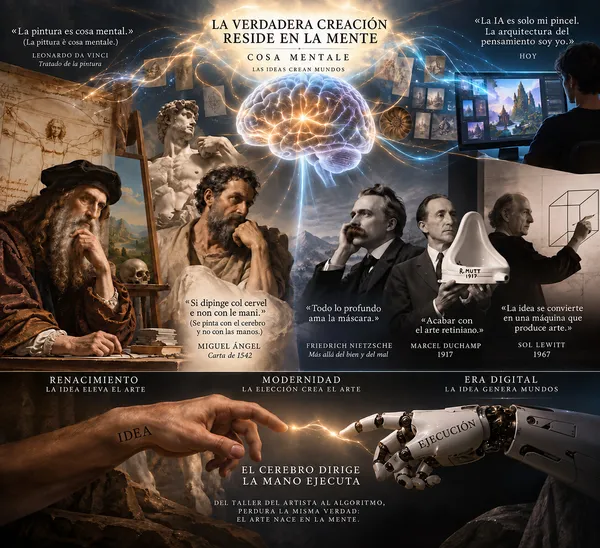
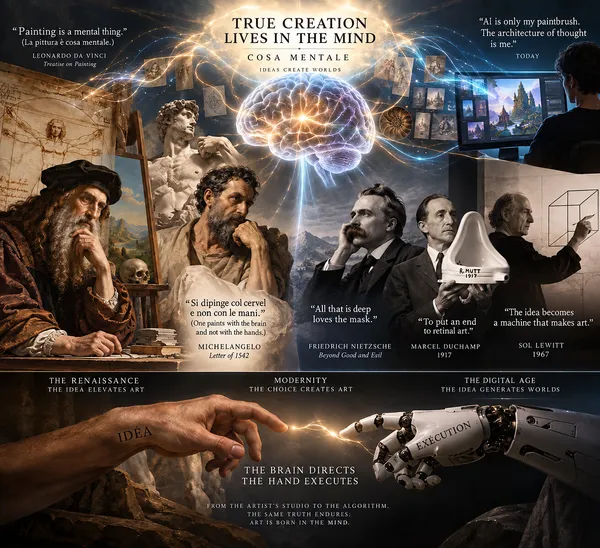
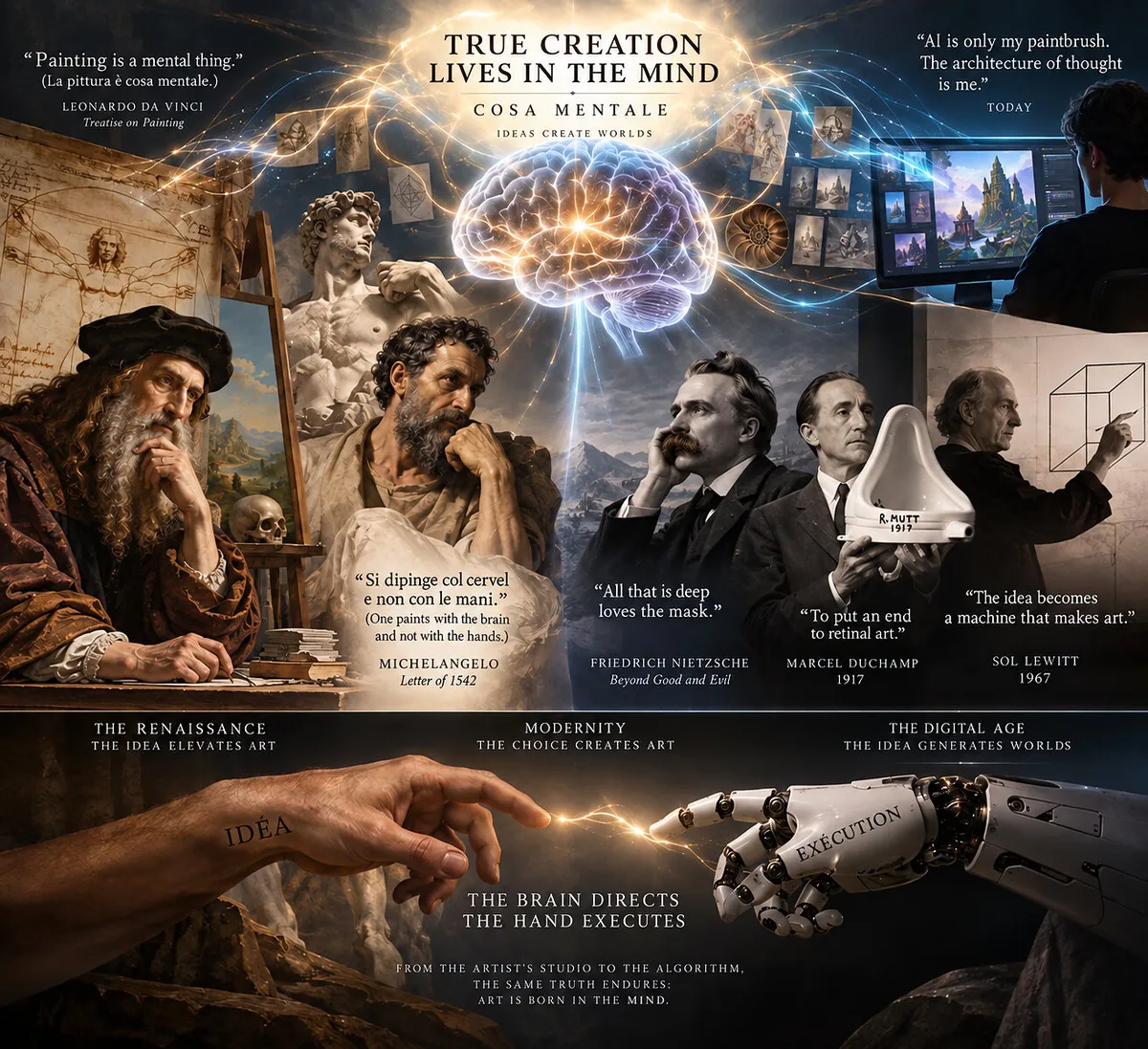
Ehrmann draws on Leonardo da Vinci's idea of the cosa mentale, the notion that art and creation are above all matters of the mind. The release argues that AI can now process natural language, so skills such as nuance, memory, imagination and the art of asking a question become central to mastering advanced technologies. In its words, people can still code, but can now also converse.
The Goncourt controversy and wider rules debate
The release positions the book against a debate that, it says, has escalated since early September 2026. In France, the discussion crystallized around the removal of Thélyson Orélien's "C'était ça ou mourir" from the Prix Goncourt selection, amid suspicions of AI use that the author disputes. The release also mentions separate revelations about earlier plagiarism, and stresses that a suspicion of algorithmic generation is not in itself proof of plagiarism or a court decision.
It lists other responses from the sector:
- In Canada, literary bodies such as the Writers' Trust and the Giller Foundation have adopted restrictions on AI-generated texts.
- The Authors Guild in the United States launched a Human Authored certification, based mainly on the human provenance of the published text, with limited tolerance for certain de minimis uses.
- In France, Gaspard Koenig defends a label called Livre sanctuaire, 100 % humain.
According to the release, these initiatives do not all draw the line in the same place between documentary research, conception, correction, rewriting and generation of prose.
The release also cites a 14 October 2026 piece in Literary Hub by writer and editor James Folta. He links the Orélien case to the dispute over the Caine prize and argues that uncertainty created by AI detectors could harm authors from minority languages, cultures or stylistic traditions more. He refers to a Stanford study in which several detectors produced many false positives on English essays written by non-native speakers, and supports judging panels using human, adversarial inquiry rather than treating a machine verdict as sufficient proof.
What it means
The release presents Ehrmann's open distribution as a counterpoint to what it calls administrative locks on digital flows. It describes the book as a "third way" between predictions of humanity's loss and blind faith in technology, one in which humans and algorithms inform each other without the human giving up judgment.
For readers, the practical change is access: the French text can be read directly, without relying on page-by-page machine translation. The release's own framing is promotional, and its claims about the book and the debate come from the author's side.