Factory's Droid 1.0 agent harness claims higher Terminal-Bench 4 scores at lower cost
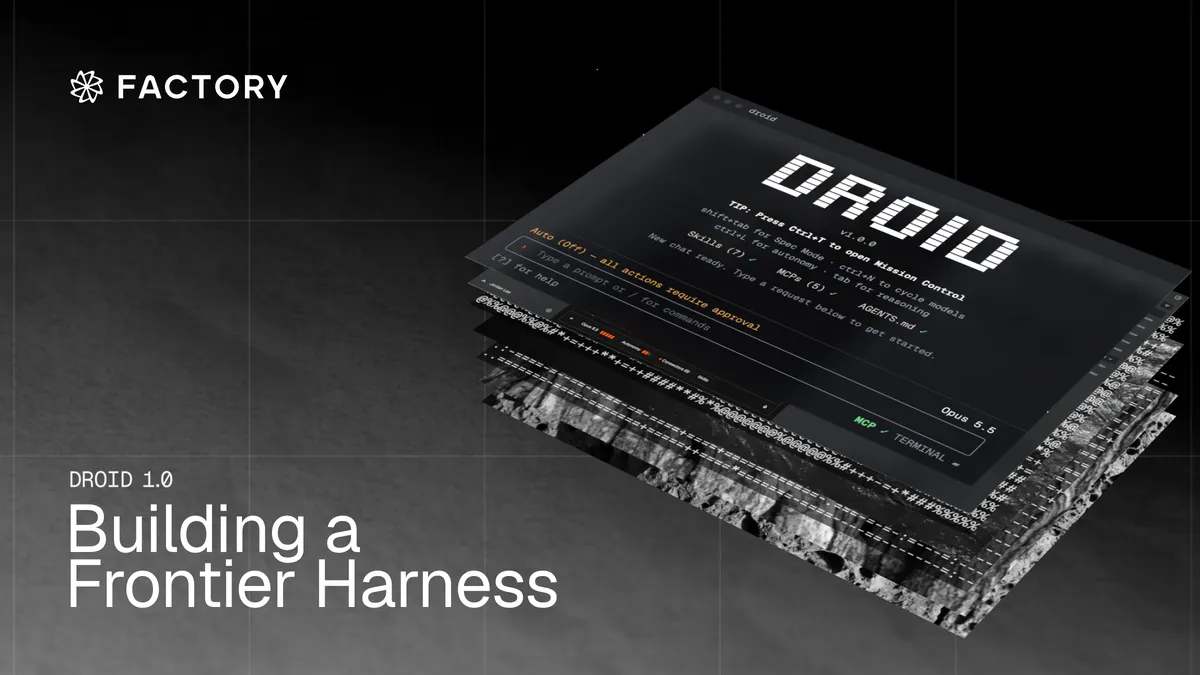
Factory has released Droid 1.0, a rebuilt version of its coding agent harness that makes programmatic tool calling the default. According to the company, Droid scores higher at a lower cost than every other harness it tested on Terminal-Bench 4.
- Factory released Droid 1.0, its agent harness, with programmatic tool calling as the default.
- On Terminal-Bench 4, Droid scored 57.6% with GPT-6.1 Sol and 65.2% with Claude Opus 5.5, according to Factory.
- Factory says Droid costs up to 24% less than the other harnesses it tested with Claude Opus 5.5.
- The Script tool runs model-written JavaScript in a sandbox and can make hundreds of tool calls in one model request.
- Script mode cuts Droid's cost by 15% on Claude Opus 5.5 versus direct tool calling, per Factory.
What Droid 1.0 is
Factory defines an agent harness as everything around the model: the prompts, the tools, how tool results come back, and the loop that runs it all. Droid is Factory's harness, and the company calls the 1.0 update its largest yet. It says the work draws on collaboration with hundreds of thousands of developers across large enterprises over the past year.
The pitch is aimed at enterprise development: high-quality results on complex tasks, efficient use of resources, and strong safety controls. Factory says that on the same tasks, Droid outperforms the native harnesses built for their models, up to 20% more efficiently.
Factory describes itself as model-independent. Users can pick a model themselves or let Droid choose a mix through its auto model router, Factory Router. The company argues that tuning a harness across many models makes it better, because improvements that hold across model families are less likely to be adaptations to one model's quirks. Droid tunes its prompts, tool descriptions and tool-calling mode for each supported model, including when users bring their own API keys, according to Factory.
Benchmark results
Factory reports results on Terminal-Bench 4, using the same tasks and the same models across harnesses. These are the company's own figures.
- GPT-6.1 Sol: Droid scored 57.6% at $0.79, against 54.0% for Codex, 51.0% for OpenCode and 45.0% for Devin. Factory says that is 3.5 points higher than Codex at 12% lower cost, and 6.6 to 12.6 points higher than OpenCode and Devin. Cursor is not shown because it has no access to OpenAI models.
- Claude Opus 5.5: Droid scored 65.2% at $4.73, against 62.1% for Cursor and OpenCode, 59.6% for Devin and 57.6% for Claude Code. Factory says that is 3.0 to 7.6 points higher, at up to 24% lower cost.
Factory argues the gap matters more as agents run longer. Over hundreds of steps, a more accurate agent leaves fewer mistakes for later steps to build on, and a cheaper one allows more agents on the same budget.
Programmatic tool calling and Script mode
Factory says the largest change behind the results is programmatic tool calling (PTC). In a standard agent loop, the model calls tools directly and every output is appended to its context. With PTC, the agent writes a program that invokes the tools and runs the whole workflow in a single invocation. Examples given include reading hundreds of files to find the few that mention a topic, triaging dozens of Linear tickets, or running a database migration in pieces.
Factory made PTC the default for three reasons. It keeps the context window clean, since only the program's output reaches the agent. It reduces the number of model requests, making complex tasks faster and cheaper. And it improves reliability, because checks and loops run deterministically in code, so a model cannot be lazy and drop a case it originally planned.
Droid implements this as a Script tool. The model writes JavaScript that runs in a sandbox with no file, network or system access of its own. A Script can make hundreds of tool calls in one model request. Printed output is capped in size, and full results are logged where the model can search them later. Calls that do not depend on each other run concurrently.
In one replayed session, fixing a failing unit test with GPT-6.1 Sol at high reasoning, direct tool calls needed 10 model calls and finished in 56.8 s. The Script tool did the same 15 tool calls in 5 model calls and 41.6 s. Factory says script mode cuts Droid's cost by 15% on Claude Opus 5.5 compared with direct tool calling, with savings concentrated in the 12.5% of Scripts that make six or more tool calls.
Internal Agent Factory and what it means
Factory says it improves the harness through an internal system called Agent Factory. Agents study benchmark failures and friction that users hit in real sessions, propose changes, and test each one on every model family it affects. Engineers review the evidence and decide what ships.
For teams choosing coding agents, the claim is that harness design, not only the underlying model, affects both accuracy and cost. The figures come from Factory's own testing, and the company links a methodology section for the benchmark comparison.
Factory: Droid 1.0: Building a Frontier Harness