Fireworks AI Trains Muse Glimmer to Beat Jev at Predicting Kalshi Markets
Fireworks AI says a version of Muse Glimmer 30B fine-tuned on historical Kalshi markets predicted outcomes more accurately than Jev, reaching 58.3% versus 47.1% on unseen topics. The company is also offering free supervised fine-tuning on the model through November 30 as the start of its Free Weights Club.
- Muse Glimmer 30B is free to fine-tune with SFT on Fireworks through November 30.
- On unseen topics, tuned Glimmer scored 58.3% accuracy versus 47.1% for Jev, an 11.2 point gap.
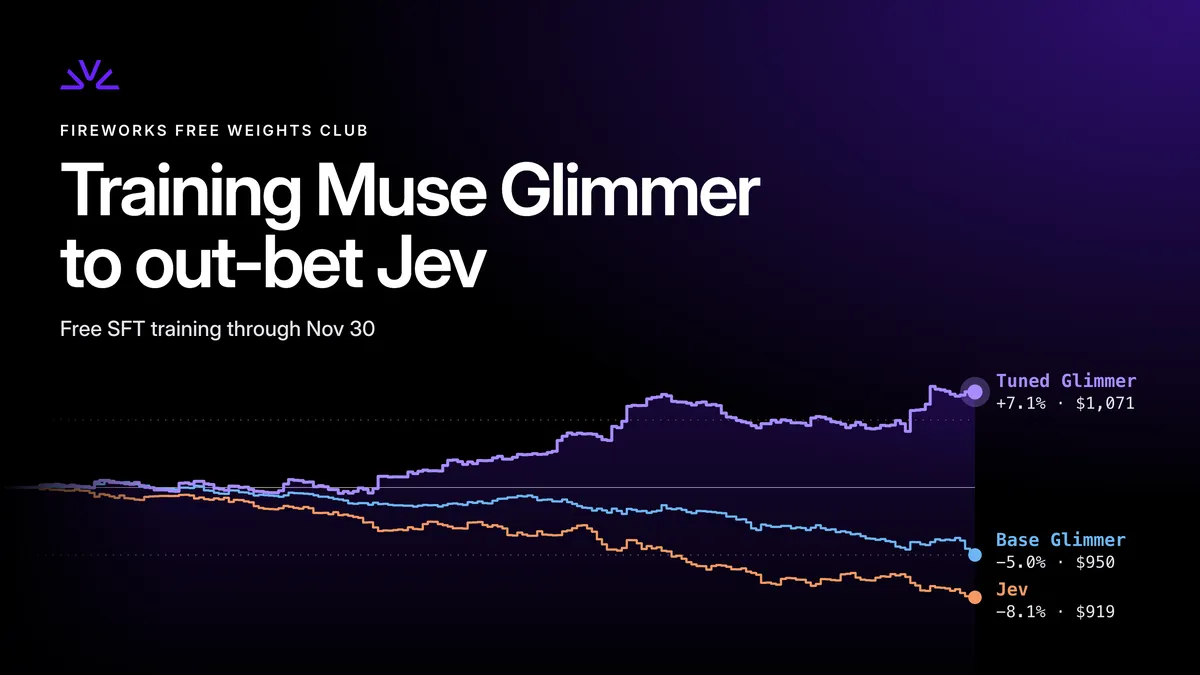
- A hypothetical $1,000 grew to $1,071 for tuned Glimmer after modeled fees, while base Glimmer and Jev lost money.
- Fireworks says System One was 2-3× faster in median server processing than BF16 chat completions in a synthetic benchmark.
- The backtest ignores liquidity and slippage, and real-money performance is untested.
Free training on Muse Glimmer 30B
Fireworks AI has launched the Free Weights Club, a program in which it promises new post-training research, a recipe to build on, and free training on a featured model for a limited time. The first model is Muse Glimmer 30B, with supervised fine-tuning (SFT) free through November 30. According to Fireworks, the model is multimodal, offers strong performance for the cost, and is a good starting point for personal agents.
For developers who want to run their own experiments, the company points to a Kalshi cookbook. Managed Training runs the SFT job from a user's examples, while the Serverless Training API gives control over the training loop.
How the experiment was built
The first experiment asked whether training Muse Glimmer on settled Kalshi markets could give it an edge in predicting outcomes. Each example held a market's title, description, rules and date, with the settled outcome as the label. The model saw no market prices or news.
Fireworks kept three sets separate:
- Training: 20,051 questions from 6,461 events that settled before January 4, 2026.
- Calibration: 6,232 questions from 2,000 events that opened January 11 or later and settled before April 1, 2026.
- Evaluation: 33,712 questions from 8,765 events that opened April 8, 2026 or later.
Within the evaluation set, 3,567 questions came from 113 topic families excluded from both training and calibration. The company removed near-duplicate inputs, rule edits made after markets opened, and later-added winning options that could reveal outcomes.
Training used the Fireworks Training API with K-way cross-entropy loss, which considers only the answer choices for a given question. Fireworks trained a LoRA adapter with SFT in one pass through the data.
Accuracy, calibration and the backtest
On the full test set, tuned Glimmer reached 64.8% accuracy, compared with 56.4% for base Glimmer and 45.9% for Jev. On unseen topics, it reached 58.3%, ahead of base Glimmer at 53.2% and Jev at 47.1%.
Fireworks then calibrated the tuned model's confidence using a separate temperature for each question type, fitted on the held-out calibration set, without retraining weights. Only tuned Glimmer received this step. When it gave an answer at least 80% probability, it was right 86.8% of the time. Those confident calls covered 14.4% of full-test questions and 6.1% of unseen-topic questions. Fireworks notes that many were "No" answers to related threshold questions, so the successes were not independent.
In a hypothetical backtest, each model received $1,000 to allocate across bets whose price plus modeled fees was at least 5¢ below the model's estimate. Tuned Glimmer finished at $1,071 (+7.1%), against $950 for base Glimmer and $919 for Jev. Its 90% event-bootstrap interval ran from +1.6% to +12.4%. On unseen topics alone, a separate allocation returned 15.2%, with an interval of −2.9% to +33.5% that still included losses.
The company lists caveats: the backtest spread a fixed budget across overlapping historical bets, allowed fractional contracts, and did not model liquidity, slippage or historical fee changes. Whether the result holds with real money, Fireworks says, remains an open question.
System One serving and what it means
Because the task needs probabilities over a fixed set of answers, Fireworks used its System One API, which reads option probabilities directly without generating text and packs multiple questions about a shared context into one request. In a separate synthetic benchmark, it delivered 2-3× faster median server processing than standard BF16 chat completions, using the same adapter and a single B200 GPU. At 16-32 questions per request, it delivered up to 3.6× more decisions per second. Fireworks stresses that precision and runtime differed, so the figures compare complete serving stacks, and that this benchmark is separate from the Jev comparison.
For developers, the offer is a low-cost way to test task-specific fine-tuning on a 30B multimodal model until November 30, with a worked example and serving instructions via /inference/v1/systemone. The results come from the company's own tests and a hypothetical backtest, so they show promise rather than proof of trading profit.
Fireworks AI: Training Muse Glimmer for free to out-bet Jev