Gemini 4 Argon Retakes Top Spot on Roboflow's Vision Benchmark
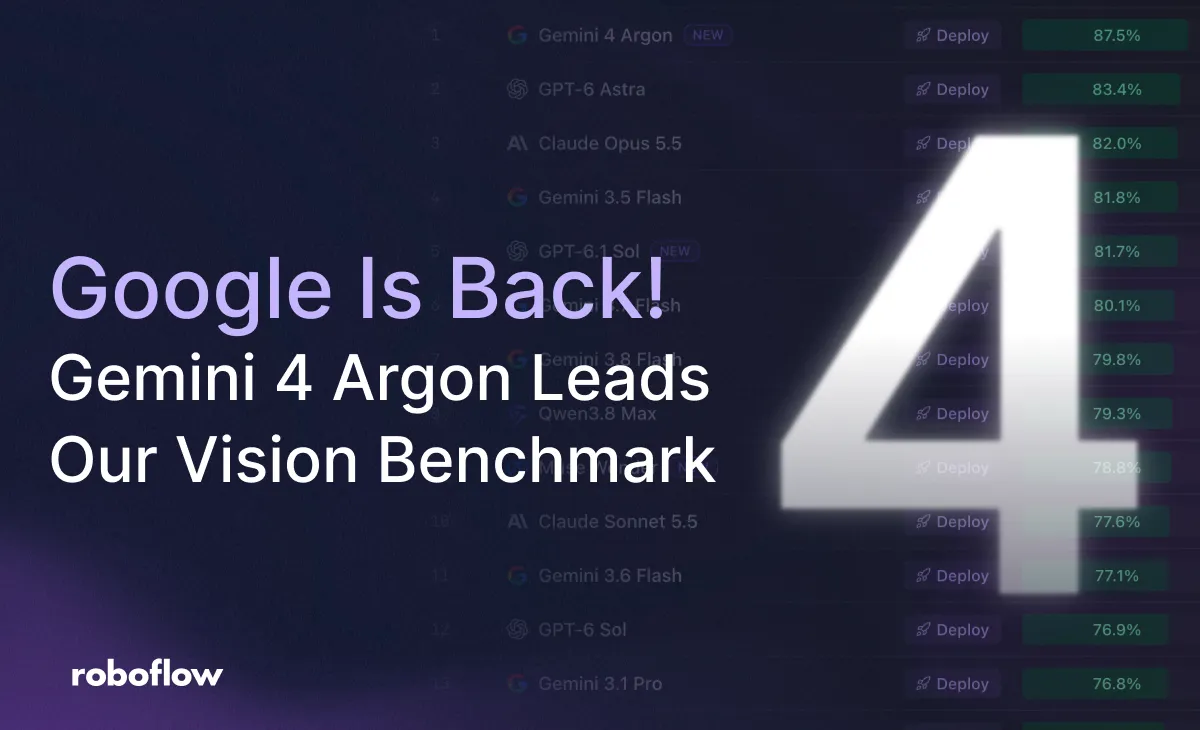
Google's Gemini 4 Argon has taken first place on Roboflow's overall vision benchmark, according to the computer vision company. Roboflow says the model overtakes GPT-6 Astra, which had led most of its benchmarks, and leads in object detection and several OCR tasks.
- Roboflow says Gemini 4 Argon now leads its overall vision benchmark, ahead of GPT-6 Astra.
- Object detection: 82.5% (low effort) and 85.1% (high effort) mAP@50.
- Single string extraction reaches 80.0% at high effort, versus 71.7% for the previous best Gemini.
- JSON extraction scores 92.6% and 94.8%; text localization and recognition scores 81.6% and 84.7%.
- Handwriting, small or blurred text and multi-step readings remain weak points.
Google returns to the top after slipping
Roboflow says Gemini models had scored consistently high on its detection and text benchmarks since it began evaluating vision-language models. More recently, other research groups sped up. According to Roboflow, GPT-6 Astra took the lead on most benchmarks, with Anthropic and Qwen close behind. Both of those companies launched increasingly capable models, including smaller and quicker variants, and Google slipped in the rankings.
With Gemini 4 Argon, Google is back at the top of the overall vision benchmark, Roboflow reports. The company tested the model on object detection, segmentation and three OCR tasks, and also tried more advanced video use cases. Roboflow also discusses the prompts, speed and cost of the experiments, and offers Argon in its Roboflow Playground so users can try detection, segmentation and OCR on their own images.
Detection and segmentation results
On object detection with text prompts, Argon leads the leaderboard at both low and high reasoning effort, scoring 82.5% and 85.1% mAP@50. Roboflow says it outperforms Astra at both levels and improves on the previous best Gemini result by over 10 percentage points for each setting.
Roboflow also tested box prompting, where the user shows the model an example object instead of naming it. Positive examples indicate what to find and negative ones what to ignore, which helps with classes that are hard to describe in words. Examples can be given as coordinates or highlighted on the image, and a reference object in one image can be used to find matches in another. Roboflow had earlier explored this with Qwen 3.8 Max and GPT-6 Astra, and says Argon performed best.
Segmentation is resource-intensive for vision-language models because each object must be described as a polygon, and objects with holes or separate parts need extra structure. Even so, Roboflow says the mask quality shows a lot is possible, citing an example with foreign objects among carrots where holes had to stay outside the masks. SAM 3, prompted with text, is much faster, Roboflow notes, but its understanding of complex text prompts can be limiting. Argon's stronger language understanding is useful when specifying the target takes more than a simple class name.
OCR: strong gains, but handwriting and small text remain hard
For single string extraction, earlier Gemini models had stayed strong even after Astra launched. Argon widens that lead, reaching 80.0% at high effort against 71.7% for the previous best Gemini model at the same setting. Failures persist with small, blurred or hard-to-read text, such as a license plate, and with cases that need reasoning beyond recognizing characters, such as combining the dials of an electricity meter into one reading.
On JSON data extraction, Argon also leads, with 92.6% at low effort and 94.8% at high effort. Roboflow says the gap between leading models is narrower here, and previous Gemini models were already very accurate. Handwriting remains problematic, with handwritten cheques and pharmacy bills given as examples of incorrect extractions.
Text localization and recognition, one of the newer tasks in the benchmark, combines finding text with reading it. Roboflow says the latest OpenAI models had been ahead, but Argon now leads at both effort levels with 81.6% and 84.7%. The task is useful for technical drawings, maps and other images where text appears in different places and orientations, including rotated characters and unusual fonts.
Video re-identification test and what it means
Roboflow also tested whether Argon could identify the same basketball players across two frames of the same play, returning bounding boxes with consistent player IDs. It had run a similar experiment with Astra and wanted to see whether it could be replicated with Argon. The source text available here ends before the results of this test.
For developers choosing a vision-language model, the benchmark suggests Argon is now a leading option for detection and text-reading work, according to Roboflow's own tests. The listed failure cases show where caution is still needed: handwriting, small or blurred text, and readings that require extra reasoning.
Roboflow: Google Is Back! Gemini 4 Argon Leads Our Vision Benchmark