Germany and NVIDIA sign declaration to push industrial AI and physical AI
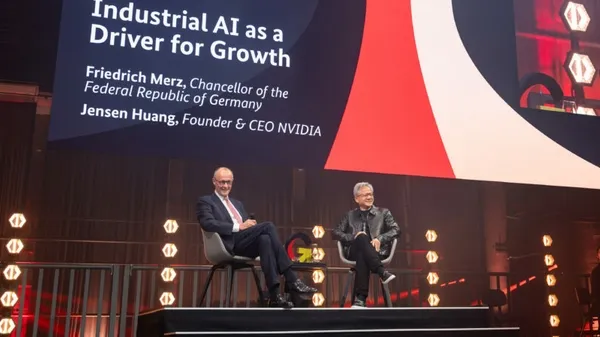
The German government and NVIDIA have signed a Joint Declaration of Intent to work on a joint initiative for advanced physical AI models, according to NVIDIA. Chancellor Friedrich Merz and CEO Jensen Huang discussed the plan at Kraftwerk in Berlin, where Huang also announced planned investments in four German startups.
- Germany's government and NVIDIA signed a Joint Declaration of Intent to work on advanced AI models for physical AI.
- The declaration formalizes NVIDIA's collaboration with the Industry 4.0 Platform.
- Huang announced planned investments in Agile Robots, Avelios Medical, Mirelo and Reflex Aerospace, part of a nearly $10 billion European commitment.
- Siemens says virtual production ramp-up cuts engineering effort by up to 85% and agent-based planning saves up to 20%.
- NVIDIA ran a 104-qubit fault-tolerant quantum computer simulation on the JUPITER supercomputer.
A declaration aimed at physical AI
Earlier on the day of the Berlin event, as part of the Invest in Germany Summit, Chancellor Merz, the Federal Ministry for Economic Affairs and Energy and the Federal Ministry for Research, Technology and Space signed the declaration with NVIDIA. According to NVIDIA, it sets out an agreement to work on a joint initiative to advance cutting edge AI models for physical AI.
The document also formalizes and expands NVIDIA's collaboration with the federal government and its "Industry 4.0 Platform", which includes representatives from politics, industry, research and trade associations. NVIDIA says this supports the government's stated goal to "systematically bring industrial AI into widespread use and to establish a state-of-the-art industrial AI ecosystem in Europe." The government's aim is to merge traditional German engineering and manufacturing expertise with cutting-edge research and AI technology.
Merz and Huang on the Mittelstand
On stage, Huang traced NVIDIA's long relationship with German industry, from gaming systems, workstations and automotive design in the early 2000s to current partnerships in autonomous vehicle development and digital twins for manufacturing. The talk centered on playing to Germany's strengths in manufacturing and automotive, and on getting small and medium-sized companies to adopt AI.
Merz said his government is "fully committed to be one of the most advanced places in the world" to work with AI. He called the Mittelstand "the biggest advantage we have in Germany" and urged its leaders to "open your doors for AI to make use of your data."
Huang praised Germany's manufacturing expertise and its strength in math and science. "AI can only augment your capability, it will not replace your capability," he said. He described AI's impact as a new industrial revolution and told the audience: "This is your chance to do it well." Merz said he would like to meet Huang at least once a year to review Germany's progress.
Startup investments and industry news
Huang announced planned investments in four German startups, part of what NVIDIA describes as a nearly $10 billion commitment to support companies, universities and research institutions across Europe. NVIDIA has already backed n8n, Neura Robotics and Black Forest Labs.
- Agile Robots, based in Munich, builds AI-powered robots, from robotic arms to its Agile ONE humanoid, for manufacturing, logistics and healthcare.
- Avelios Medical, also in Munich, develops an AI-native hospital information system for clinical and administrative workflows.
- Mirelo develops AI models that generate sound effects, speech and music for video.
- Reflex Aerospace, a Berlin-based space scaleup, builds satellites that it says are ready for launch in about 12 months instead of years.
Separately, Siemens announced a partnership with NVIDIA on AI-driven, autonomous factories and showed new AI solutions at its Erlangen factory. According to the source, fully virtual production ramp-up reduces engineering effort by up to 85%, while agent-based production planning enables cost savings of up to 20%.
NVIDIA researchers also used JUPITER, Europe's largest supercomputer at the Jülich Supercomputing Centre, to run a simulation of a fault-tolerant quantum computer. The 104-qubit run is described as the largest and most detailed of its kind to date.
What it means for German industry
The declaration gives NVIDIA's work with Berlin a formal framework and ties it to an existing industry platform. For small and medium-sized manufacturers, the message from both leaders was to put their own data and expertise to use with AI. The source does not give details on funding, timelines or specific projects under the joint initiative, so its concrete results remain to be seen.