GMIF2026 in Shenzhen: 40 Firms Show AI Memory and Storage Products
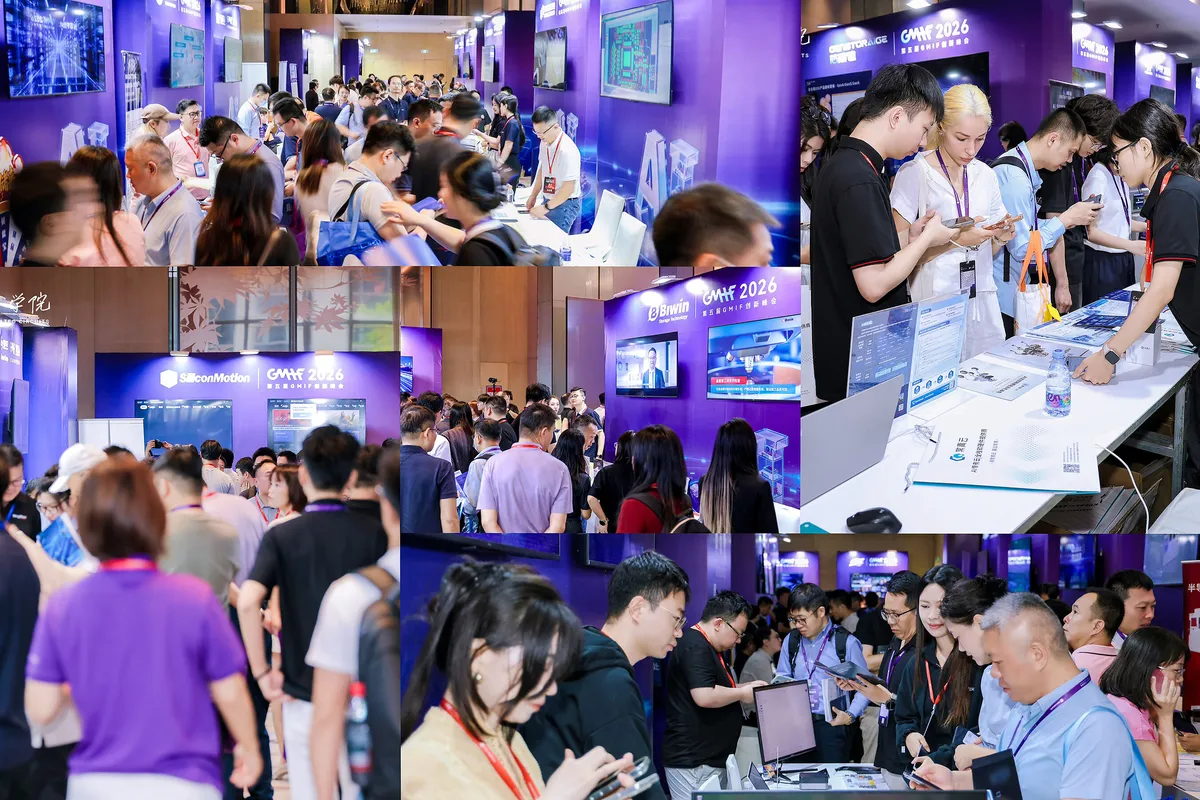
The 5th Global Memory Innovation Forum (GMIF2026) in Shenzhen closed with an exhibition of 40 companies showing memory and storage products for the AI era, from NAND flash and controllers to servers, test systems and packaging equipment. The event ran under the theme "The Future Built on AI Memory and Storage."
- GMIF2026 in Shenzhen hosted 40 companies showing AI memory and storage products under the theme "The Future Built on AI Memory and Storage."
- Silicon Motion's SM8466 targets PCIe Gen6 with 28GB/s sequential read and 7M random read IOPS.
- Sandisk showed an automotive UFS 4.1 device on 218-layer BiCS8 NAND, claiming 2.8x faster reads than UFS 3.1.
- Infplane and Genstoraige presented AI SSD approaches that offload KV cache to NAND for running 100B+ parameter models.
- Performance figures are company claims, several based on internal testing.
Flash, controllers and servers
GMIF2026 was co-hosted by the Shenzhen Memory Industry Association (SMIA) and the School of Integrated Circuits at Peking University. It took place at the Renaissance Shenzhen Bay Hotel, and the accompanying exhibition brought together 40 companies across the value chain, according to the organizers' recap.
Sandisk focused on industrial, automotive and enterprise products. Its iNAND AT EU752 automotive UFS 4.1 embedded flash uses 218-layer BiCS8 3D NAND, supports temperatures from -40°C to 105°C and is certified with AEC-Q100. With SmartSLC technology, the company says it reads 2.8x faster and writes 2.5x faster than the previous UFS 3.1. For enterprise, Sandisk showed the SN861 NVMe drive with read throughput of up to 13700 MB/s and Flexible Data Placement (FDP) to reduce write amplification, plus BiCS8 enterprise-grade QLC NAND with up to 8TB per package.
Silicon Motion presented controllers for AI factories (data centers), edge AI and physical AI. Its SM8466 flagship is built on TSMC's 4nm process for PCIe Gen6 enterprise platforms. It delivers 28GB/s sequential read and 7M random read IOPS, supports the E3.S form factor, and can address single drives of 512TB and above. It includes a Caliptra 2.1 root of trust supporting post-quantum cryptography.
Lenovo showed its WenTian AI servers. The flagship WA5480 G3 is a 4U rack supporting up to 10 double-wide GPUs and 32 DDR5 DIMMs. The WR5220 G5 and WR5225 G3 run on Intel Xeon 6 and AMD EPYC processors.
Maxio Technology showed SSD controllers across PCIe Gen5, Gen4, UFS and eMMC. The MAP1808/MAP1802 reach read/write speeds of up to 14,800/14,200MB/s, and the MAU3602 is an embedded UFS 4.1 controller with up to 4,200MB/s.
New approaches to AI data paths
Several exhibitors targeted the bottleneck between limited DRAM or GPU memory and large models.
Infplane showed an AI SSD solution that uses a dedicated acceleration partition and custom scheduling to persist KV cache, prefetch hot and cold experts for MoE models, and tier model data. By using NAND to supplement limited DRAM/VRAM, it lets thin-and-light laptops and workstations run models with at least 2x more parameters, while cutting time to first token (TTFT) by 90%, 95%, the company says.
Genstoraige presented its Edge AI90 Inference Token Factory, which offloads KV cache to AI SSDs and orchestrates a three-tier HBM + DRAM + SCM hierarchy, expanding effective memory to the TB level. According to the company, this enables edge deployment of models with 100B+ parameters, delivers 10x higher token throughput and, in testing, cuts inference cost to 1/67 of the cloud. It is paired with the in-house PT200Z AI SSD at 14.8 GB/s.
Numbers Law built its PMD (Parallel Magnetic Drive), a high-capacity AI hard drive, on its in-house M3 architecture. The company says PMD delivers 21x the bandwidth and more than 1,000x the random IOPS of conventional HDDs.
On the compute side, NEXWISE subsidiary KuberCloud says vGPU pooling raises utilization to 70% or more, while Paratera says its scheduling system orchestrates heterogeneous compute across millions of CPU cores and tens of thousands of GPUs, lifting utilization above 85%.
Testing, packaging and consumer storage
The supply chain behind memory was also represented. OKN Technology says it was first to release a PCIe Gen 6 eSSD test system and a next-generation high-speed DDR5 test system, and brought its GA300 series SSD test system to the show.
Attach Point focuses on advanced packaging equipment, including wafer-level thermocompression bonding (TCB) and hybrid bonding (HB). It featured its AP-SMART INLINE packaging line with ±7μm XY placement accuracy and a Cpk above 1.67, and the VULCAN PRO thermocompression bonders for HBM and ultra-thin stacking.
BIWIN showed storage spanning cloud, edge and on-device AI, including eMMC, UFS, LPDDR and BGA SSD for devices such as smartphones and AI/AR glasses, plus enterprise SATA and PCIe SSDs, CXL and DDR5 RDIMM. Topdisk exhibited an M.2 PCIe Gen5 SSD with a DRAM cache reaching read/write speeds of up to 14,000/13,000MB/s, and Extreme series microSD cards with 240MB/s read speeds.
What the show signals
The exhibitor list points to where vendors are placing their bets: PCIe Gen6 for enterprise drives, UFS 4.1 for automotive and mobile, and SSDs used as an extension of scarce DRAM and GPU memory for large-model inference. Many of the performance claims come from the companies themselves and, as the recap notes in some cases, from internal testing, so they should be read as vendor figures rather than independent benchmarks.