Google brings offline speech recognition and TTS to AI Edge Gallery
Google is adding on-device Automatic Speech Recognition and Text-to-Speech to Google AI Edge Gallery, allowing developers to build voice-enabled AI experiences that work locally and offline. The release combines Google’s Android speech models with open-weight models for cross-platform applications.
- Google AI Edge Gallery now supports on-device ASR and TTS.
- ML Kit supports multilingual transcription across 100+ languages.
- Google’s Android TTS model starts speaking in approximately 100 ms.
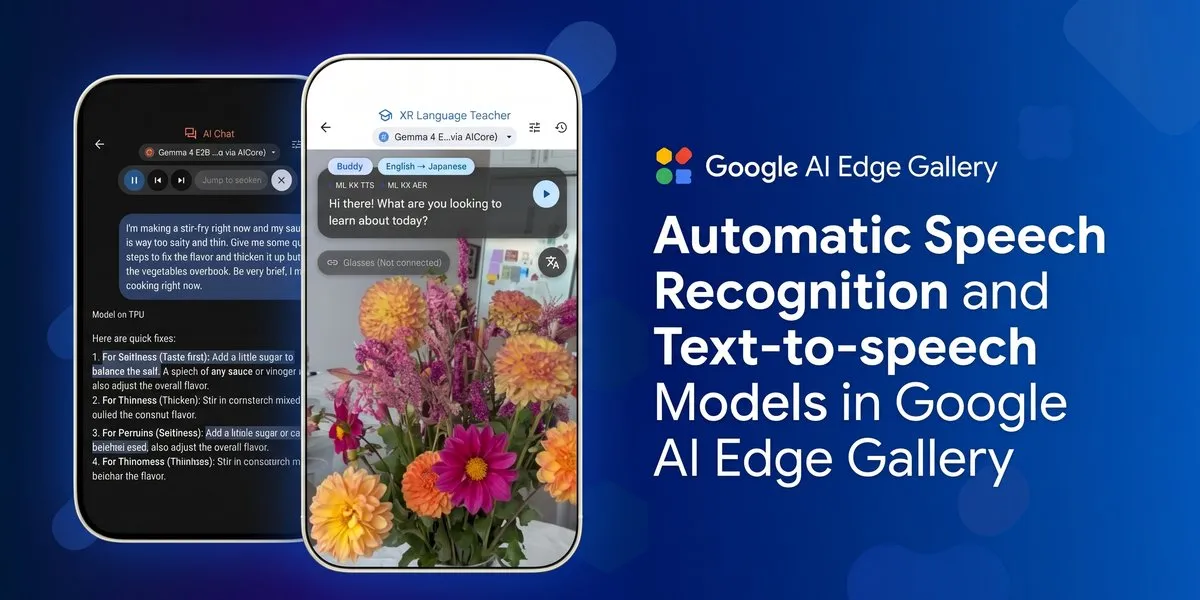
- XR Language Teacher combines camera input, local models and bilingual speech.
- MediaPipe Tasks and LiteRT extend speech support beyond Android.
Speech models designed to run locally
Google says compact speech architectures now make it possible to run multilingual speech recognition and expressive speech synthesis entirely on devices, with low latency and a small memory footprint. When paired with small language models such as Gemini Nano and Gemma 4, the models can support live transcription and spoken replies without sending voice data to a server.
For Android, ML Kit provides system-integrated speech models that Google says can transcribe more than 100 languages at 10x real-time speed. Its text-to-speech model starts speaking in approximately 100 ms, produces 24 kHz audio, and can operate at up to 50x real-time speed. Both models are integrated into the operating system and add 0 MB to an app’s APK, according to Google.
For web, desktop and other platforms, Google highlights speech bundles including Parakeet-TDT 0.6B, PocketTTS 100M, Kokoro-82M and Phonon 31M. These models are supported through MediaPipe Tasks and LiteRT, and are designed to run alongside on-device small language models.
XR Language Teacher demonstrates offline voice AI
Google’s XR Language Teacher showcase combines the camera, language models and speech tools in a single local experience. A user can point a phone camera at an unfamiliar object or menu and ask a question aloud. The application then explains the scene in the user’s language and provides pronunciation in the local language, without requiring a network connection.
On Android, on-device speech recognition streams the spoken question to Gemini Nano alongside the camera frame. On other platforms, the showcase uses Gemma 4. Structured outputs separate foreign-language phrases from the rest of the response, allowing text-to-speech to switch voices and accents mid-sentence. Google says the same experience can also be adapted for intelligent glasses when inference runs on a paired phone.
Voice controls are also built into AI Chat
Google has added speech recognition and text-to-speech to the main AI Chat feature in Google AI Edge Gallery. Users can choose speech pipelines, preset voices and downloaded language packs in Model Management. AI Chat supports streaming voice dictation and read-aloud playback, including automatic playback or a speaker control for individual responses.
A floating text-to-speech bar highlights each spoken sentence and lets users jump to a selected sentence. Google’s open-source reference implementation removes Markdown syntax, skips non-spoken sections such as code and tables, and schedules synthesis at sentence level to reduce compute and memory contention while the language model generates tokens.
For developers, ML Kit offers Android APIs managed through AICore and Google’s on-device speech services. MediaPipe Tasks provides unified interfaces across iOS, macOS, Windows, Linux and the web, while LiteRT supports more direct control over speech processing and custom model architectures. The release gives developers a local voice pipeline for phones, browsers, desktops and wearable scenarios, with the source positioning offline operation and reduced latency as its central benefits.
Google for Developers: On-Device Speech Recognition and Text-to-Speech in Google AI Edge Gallery- Google Developers Blog