Google details Antigravity’s multiagent results in mathematics and engineering
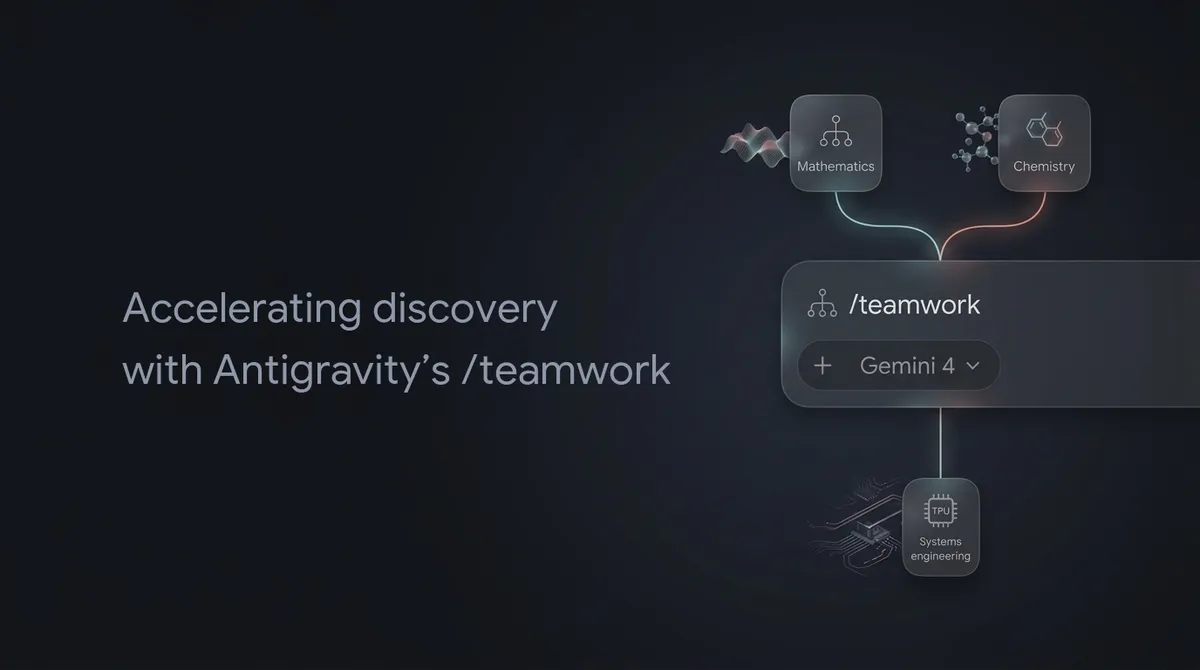
Google says its Antigravity /teamwork multiagent systems have helped human researchers address open problems across mathematics, chemistry, systems software and machine learning engineering. The company is making the tools available externally through Antigravity.
- Google says Antigravity’s /teamwork supports human-AI research collaborations.
- The workflows use parallel exploration, critics and external verification tools.
- Researchers used Gemini 4 models across mathematics, science and systems engineering.
- Google says a team formalized the Courtade, Kumar proof in Lean 4.
- The tools are being made available externally through Antigravity.
Human researchers work with specialized agents
In a Google Research post dated November 13, Google Fellow and Vice President Vahab Mirrokni described recent work involving teams at Google and academic partner institutions. According to Google, the collaborations used Gemini 4 Argon, Gemini 4 Carbon, Gemini 4 Hydrogen and multiagent workflows such as Antigravity’s /teamwork.
The company says these projects produced innovations in information theory, formal verification, molecular structure discovery and kernel optimization, as well as gains in Google’s production infrastructure. The tools are being made available in Antigravity alongside /boost and other agents, allowing researchers and developers to apply the workflows to their own projects.
Google presents the system as an interactive process rather than an autonomous replacement for researchers. People frame questions and define theoretical or physical constraints, while agents write custom solvers, explore large search spaces, test candidate designs and check extended chains of reasoning.
How Antigravity’s /teamwork handles long tasks
Google says /teamwork is designed around two limitations of current language models. A model may produce an incorrect answer even when a correct solution exists, and it may lose track of details during tasks that extend across multiple days.
To address the first issue, the system combines parallel exploration with dedicated falsifiers. These can include the Lean 4 proof checker, unchanged software test suites, execution simulators, web search and hardware counters. The tools are used to verify which candidate solutions work.
To address the second, /teamwork partitions context so that each specialized agent receives only the files and tools needed for a particular step. Coordinators hand tasks to fresh successors, while critics and auditors review results from clean contexts without access to the original producer’s reasoning.
Google says /teamwork expresses these processes as declarative, self-improving natural-language patterns and routes prompts to the pattern best suited to each task. These include distributed coding, iterative problem solving through /boost, long-proof workflows and document review. The company says more updates will follow in the coming weeks as further features are provided to external users on Antigravity.
Reported advances in mathematics and computer science
Google highlighted a proof of the Courtade, Kumar conjecture, an information theory problem from 2013. Researchers from Google, CUHK, USC and CMU used the Long Proof pattern, which implements Stellar Colosseum in Antigravity. Google says the work proves in full generality that, when a random bit string passes through a noisy channel, a compression to a single bit cannot preserve more information than a dictator function, which copies one input bit.
The company says Gemini first found counterexamples to a generalized conjecture from an earlier CUHK paper. Researchers then proposed a new candidate function and reduced the problem to a 14-variable optimization problem. Gemini 4 Argon and earlier Gemini models helped partition the parameter space and develop analytical bounds and interval-arithmetic certificates. The team formalized the complete proof in Lean 4, producing 50 million lines of code.
Other examples described by Google include a Lean-verified result on near-optimal sample bounds in adaptive data analysis, a new construction in quantum computing that settles a 2014 question, and a deterministic algorithm addressing the main open question from STOC 2024 on Boolean matrix multiplication and triangle detection.
Google also reported results involving sparse networks, randomized linear algebra, dynamic graph sparsification, online inverse linear optimization, integer multiplication, data structures and high-dimensional statistics. The source says researchers verified, simplified and edited the resulting algorithms and proofs for publication, underscoring the role of human experts in the reported work.
Google Research: Advancing science & engineering with Antigravity’s /teamwork