Google Research proposes wearable-based CKM health coaching framework
Google Research has introduced an investigational machine learning framework that turns passive wearable signals into a modifiable “coachable health age” and simulates personalized 12-week habit changes. The system is designed to track early cardiovascular-kidney-metabolic, or CKM, health and produce tailored coaching plans.
- Google Research introduced an investigational wearable-based CKM health framework.
- Its coachable health age uses modifiable wearable signals including steps, sleep and resting heart rate.
- SensorWM simulates 12-week habit trajectories from 2.28 million person-weeks of Fitbit data.
- Coaches preferred counterfactual-grounded plans in 71.4% of evaluations.
- The framework can incorporate routine blood biomarkers when available.
From wearable tracking to actionable health measures
Google Research says CKM syndrome connects heart disease, kidney conditions and metabolic disorders such as type 2 diabetes. Its progression can begin years before symptoms appear and may be influenced by everyday behaviors, including movement, sleep and cardiovascular activity.
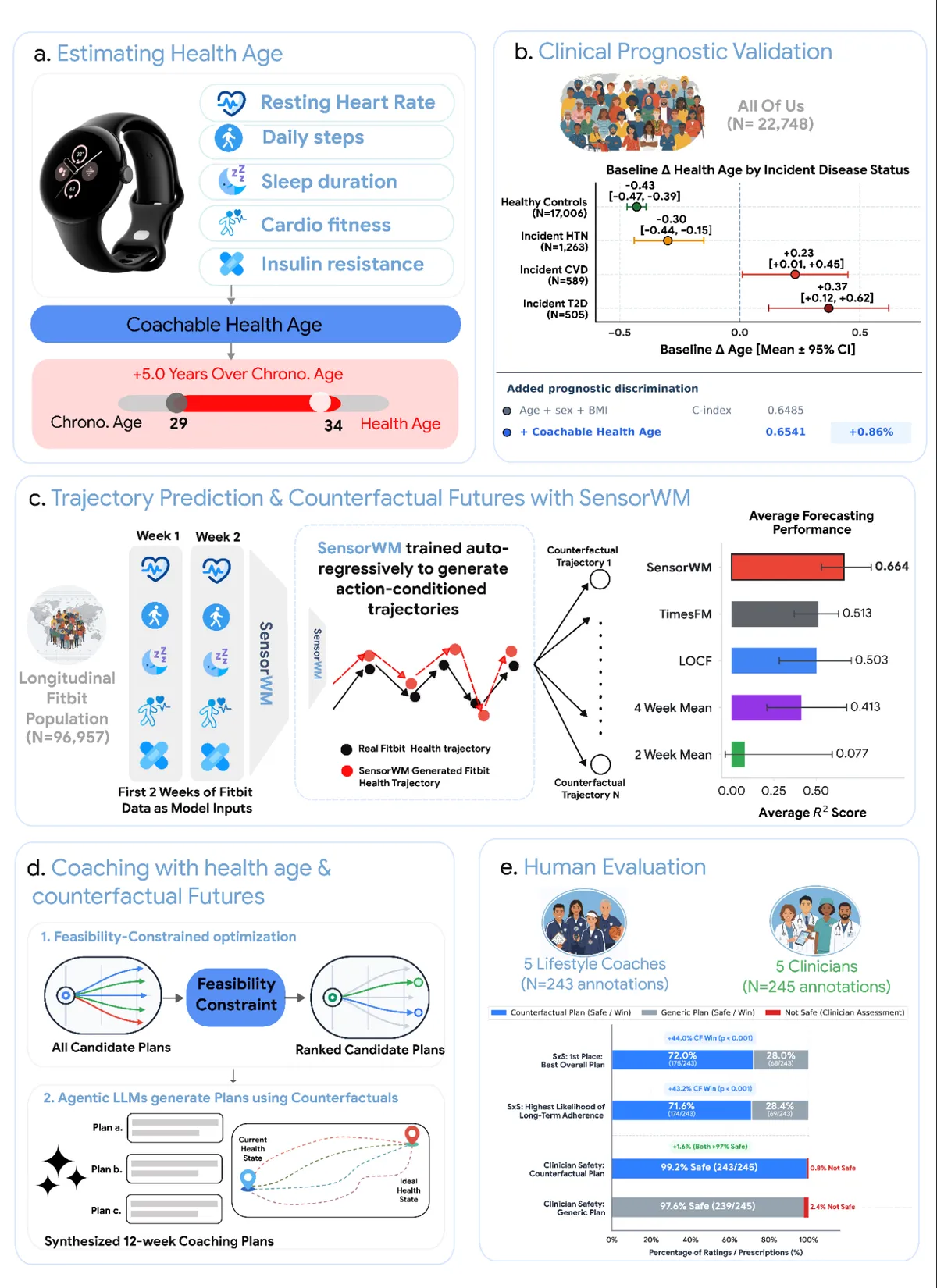
The framework is built around a coachable health age model that uses modifiable signals collected passively by consumer wearables. Its four core inputs are resting heart rate, daily step count, sleep duration and weekly Active Zone Minutes. Optional inputs can include VO2max, sleep schedule regularity and insulin resistance, when available.
The resulting health age delta compares the model’s health age with a person’s chronological age. Google Research says a negative delta indicates that a person’s physiological profile appears younger than their chronological age, while a positive delta signals accelerated aging. The model adjusts for overlap between signals so that each behavior contributes its distinct share.
A model for testing 12-week habit changes
The researchers also developed Sensor World Model, or SensorWM, an action-conditioned model trained on 2.28 million person-weeks of de-identified data from roughly 100,000 consenting Fitbit users. Using two weeks of baseline wearable data, it forecasts how 20 physiological markers may change over the following 12 weeks under different step, sleep and cardio routines.
SensorWM compares 125 candidate 12-week habit combinations with a status-quo projection. A feasibility-constrained optimizer then considers projected health-age reductions, a person’s historical habit flexibility and clinical safety bounds. The system can select a more ambitious target, such as −2.3 years, for someone with high flexibility, or a gentler −1.3-year target for someone with a more constrained routine.
A language model coaching agent converts the selected pathways into a progressive coaching plan. Google Research says SensorWM outperformed general-purpose time-series foundation models such as TimesFM while preserving clinical patterns associated with diabetes, hypertension and insulin resistance.
Evidence from cohorts and expert reviews
Google Research validated the coachable health age model across three independent cohorts. In the All of Us research program, involving 22,748 participants and more than 68,000 person-years of Fitbit and electronic health record follow-up, participants whose health age exceeded their calendar age were more likely to develop hypertension, cardiovascular disease or type 2 diabetes over the next eight years. Adding the measure to age, sex and BMI improved disease-risk prediction, especially among adults under 50.
In a longitudinal Fitbit cohort of 1,464 users, people with sustained habit changes showed decreases in coachable health age across consecutive three-month windows over two years. The measure also aligned with the modified American Heart Association’s Life’s Essential 8 cardiovascular score, metabolic syndrome severity and self-reported health in the WEAR-ME study.
In a blinded review involving five certified lifestyle coaches and five board-certified primary care and lifestyle medicine physicians, coaches selected the counterfactual-grounded plan as the best overall plan in 71.4% of evaluations and as more likely to support long-term adherence in 71.0%. Physicians rated 99.2% of the plans within safe exercise-intensity limits and 97.6% accurate on physiological claims, according to Google Research.
Extending the approach to blood biomarkers
When routine blood tests are available, Google Research says the framework can combine wearable streams with laboratory biomarkers. The aim is to identify early, subclinical strain across the heart, kidney and metabolic systems, extending the approach beyond passive monitoring toward personalized CKM risk profiling.
The work remains investigational. Its proposed user benefit is a feedback loop in which daily behaviors inform a health-age measure, simulations show possible consequences of changing those behaviors, and a coaching agent turns the results into a plan that reflects feasibility and safety.