GPT-6.2 Sol Matches Astra’s Accuracy at One-Quarter the Cost
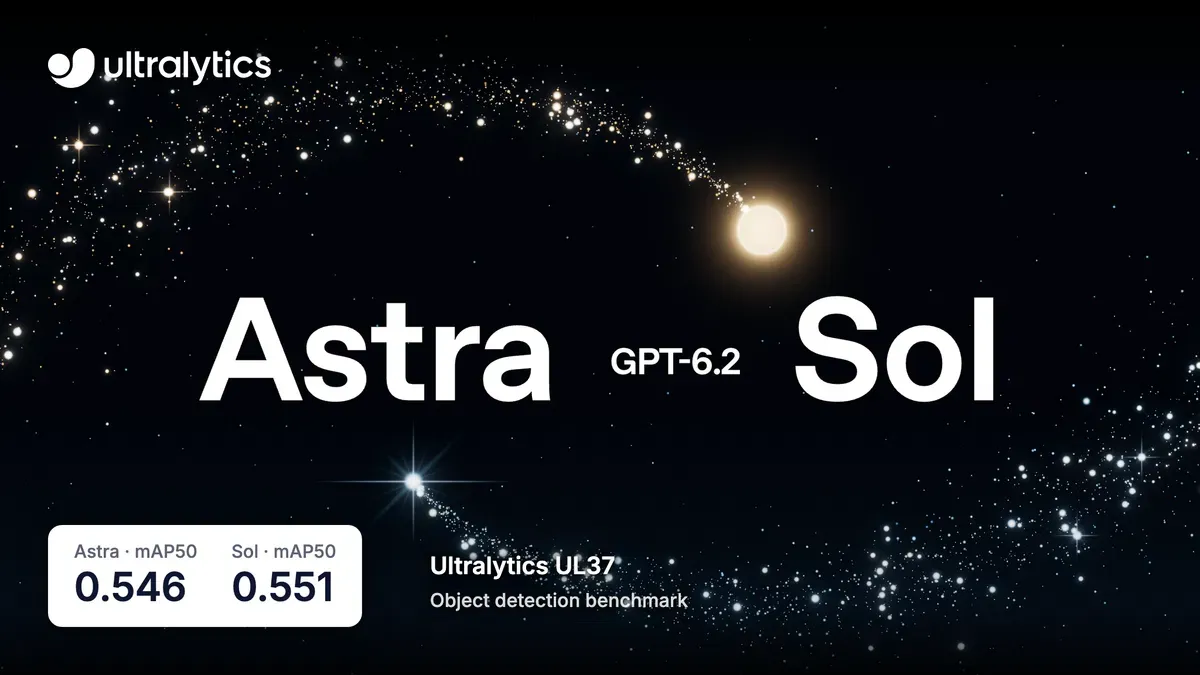
GPT-6.2 Sol delivered nearly the same auto-annotation accuracy as GPT-6.2 Astra in Ultralytics’ 36-dataset benchmark, while costing about one-quarter as much per 1,000 images. Ultralytics says Sol scored 0.551 mAP 50, compared with 0.546 for Astra.
- GPT-6.2 Sol scored 0.551 mAP 50, versus 0.546 for GPT-6.2 Astra.
- Ultralytics calculated costs of $8.10 and $31.88 per 1,000 images.
- Sol led on medical, roads and nature images, while Astra led on aerial and retail data.
- GPT-6.1 Terra remains second on the Ultralytics VLM Leaderboard at 0.560 mAP 50.
- Both GPT-6.2 models are available for auto-annotation in Ultralytics Platform.
Similar benchmark scores, sharply different costs
Ultralytics tested GPT-6.2 Sol and GPT-6.2 Astra through UL37, its 36-dataset detection benchmark, on November 17, 2026, the day OpenAI released the models. The test used 360 images, with 10 images from each dataset, covering areas including medical scans, aerial imagery, retail shelves, sports, documents and circuit boards.
In the resulting leaderboard, Sol ranked fourth of 50 models and Astra ranked fifth. Sol recorded 0.551 mAP 50, while Astra reached 0.546. Their mAP 50-95 scores were also close, at 0.346 and 0.345 respectively. Sol had higher recall, 0.643 versus 0.625, while Astra had slightly higher precision, 0.626 versus 0.623.
The cost difference was much larger. Ultralytics calculated provider costs of $8.10 per 1,000 images for Sol and $31.88 for Astra. Sol also had a lower median processing time, 3.4 seconds per image compared with 4.3 seconds for Astra. Both models had a 0% failed request rate in the run.
Each model performs better on different data
Astra scored higher on 17 of the 36 datasets, while Sol led on 15 and four were ties. Sol’s average advantage was strongly affected by TN5000 thyroid ultrasound, where it scored 0.995 compared with Astra’s 0.769. Without that dataset, the averages were 0.539 for Sol and 0.540 for Astra.
Ultralytics found Sol stronger on medical, roads and nature images. Its medical average was 0.466 against Astra’s 0.411, and it led on wheat heads in GWHD and road markings in CeyMo. Astra performed better in aerial, retail, document and people images. On the SSDD aerial ship dataset, it scored 0.880 versus Sol’s 0.749, while its retail checkout score on RPC was 0.978 compared with 0.823.
The company cautions that individual dataset results should be treated as signals to test rather than final verdicts. It recommends reviewing the models’ recorded boxes on benchmark datasets before labeling a large dataset.
Both models replace older OpenAI options
GPT-6.2 Sol and GPT-6.2 Astra are now the OpenAI auto-annotation choices in Ultralytics Platform, replacing GPT-6.1 Sol and GPT-6 Astra. Compared with those models, both GPT-6.2 versions scored higher, processed images faster and had lower per-image costs in Ultralytics’ comparison.
Sol scored 0.551 mAP 50, compared with 0.514 for GPT-6.1 Sol. Astra scored 0.546, compared with 0.525 for GPT-6 Astra. However, the newer models were weaker on some circuit-board datasets. Both scored 0.000 on DeepPCB bare-board defects, where GPT-6.1 Sol scored 0.393. Ultralytics also describes both GPT-6.2 models as weak on security X-rays.
GPT-6.1 Terra remains OpenAI’s highest-ranked annotator in the comparison, with 0.560 mAP 50 and a provider cost of $4.36 per 1,000 images. Terra had higher precision than Sol but was slower, with a median time of 5.1 seconds per image.
What annotation batches cost in Platform
Ultralytics says a batch of 1,000 images costs $8.10 in OpenAI provider charges with Sol and $31.88 with Astra. Platform adds a $1.00 processing fee per 1,000 images, producing totals of $9.10 and $32.88 respectively. For 10,000 images, the company estimates roughly $91 with Sol and $329 with Astra.
Users supply their own OpenAI API key and pay OpenAI directly, including for test predictions. In Ultralytics Platform, users can select either model in Smart mode, compare predictions on representative images, and then use Batch Annotation for unlabeled images. The platform saves a dataset version before processing, allowing users to roll back and review the boxes before saving them.