Harvey launches fact graph for litigation and investigations teams
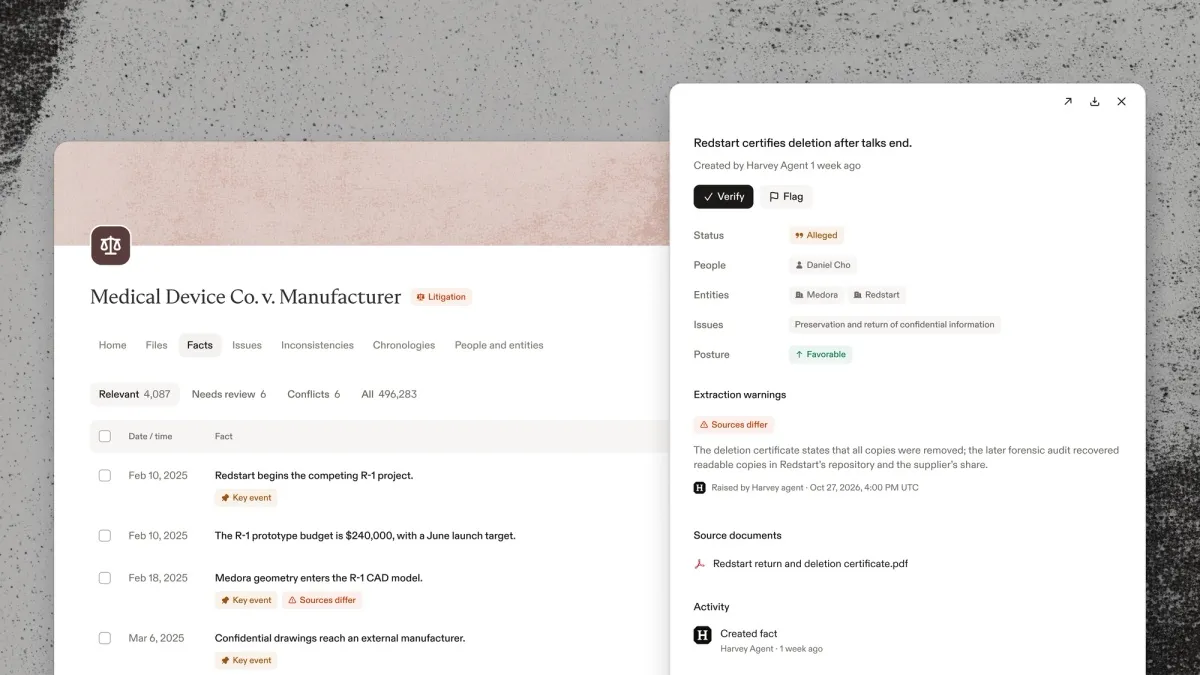
Harvey is introducing a fact graph for disputes, litigation, and investigations teams that connects facts across millions of documents and links them to supporting sources, people, events, and issues. The company says the capability is designed to keep a matter’s factual record current as evidence and teams change.
- Harvey introduced a fact graph for disputes, litigation, and investigations teams.
- It connects facts across millions of documents to sources, people, events, and issues.
- The system can flag inconsistencies as new documents are added.
- Harvey says agents can use the connected record to draft legal work product.
- Early Access opens soon.
Connecting facts across the full record
The fact graph is the newest addition to Harvey Graph, which Harvey describes as a connected map of legal knowledge and matter context used by its agents to find information, cite it, and carry it forward.
According to Harvey, the new capability extracts facts from each document, links them to the exact line of text that supports them, and connects related events even when they appear years apart or seem unrelated. As documents are added, it extracts new information, connects it to the existing record, and flags inconsistencies.
Harvey frames this as a way to help legal teams move from isolated facts to a strategic narrative. For example, an email could show that an executive received a warning about a defect, while meeting notes months later could record approval of a product launch despite that knowledge. Connecting the material can help teams trace actions, assess what the evidence supports, and identify gaps in the record, according to the company.
From an evolving record to work product
Harvey says teams can use the connected facts in chronologies, witness outlines, memos, and reports. The system is intended to keep the context behind that work up to date and flag where earlier work has become outdated, rather than requiring teams to manually update every document.
Harvey’s agents can draw on established facts and connections to generate first drafts for different stages of a matter. The company gives witness interview outlines early in an investigation, deposition memos as evidence builds, and preparation materials for a hearing or trial as examples.
This approach is designed to let each stage build on the team’s accumulated understanding. Harvey says teams will not need to reconstruct the factual context for every new task as a matter develops.
Designed for matters that change over time
Legal matters can continue for years, while team members, responsibilities, and counsel change. Harvey says the fact graph keeps a matter’s facts, supporting sources, review decisions, and work product together, allowing incoming teammates or counsel to trace the audit log and see how earlier information was assessed.
Litigators make up a third of Harvey’s customer base, according to the company. Harvey says those customers often face a cold start problem when rebuilding connections, keeping work product current, and adjusting strategy as matters evolve. The fact graph is being developed with design partners including Slaughter and May.
Richard Jeens, disputes partner and member of Slaughter and May’s Innovation Committee, said the firm’s lawyers are trusted with complex matters where expertise and judgment are critical. “Working with Harvey as a design partner gives us the opportunity to combine the breadth and depth of our experience with their technology expertise to shape tools to deliver effectively what our clients need,” Jeens said.
Early Access opens soon for the new disputes, litigation, and investigations capabilities. The offering gives teams a shared, traceable foundation for building analysis and work product throughout a matter, based on the functionality Harvey describes.