Harvey Graph gives legal AI agents matter context before they start work
Harvey has described Harvey Graph, a set of specialized graphs that organize firm data and legal knowledge and hand that structure to its AI agents at run time. According to the company, early experiments show the approach improved rubric pass rates by up to 30% while cutting task cost by up to ~50%.
- Harvey Graph combines a US Case Law knowledge graph and a per-Space context graph that agents use at run time.
- On Legal Agent Bench, Harvey says the context graph raised rubric pass rate by up to 30% and cut task cost by up to ~50%.
- In one precedent-finding task, the score rose from 0% to 75% of rubric criteria with the graph, according to Harvey.
- Planned additions include precedent flags, cite checking, law evolution tracking and firm-defined legal ontologies.
Why context decides agent quality
Harvey argues that as models get better at legal task execution, the difference between agents comes down to what they know before they begin: the matter, the documents, precedents, client preferences and the way a team works. The company says it benchmarks new models on agentic legal work in Harvey LAB, and that the results show how far model capabilities have advanced.
Legal work is highly relational, according to Harvey. A single credit agreement arrives with drafts, amendments and side letters, and an agent must know which version controls before answering anything about it. A diligence finding can depend on a change-of-control clause, the counterparty it names and the deal timeline. Without a graph, Harvey says, agents try to rebuild those connections from raw files on every task. It describes flat retrieval, which ranks chunks by similarity, as finding passages rather than relationships, so agents spend time and tokens rediscovering the same entities and cross-references.
The hard part, the company says, is that a firm's data does not announce how it connects. Nothing in a document states that it is the fourth draft of a later superseded agreement, or that a case it relies on was overruled last year. Those links have to be inferred, verified against the source and kept current across millions of documents, under existing permissions and ethical walls.
What Harvey Graph contains today
Harvey Graph is the name for the combination of specialized graphs, including ones still in development. Users do not have to activate or manage it, and the graphs follow a Space's governance and security settings automatically. Two components exist today:
- Knowledge graph: a structured map of US Case Law and the relationships and citations connecting it.
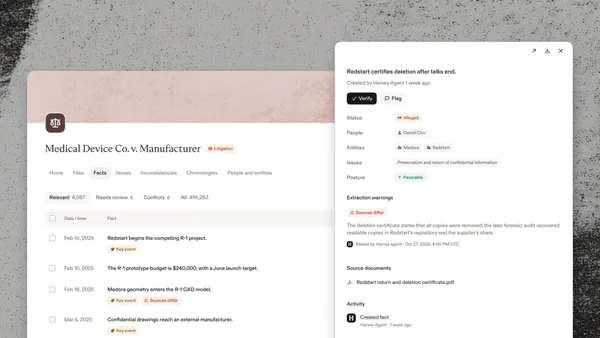
- Context graph: a per-Space map of how matters, data and documents from Vaults and integrations connect.
For US Case Law, Harvey says it built the knowledge graph across the whole corpus: millions of opinions from every federal district and appellate court and all 50 states. It extracted who cites whom, how a case has been treated, and where a line of reasoning holds or breaks. The Harvey agent then retrieves authority, follows citations, checks how those cases were treated and checks its own work against the question. The Spaces graph arrived with the release of Harvey II this month.
Harvey also links the graph to memory. The company says the system learns drafting style, citation habits and house rules, and that memory will next accrue to Spaces so matter context builds over time. Every memory will stay transparent, traceable and under the user's control, according to Harvey.
Early evaluation results
Harvey ran experiments on Legal Agent Bench. For each task, an agent first reviewed every document in a client matter and built a graph of entities and relationships, such as parties, dates, draft versus executed status and which versions belong to the same contract. The company compared agents with and without the context graph using LAB's standard grading setup. The agent with the graph improved rubric pass rate by up to 30% and reduced task cost by up to ~50%.
In one firm-knowledge task, the agent had to find the firm's most recent secured financing and retrieve the executed credit and security agreements as precedents for a new facility. Working from raw files, the agent searched several files in sequence, looked at many matters and chose the wrong precedent, scoring 0% of rubric criteria. With the context graph, it found the relevant matter and its executed agreements immediately, scoring 75%.
Harvey also cited a survey after the general availability of user memory last month: 93% of respondents say memory makes Harvey more useful and 50% say they now repeat less context. The company calls these early results and says it will publish more as experiments move into production.
What comes next for users
Harvey says the investment is far from complete. Over the coming months it plans to launch precedent flags and cite checking for US case law, law evolution tracking across authorities, a new legal research surface built for following connections, and the ability for firms to define their own legal ontology on top of their documents.
For users, the company says the visible change will be an assistant that asks less up front while delivering accurate work that can be verified with citations. Harvey states its view that the next gains in legal AI will come from what an agent knows before it is asked, not only from a smarter model.
Harvey: Improving Agent Accuracy With Harvey Graph