Harvey launches Motion to Dismiss workflow built with LexisNexis
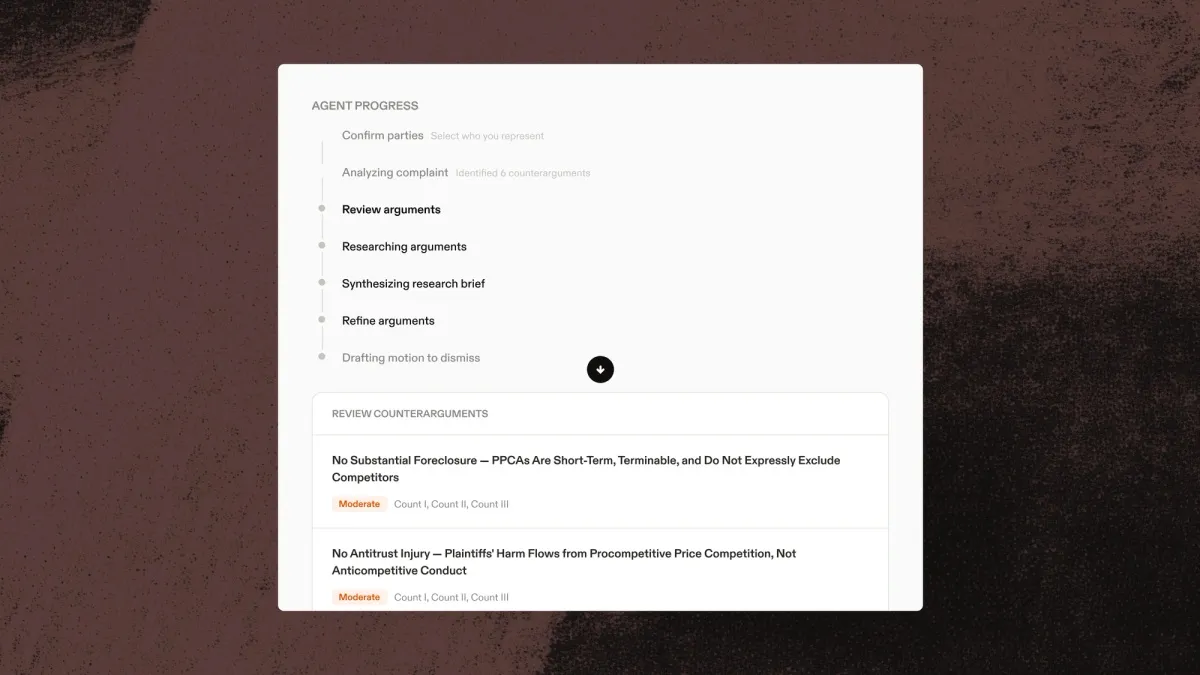
Harvey has introduced a drafting agent that prepares an entire motion to dismiss from an uploaded complaint, grounded in LexisNexis primary law and Shepard's Citations. It is the first workflow co-developed with LexisNexis under the alliance the two companies announced in June 2025.
- Harvey introduced a Motion to Dismiss workflow, the first co-developed with LexisNexis.
- Agents plan, research and draft, with lawyer approval of the strategy before deep research begins.
- Research draws on LexisNexis case law and statutes, with cases validated through Shepard's Citations.
- Available to Harvey customers with Ask LexisNexis or Lexis+ with Protégé.
- A Motion for Summary Judgment workflow is the next one planned.
A multi-agent workflow with lawyer checkpoints
According to Harvey, drafting a motion to dismiss is among the most time-intensive tasks in early-stage litigation. The company says an associate typically has to read the complaint, identify viable grounds for dismissal, research each ground in the right jurisdiction, check for adverse authority and write 20 to 30 pages of argument. Harvey puts the usual effort at 40 to 50+ hours.
The new workflow is agentic. A series of specialized agents plan, research and draft in a review-and-approve loop, with human checkpoints where a lawyer's judgment matters most. Harvey describes four stages:
- Harvey reviews the complaint and proposes a set of ranked arguments for dismissal.
- The lawyer approves or adjusts the plan.
- Multiple agents conduct in-depth research on each approved argument.
- A final agent drafts the motion.
Planning, research and drafting
The planning agent identifies the forum and the governing law, then runs an initial research pass with LexisNexis US primary law to surface up to eight candidate grounds for dismissal. It checks each ground against the elements of the pleaded claims, such as a missing element of a cause of action, a jurisdictional defect or a timeliness issue, and factors in choice-of-law issues. Each ground gets a strength rating with a short explanation, and the lawyer can approve the plan as is or add or drop arguments before deep research begins.
Parallel research agents then run LexisNexis searches for each approved ground, using jurisdiction-filtered boolean queries tuned to the motion-to-dismiss stage. Where state authority is thin, they add federal decisions applying that state's law. Each argument comes back as a memo with the applicable legal standard and three to five of the strongest cases. Every case includes a full Bluebook citation, a direct link to the opinion on Lexis+ with Protégé, its key holding and how it applies to the allegations. The memo also covers weaknesses the plaintiff is likely to raise, plus key adverse authority and how to distinguish it. Cases are validated through Shepard's Citations, with the Shepard's Signal reported alongside them.
The drafting agent then assembles the motion for both federal and state courts. For a state-court complaint it detects the caption and confirms the correct procedural vehicle, such as a demurrer in California, a CPLR 3211 motion in New York or preliminary objections in Pennsylvania. For a federal complaint it drafts to the Rule 12(b)(6) standard under Twombly and Iqbal and addresses other threshold 12(b) grounds available on the face of the pleading.
According to Harvey, every factual assertion is cited back to the complaint and every legal proposition to case law, so each statement can be checked. The finished motion includes a Table of Contents, a Table of Authorities, the forum-specific pleading standard and motion-appropriate formatting.
Availability and what comes next
Harvey says the workflow produces research and a first draft in a matter of hours rather than days of associate time, with lawyer review built into each stage. The saved time can go toward refining strategy, addressing edge cases or moving the case forward faster.
The workflow is available to all Harvey customers with access to Ask LexisNexis, as well as Harvey customers who also use Lexis+ with Protégé, whether or not they use the Ask LexisNexis integration. Ask LexisNexis, introduced after the June 2025 alliance announcement, brings citation-backed answers grounded in LexisNexis primary law content into Harvey.
This is the first of two co-developed workflows. A Motion for Summary Judgment workflow is next, according to Harvey.