Haut.AI Launches SkinFM and SkinBench, Says Leading AI Models Misread Skin
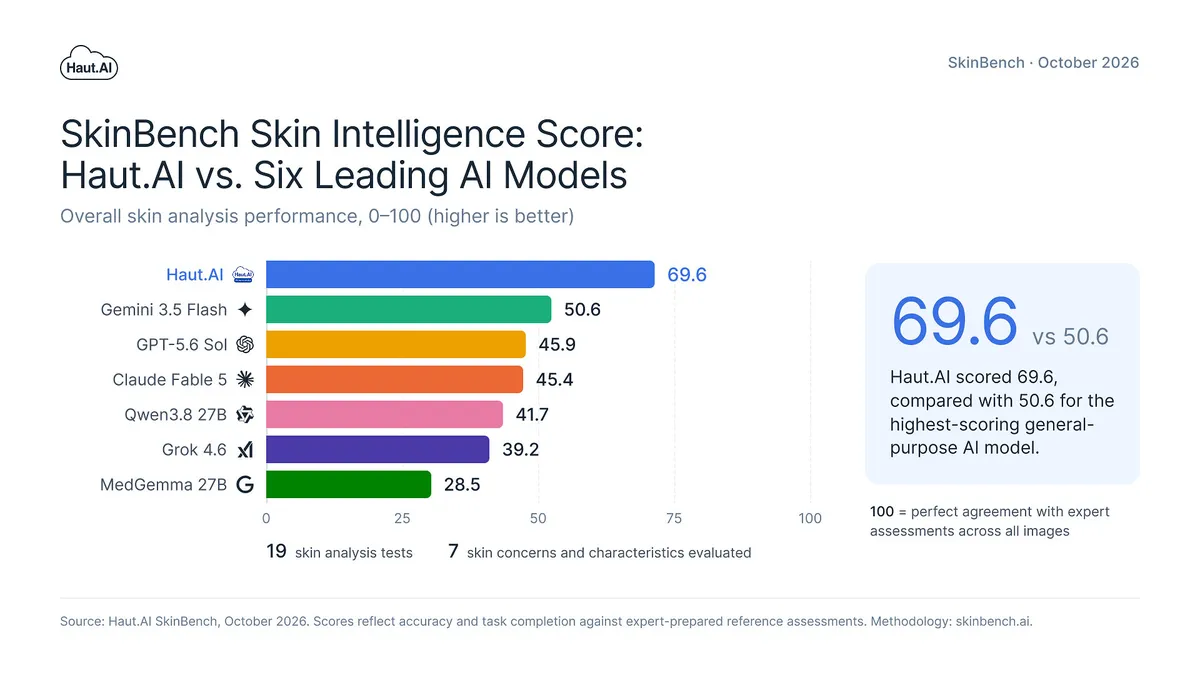
Haut.AI has unveiled SkinFM, a skin analysis foundation model trained on more than 4 million real skin images, alongside a public benchmark called SkinBench. According to the company, the benchmark shows that six leading AI models often detect skin concerns that are not present or miss ones that are.
- Haut.AI unveiled SkinFM, a foundation model trained on more than 4 million real skin images.
- SkinBench is a public benchmark of 19 tests across seven skin concerns, comparing six leading AI models.
- Haut.AI scored 69.6 out of 100, versus 50.6 for Gemini 3.5 Flash, the best general-purpose model.
- According to Haut.AI, the six models falsely detected eye puffiness in about 95% to 100% of images where it was absent, versus about 18% for its own analysis.
- Gemini 3.5 Flash beat Haut.AI on crow's feet grading and skin tone assessment.
What SkinFM is and what it does
Haut.AI, a SaaS company focused on AI-powered skin intelligence and personalized skincare, describes SkinFM as an image-based foundation model. Unlike traditional systems that need separate models for different skin analysis tasks, SkinFM uses a single foundation to analyze multiple skin characteristics, according to the company.
Haut.AI says this lets it develop new skin measurements faster and build customized grading systems for individual brands. Its technology can assess more than 230 skin measurements and 48 biomarkers, including wrinkles, redness, pigmentation and other visible characteristics. For beauty brands, the company says this means tailoring assessments to their products and customers, introducing new measurements faster, making more informed personalized recommendations, tracking visible improvements over time and supporting research and product development.
What SkinBench measures
SkinBench was developed by Haut.AI's Data Science team. It compares the company's specialized technology with Gemini 3.5 Flash, GPT-5.6 Sol, Claude Fable 5, Grok 4.6, Qwen 3.8 27B and MedGemma 27B. It covers 19 tests across seven skin concerns: wrinkles, sun spots, redness, skin tone, skin type, dark circles and eye puffiness. Eleven tests identify and grade visible features, and eight measure how accurately models locate them. Results are compared with reference assessments prepared by experts.
On the SkinBench Skin Intelligence Score, a 0 to 100 measure where 100 means perfect agreement with expert assessments on every image, Haut.AI scored 69.6. Gemini 3.5 Flash, the highest-scoring general-purpose model, scored 50.6.
Key findings: false positives and missed detections
Haut.AI says all six models incorrectly detected eye puffiness in approximately 95% to 100% of images where it was absent. Its own SkinFM-powered analysis had an approximately 18% false detection rate. The lowest-scoring model missed 85% of deep forehead wrinkles, while Haut.AI's model found 82% of them, compared with 15% to 60% for the other models.
- Frown lines: Haut.AI scored 0.82 for agreement with expert assessments of severity, against 0.73 for GPT-5.6 Sol and 0.86 for human graders, based on 350 computer-generated faces.
- Locating wrinkles: when tracing frown lines on 350 synthetic faces, Haut.AI scored 47.8 out of 100, versus 20.2 for GPT-5.6 Sol, the strongest competitor. In one example, Claude Fable 5 marked the nose and mouth instead.
- Skin type: Haut.AI scored 77.8 out of 100, compared with 57.7 for the strongest competing model.
- Skin tones: Haut.AI scored 50.9, against 30.3 for the next-best general-purpose model. The score focuses on each model's weakest-performing eligible skin-tone group.
Haut.AI did not win every test. Gemini 3.5 Flash did better at grading crow's feet (71.7 versus 61.8) and assessing skin tone (90.4 versus 87.6). The company says this shows the importance of evaluating AI tools on the specific tasks they are meant to perform rather than relying on a single overall score.
Why it matters for skincare
Haut.AI points to growing consumer use of AI for beauty advice. It cites NielsenIQ, which found that 49% of consumers have taken beauty product recommendations from GenAI, and Accenture, which found 75% of beauty consumers are open to an AI-powered shopping experience. A Haut.AI survey of 1,238 U.S. women found 62% are interested in or already use AI for skincare or bodycare advice.
"AI can recognize a face, but that doesn't mean it can accurately assess the skin," said Anastasia Georgievskaya, CEO and co-founder of Haut.AI. The company argues that inaccurate assessments could lead to unnecessary product recommendations, wasted spending and less trust in brands' personalized services. It also cites a Gartner prediction from April 2025 that by 2027 businesses would use smaller, specialized AI models at least three times as often as general-purpose large language models.
Because SkinBench is both published by Haut.AI and compares its own product, the results are the company's claims. The benchmark is public, however, so others can examine how the models perform.