Hebbia launches knowledge graphs to connect financial institutions’ data
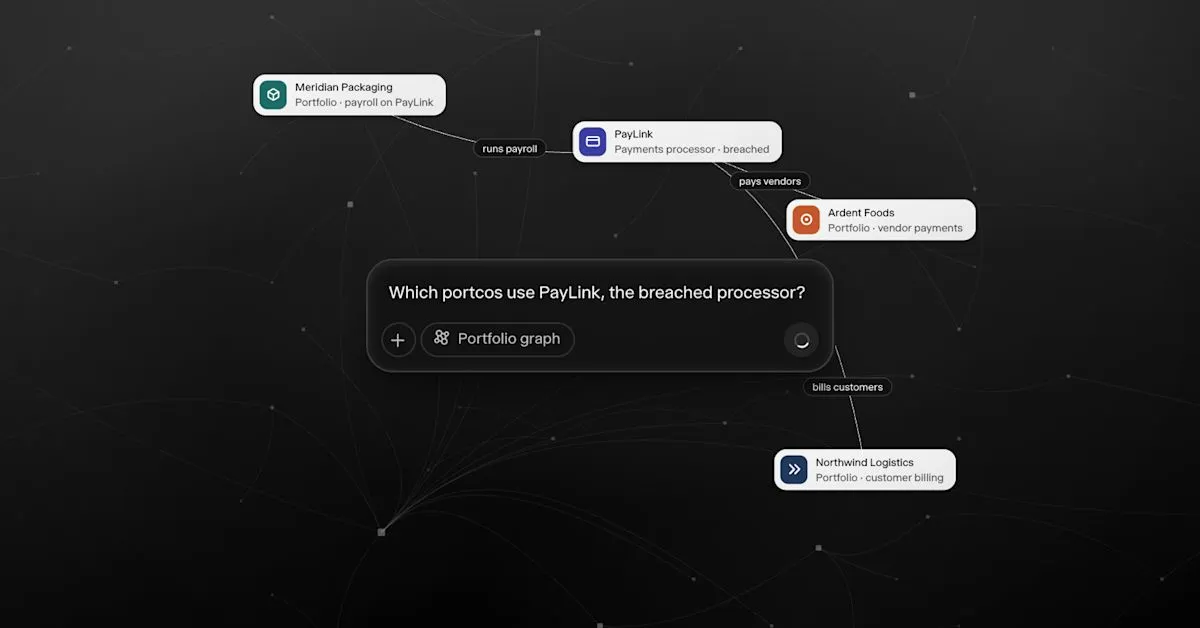
Hebbia is launching knowledge graphs for financial institutions, creating firm-specific records that connect structured and unstructured data across agreements, holdings and other files. The company says the graphs help AI agents trace relationships across multiple degrees and produce more accurate, lower-cost answers.
- Hebbia is launching knowledge graphs for financial institutions.
- The graphs connect structured and unstructured data with source links.
- Hebbia says early evaluations showed answers costing 80% less.
- The system supports entity matching, version tracking and access controls.
- Hebbia says it connects to SharePoint, Box, Snowflake and SQL tables.
A shared record for disconnected data
Financial institutions often store the information needed to answer a single question across documents and systems that do not reference one another. Questions about amended borrower covenants, shared suppliers or loans affected by another default may require connections between agreements, holdings data and other files.
According to Hebbia, existing AI approaches either search for passages that resemble a question or read through organized folders. Both approaches can require the system to reconstruct relationships from scratch for each query, while offering no way to confirm that the answer is complete.
Hebbia’s knowledge graphs are designed to give each firm a system of record for how its data relates. The company says every connection is stored with its source, allowing teams and agents to reason from the same facts. In early evaluations, Hebbia says answers using the graph cost 80% less and were more accurate than answers from a leading frontier model working without one.
Five requirements for financial data
Hebbia says a graph for finance must handle five areas. It must process large archives, including data rooms, purchase agreements and portfolio reports that can reach millions of pages, then preserve what it finds for later questions.
It must also interpret deal terms and their dependencies. Credit agreements can contain economic terms such as pricing and non-economic terms such as EBITDA add-backs, with meanings affected by definitions and later amendments. The graph records these terms as facts that can be compared across deals.
Other requirements include matching different names to the correct legal entity, preserving changing facts with their effective dates, and enforcing access restrictions across every entity and relationship. Hebbia says the system should identify when permissions limit an answer rather than fill the gap with a guess.
The company says its technology connects to data where it already resides, including SharePoint, Box, Snowflake, SQL tables and other systems, with no migration required. Hebbia also says its in-house experts help firms tailor the relationships the graph maps, drawing on experience with financial institutions.
Tracing exposure beyond direct holdings
Hebbia uses the failure of Silicon Valley Bank as an example of why indirect relationships matter. On March 8, 2023, SVB said it had sold $21 billion of securities at a $1.8 billion loss. Depositors tried to withdraw $42 billion the next day, and regulators shut the bank on March 10.
The company describes how a fund holding USDC could have been exposed through Circle, the stablecoin’s issuer, which kept $3.3 billion of its reserves at SVB. USDC traded at 87 cents, even though a fund’s holdings might never mention SVB directly. A graph could link SVB to Circle and then to funds holding USDC, provided those relationships appear in the firm’s source material.
Hebbia says the same connected data could help firms identify opportunities as well as risk. USDC was back near a dollar within days of regulators guaranteeing SVB’s deposits on March 12, according to the company.
What the launch means for financial teams
The launch is aimed at banks, law firms, investors and advisory teams that need to connect information across deals and counterparties. Hebbia says the graph can support use cases including an entity master for credit teams, a deal graph for banking teams and a contract registry for legal teams.
The company’s central claim is that AI models may be widely available, while each firm’s deal history, counterparties and contract context are specific to it. By turning those relationships into a traceable shared record, Hebbia says firms can identify exposure and opportunities without relying on one person to locate connections across the organization.
Hebbia: Building a Knowledge Graph for Financial Institutions