Huawei's Bob Chen Outlines Three 'R' Pillars for Networks in the AI Era
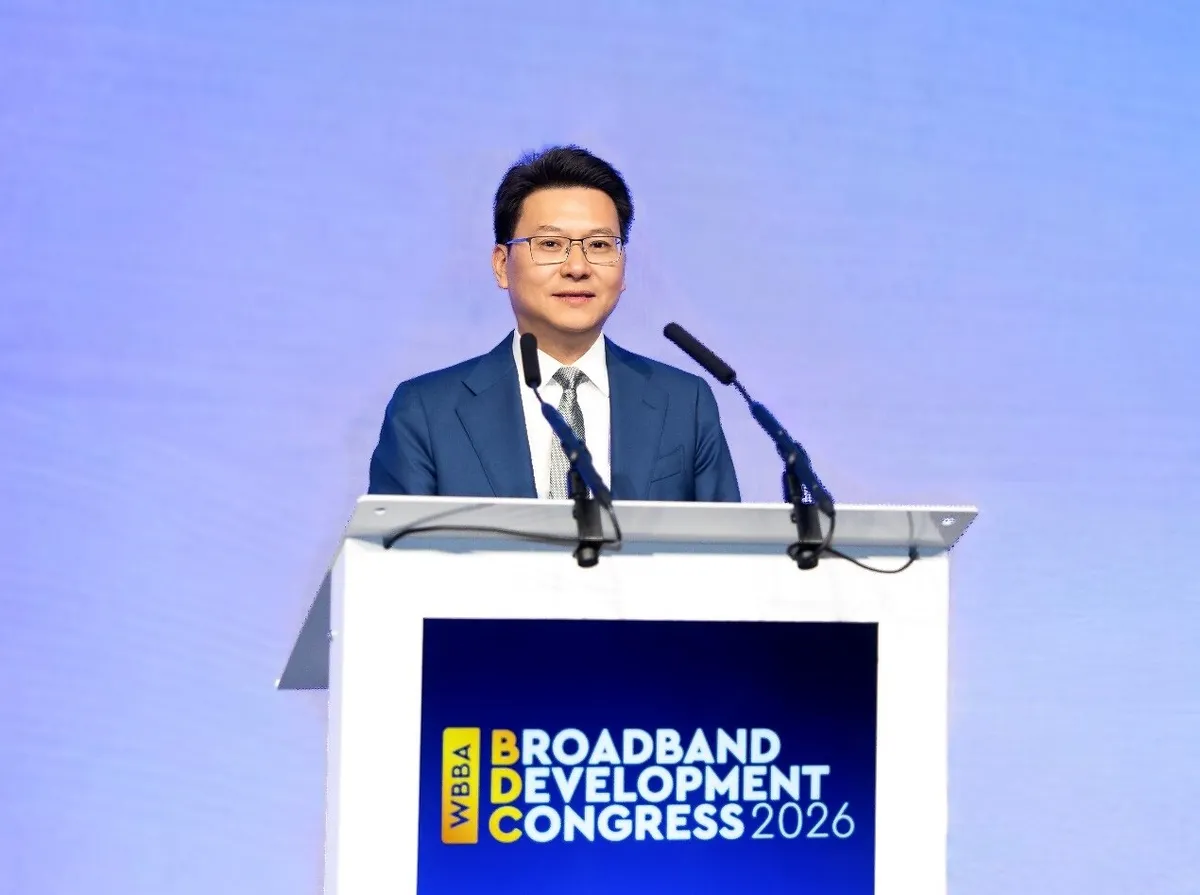
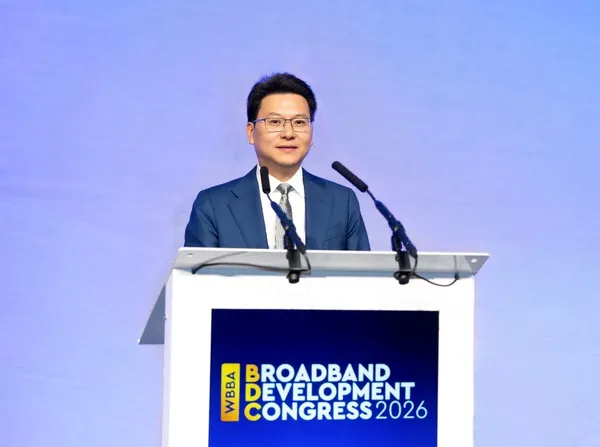
Huawei's Bob Chen has called on the telecom industry to rethink how networks are built for the AI era, proposing three pillars: rebuild the network architecture, reconfigure the business model and redefine operations and maintenance (O&M). He spoke in a keynote at the Broadband Development Congress in Vienna, held by the World Broadband Association during Network X 2026.
- Huawei's Bob Chen presented three 'R' pillars at the WBBA Broadband Development Congress during Network X 2026 in Vienna.
- Chen said AI models have close to 10 trillion parameters and token consumption rose almost 50-fold in a year.
- He called for networks centered on AI data centers, with 1, 5 and 20 ms latency tiers via one-hop mesh.
- Operators are urged to sell 'Bandwidth + Latency + Reliability' and integrated network and computing services.
- Huawei cites about 20% faster Wi-Fi and over 20% lower device energy use from AI-based O&M.
A keynote on reshaping network value
Bob Chen, president of Huawei's optical business product line, gave the keynote titled "Reconfigurar el valor de la red para un nuevo crecimiento en la era de la IA" (reconfiguring network value for new growth in the AI era). The World Broadband Association (WBBA) organised the Broadband Development Congress (BDC) as part of Network X 2026.
Chen argued that over the past three decades every boom in services, from voice and the internet to video, has relied on network support. AI is now developing quickly, he said: large AI models have close to 10 trillion parameters, and token consumption has grown almost 50-fold in the past year. In his view, the objects, frequency and quality of network connections have changed sharply, and the whole sector must rethink how to reconfigure network value.
The core of that shift, according to Chen, is a change in the philosophy of network construction. Planning and deployment should focus on the demands of AI services and the layout of AI data centers (AIDC), while AI technology is used to strengthen O&M. He summarised this in three "R" pillars.
Rebuilding architecture around AI data centers
Networks have traditionally been organised around administrative regions, split into national backbones, provincial backbones and metropolitan networks. Chen said the number of AIDCs has grown almost tenfold, and traffic is no longer determined by population but by computing power.
He cited Zhongwei in China as an example. Its traffic once made up about 0.1% of the national total. It is now one of China's eight national computing hubs, and its intelligent computing traffic accounts for more than 10% of the country's total bandwidth, making it a central node in the AIDC interconnection network.
Chen said architecture should therefore move from an administrative-region focus to an AIDC focus, with hierarchical layers built around Core DCs, Regional DCs and Edge DCs. One-hop mesh connections between data centers can establish deterministic latency tiers of 1, 5 and 20 ms and speed up time to market.
New business models for enterprise and home
For enterprise customers, Chen pointed to an AI-based industrial design firm in China that uses AI rendering to shorten production cycles and needs latency below 2 milliseconds. Operators can evolve their private lines from bandwidth alone to "Bandwidth + Latency + Reliability". Technologies such as OXC, ASON and quantum encryption can guarantee deterministic latency, high reliability and top-level security, which raises the value of private lines. By integrating computing platforms, operators could also move to a "Network + Computing + Model/Application" offer with integrated network and computing services.
In residential broadband, Chen described a strategy of "One fiber, one network, one home". One network means high-quality Wi-Fi throughout the home using FTTR or Wi-Fi mesh. One home means a wide range of smart applications driven by AI home terminals and AI agents, which also let users control their home networks in real time with simple voice commands.
AI-driven operations and maintenance
The third pillar moves O&M from traditional semi-automated operations to intelligence across the full lifecycle, covering planning, construction, maintenance, optimisation and operation, at the level of network elements, the whole network and services.
Chen gave three examples:
- Wi-Fi optimisation: most home network complaints stem from Wi-Fi. AI optimisation identifies sources and types of interference and adjusts transmit power and other parameters in real time, raising Wi-Fi speed by about 20% in interference-heavy environments.
- Energy saving: intelligent traffic analysis allows dynamic power adjustment on OLT chassis and line cards, cutting total device energy consumption by more than 20%.
- Self-healing: home broadband faults are handled at three levels. AI O&M agents fix air-interface problems such as roaming failures automatically, configuration issues are handled remotely at the NOC with AI agents, and physical fiber problems are pinpointed with O&M Copilot during site visits.
What it means for operators
The talk is a vendor's view of where operator investment should go, and the figures come from Huawei's presentation. Its message is that network planning should follow AI computing demand rather than population, and that operators can sell latency, reliability and integrated computing alongside bandwidth. At home, the pitch is a shift from basic connectivity to whole-home networks and smart-home experiences.
"Ante la era de la IA, debemos cambiar nuestra filosofía para reconstruir la arquitectura de red, reformar el modelo de negocio y redefinir la O&M de la red", Chen concluded. He added that through the three "R" pillars the industry can reshape the value of the UBB network and move toward new growth in the AI era.
PR Newswire: Reconfigurar el valor de la red para un nuevo crecimiento en la era de la IA