Huawei's Bob Chen: Networks Must Be Rebuilt Around AI Data Centers
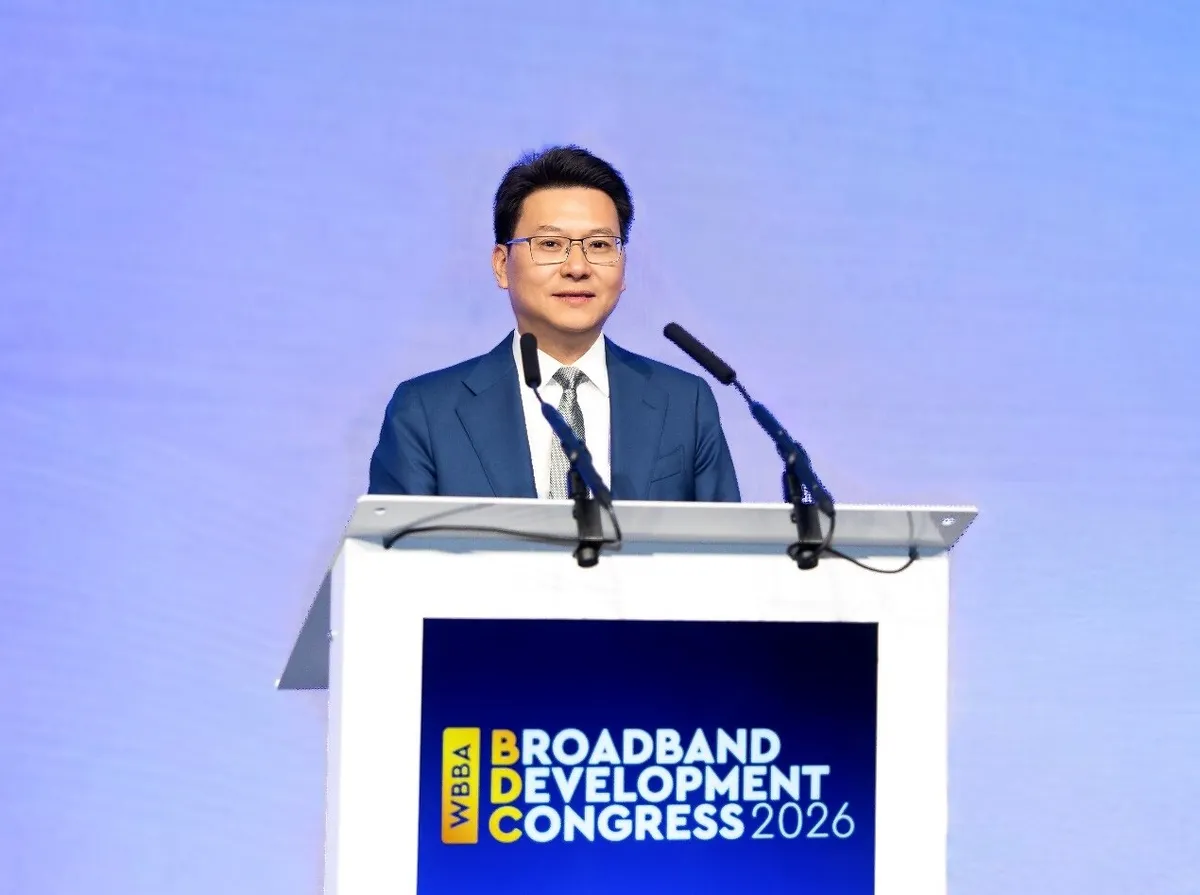
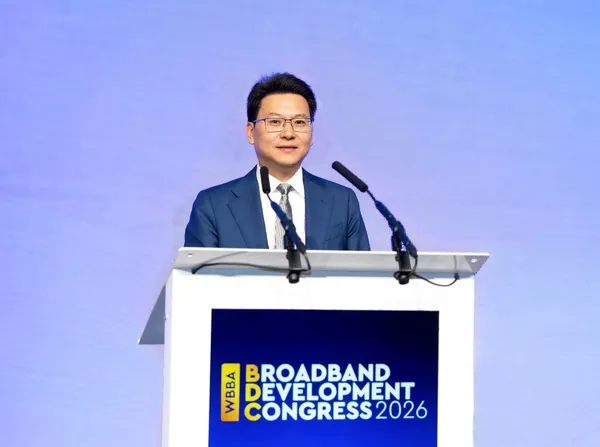
Huawei's Bob Chen says the network industry must rethink how it builds and runs networks for the AI era, centered on three "Rs": rebuilding network architecture, reshaping business models and redefining operations and maintenance. Chen, President of Huawei's Optical Business Product Line, made the case in a keynote at the Broadband Development Congress in Vienna.
- Huawei's Bob Chen gave the opening keynote at the WBBA Broadband Development Congress in Vienna, part of Network X 2026.
- He proposed three Rs: rebuild network architecture, reshape business models, redefine network O&M.
- Chen said large AI models have about 10 trillion parameters and token consumption rose about 50 times in a year.
- He said AI-assisted Wi-Fi tuning raises speeds by about 20% in interference-heavy settings, and dynamic power adjustment cuts device energy use by more than 20%.
- Architecture should become AIDC-centric, with Core, Regional and Edge Data Centers linked by 1-5-20 ms latency loops.
Keynote at Network X 2026 in Vienna
The World Broadband Association (WBBA) hosted the Broadband Development Congress (BDC) in Vienna as part of the Network X 2026 event. Chen delivered the opening speech, titled "Reshaping Network Value for New Growth in the AI Era", according to a PR Newswire release dated 16 October 2026.
Chen argued that over the past thirty years, every service boom, from voice to the internet to video, has relied on network support. He said large AI models now have around 10 trillion parameters and that token consumption has grown about 50 times in the last year. In his view, the scope, frequency and quality of network connections have changed significantly, and the whole industry needs to rethink how network value is created.
The central point, he said, is a change in network construction philosophy: planning and building should follow AI service demand and the layout of AI data centers (AIDCs), while AI technology should be adopted to improve operations and maintenance (O&M).
Rebuilding architecture around AIDCs
Networks were previously organized by administrative region, split into national backbone, provincial backbone and metro networks. Chen said the number of AIDCs has grown nearly tenfold with the spread of AI, and traffic now depends on computing power rather than population.
As an example he cited Zhongwei in China. The city once accounted for only about 0.1% of the country's total traffic. It has since become one of China's eight national computing hubs, and its intelligent computing traffic makes up more than 10% of the country's total bandwidth, according to Chen. He said similar cases exist worldwide.
His conclusion is that architecture should move from administrative-region-centric to AIDC-centric, with networks layered around Core, Regional and Edge Data Centers. Direct single-hop links between data centers would provide deterministic latency loops of 1-5-20 ms and fast time to market.
New business models for enterprise and home
For enterprise customers, Chen said operators can move from selling bandwidth alone to selling "bandwidth + latency + reliability". He gave the example of an AI industrial design firm in China that uses AI-based visualization to shorten production cycles and needs real-time latency below 2 milliseconds. Networks supported by OXC, ASON and quantum encryption could offer deterministic latency, high reliability and top-level security, raising the value of private lines. Using computing platforms, operators could also shift from selling networks to selling "Network + Computing + Model/Application" as integrated services.
For home broadband, Chen described a "One Fiber, One Network, One Home" approach. One Network means high-quality whole-home Wi-Fi through FTTR or Wi-Fi Mesh. One Home means rich smart applications powered by in-home AI terminals and AI agents. Home AI agents are also changing how users interact with their broadband, allowing them to control home networks with simple voice commands.
Redefining operations and maintenance
Chen called for end-to-end intelligence across planning, construction, maintenance, optimization and operations, delivered through network element, network and service intelligence. He gave three examples:
- Wi-Fi tuning: Most home network complaints stem from Wi-Fi problems. AI-assisted tuning detects sources and types of interference and adjusts transmit power and other parameters in real time, raising Wi-Fi speeds by about 20% in interference-heavy environments.
- Energy saving: Network equipment used to run at full capacity regardless of traffic. Intelligent traffic analysis now enables dynamic power adjustment for OLT chassis and line cards, cutting total device energy consumption by more than 20%.
- Fault self-healing: Home broadband troubleshooting is split into three stages. Air interface issues such as roaming faults are fixed automatically by O&M AI agents. Configuration problems are handled remotely at the Network Operations Center (NOC) with AI agent help. For on-site visits, an O&M Copilot helps pinpoint physical fiber connection faults.
What it means for operators
The talk reflects Huawei's view that operators' value is shifting from connectivity volume toward guaranteed quality, integrated computing services and automated operations. Chen closed by saying the industry must shift its philosophy toward the three Rs, and that through them it can "reshape the value of the UBB network" and move toward new growth together in the AI era. The figures cited come from the speech as reported by the company, and the release does not provide independent verification.
PR Newswire: Yapay Zeka Çağında Yeni Büyüme İçin Ağ Değerini Yeniden Şekillendirme