Husky and Jackal Robots Feature in Six Research Papers at IROS 2026
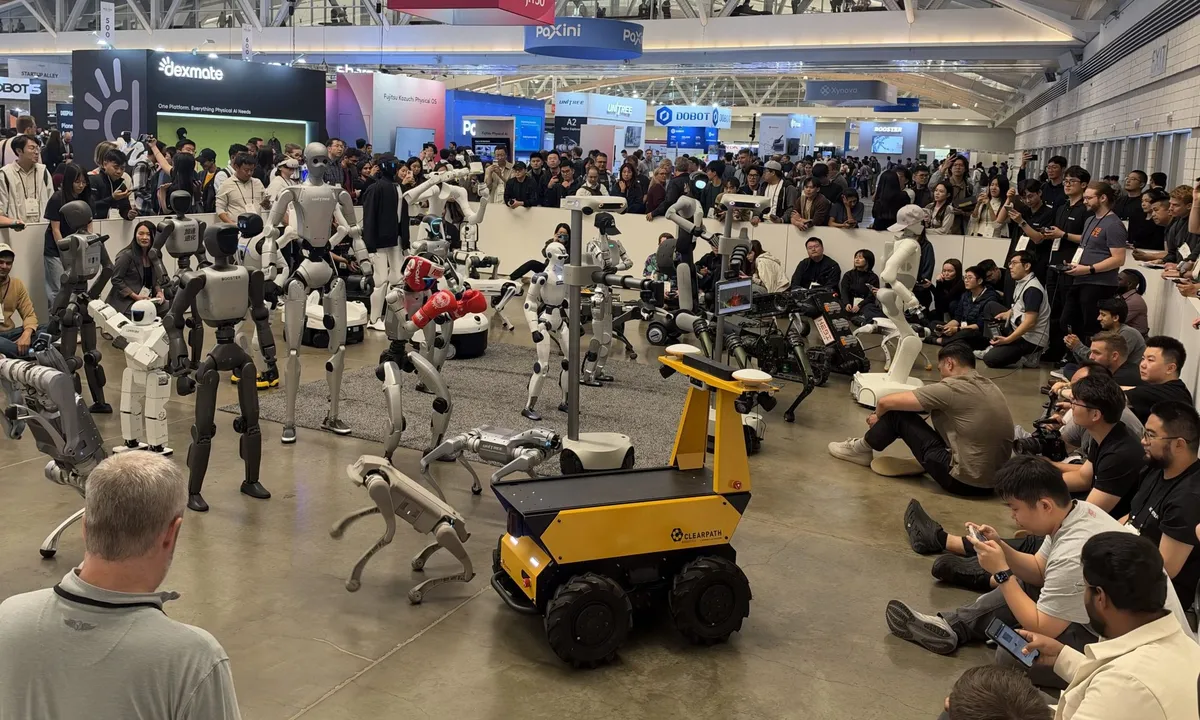
Clearpath has published a round-up of research presented at IROS 2026 that used its Husky and Jackal robots, covering topics from orchard disease detection to navigation in underground coal mines. The company says the work shows the platforms' flexibility for developing, testing and validating robotics research.
- Clearpath highlighted six IROS 2026 papers that used its Husky and Jackal robots.
- SPINE-HT, an LLM-based framework for mixed robot teams, reached an 87.5% success rate in real-world missions, according to its authors.
- A Carnegie Mellon and Virginia Tech team used a Husky to detect fire blight in apple trees, with a best lab F1 of 0.9058.
- FIRE-LIVWO fuses radar, LiDAR, vision and wheel odometry for coal mines, with an average localization error of 5.677m and open-source code.
- A University of Liverpool safe RL method reported a 98.3% success rate and was tested on a physical Jackal.
Generative AI for mixed robot teams
One paper, from Texas A&M University, the U.S. Army Research Laboratory and the GRASP Laboratory at the University of Pennsylvania, presents SPINE-HT. The framework grounds the reasoning of large language models in the changing context of a heterogeneous robot team. According to the abstract, an LLM first infers the necessary subtasks from natural language mission specifications and team capabilities. The subtasks are then checked for feasibility and assigned to robots based on capabilities such as traversability or perception. Finally, semantic maps and task outcomes collected by the robots are used to update subtasks online.
The authors report that in simulation the framework achieves nearly twice the success rate of earlier LLM-enabled heterogeneous teaming approaches. In real-world tests with a Clearpath Jackal, a Clearpath Husky, a Boston Dynamics Spot and a high-altitude UAV, the method reached an 87.5% success rate in missions that required reasoning about robot capabilities and refining subtasks with online feedback.
Agriculture and underground mining
A team from Carnegie Mellon University's Robotics Institute and the Department of Plant Pathology at Virginia Polytechnic Institute and State University used a Husky for an autonomous active perception system aimed at fire blight in dormant apple trees. The authors say manual scouting is labor-intensive and financially impractical at the scale of modern orchards, so outbreaks are often detected late and tracked only at orchard-block level. Their system combines flash-illuminated stereo RGB sensing, real-time depth estimation, instance-level segmentation and confidence-aware semantic 3D mapping.
The paper compares three viewpoint planning strategies. In simulation, the semantic planner achieved the highest F1 score (0.6106) after 30 viewpoints, while the volumetric planner achieved the highest ROI coverage (85.82%). In the lab, the semantic planner reached the highest final F1 (0.9058). The authors describe the experiments, run on a fabricated lab tree and five simulated symptomatic trees, as a precursor to a field evaluation.
Researchers at the China University of Mining and Technology, also using a Husky, tackled SLAM in large-scale underground coal mines. Smoke and dust degrade visual and LiDAR data, and long, self-similar corridors cause odometry drift. Their FIRE-LIVWO framework fuses 4D mmWave radar, LiDAR and visual features, and adds wheel odometry in degenerate corridors. A strategy that detects degeneration and adjusts modality weights online is described as the central contribution. In real-world mine experiments, the authors report an average localization error of 5.677m and say they have open sourced their code on Github.
Safe navigation and what the round-up shows
A University of Liverpool team used a Jackal to validate a safety-focused reinforcement learning approach. The framework trains policies with Conditional Value-at-Risk (CVaR) constraints on a TD3 backbone, then checks safety margins after training through neural network reachability verification. Across ten navigation scenarios and six baselines, the authors report a 98.3% success rate and the highest safety verification rate among compared methods. They also say average cost rankings and reachability-based safety rankings can diverge, meaning reachability verification captures risks that empirical cost metrics miss. The method was validated on a physical Clearpath Jackal, demonstrating successful sim-to-real transfer.
The round-up also lists a sixth paper, Stereo4DWalker, on learning 4D-aware embodied urban navigation from internet stereo videos, but the source text provided here cuts off before its details.
For the research community, the selection points to Husky and Jackal being used across very different settings, from orchards and mines to multi-robot teams and safety verification. Clearpath describes them as trusted platforms for this kind of work.
Clearpath/OTTO: IROS Research Round-Up: Husky and Jackal in Action