Individual Centricity gets US patent allowance for anti-deepfake identity tech
The U.S. Patent and Trademark Office has issued a Notice of Allowance for Individual Centricity Corporation's (IC-Corp) patent application for a device-based method of authenticating user identity. According to the company, examination is complete and the claims have been found patentable.
- The USPTO issued a Notice of Allowance for IC-Corp's U.S. Patent Application No. 18/328,438 on device-based identity authentication.
- IC-Corp says verification happens on the user's own device, with no central database of personal data to steal.
- The company filed twelve additional provisional patent applications in October 2026.
- Pilot testing of the product is planned to begin in Q1 2027.
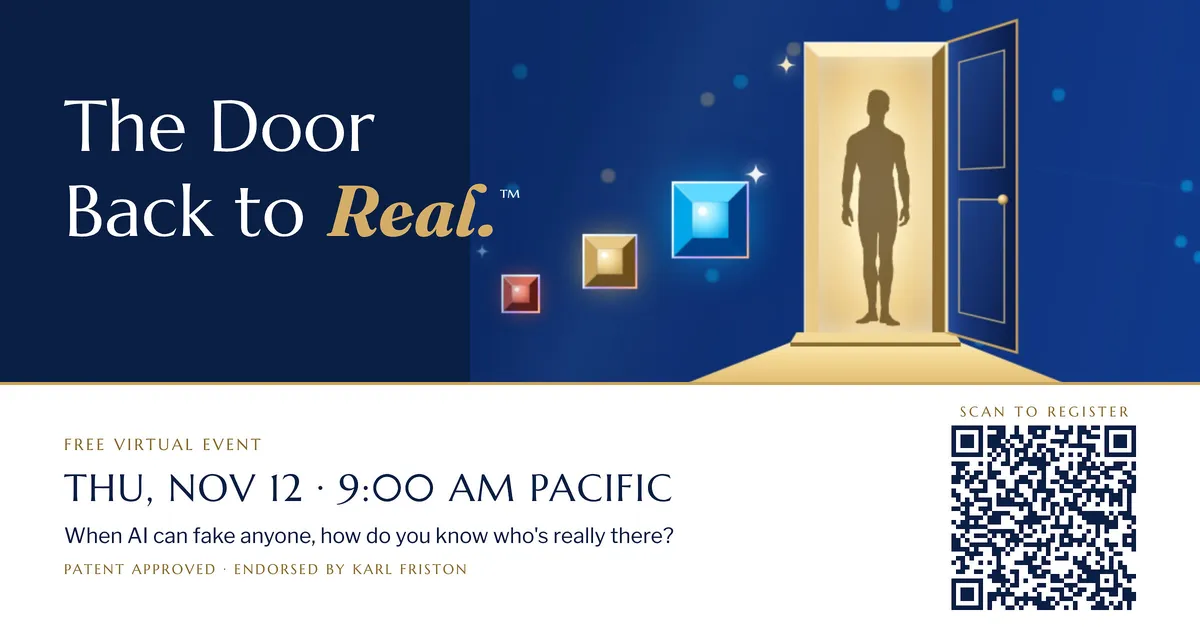
- A free webinar, "The Door Back to Real™," takes place on November 12, 2026, at 9:00 a.m. Pacific.
What the patent covers
The allowance applies to U.S. Patent Application No. 18/328,438, titled Individually Centric Device, System and Method for Authenticating Device User Identity. IC-Corp says its approach works on the individual's own device rather than in central databases, and argues this addresses the weakness that deepfakes now exploit.
The company describes a shift in the question that security systems ask. Today's checks ask whether a face or voice matches. IC-Corp asks whether the entity present is the one expected, and whether that remains true a minute later. In the company's words, the question is not "does it match?" but "is it true?"
The release lists several features of the Individually Centric Device System:
- It learns the individual instead of comparing that person against a database of other people.
- Verification happens on the individual's own device, with no name, address, personal file or database to steal, according to the company.
- It focuses on whether the person is the one expected and still is, not whether a match occurred once.
IC-Corp also says that faking one channel is easy, while faking a person's agreement across channels is the hard part.
The deepfake fraud problem
The company points to a case reported by Hong Kong police. In January 2024, a finance employee at engineering firm Arup's Hong Kong office joined a video call with his chief financial officer and several colleagues. He knew their faces and voices. He then sent $25.6 million in 15 transfers to fraudsters. According to the release, every person on that call was a deepfake.
IC-Corp uses the case to argue that current security, which asks only whether a face matches, can be passed by synthetic imitations. CEO Bob DeKoning put the company's position this way: "Everyone else is guarding a vault full of your data. We upload nothing that can be stolen or faked."
Backing, team and next steps
IC-Corp says its work is endorsed by Karl Friston of University College London, described in the release as one of the most highly cited scientists alive and the main architect of the free energy principle. The principle explains how the brain predicts what to expect and notices surprise, and the company says its approach works the same way.
Co-founder Juval Löwy, named a "Software Legend" by Microsoft and founder of IDesign, is leading the hiring of the development team. The team is to finish the product design and begin pilot testing in Q1 2027. IC-Corp also filed twelve additional provisional patent applications in October 2026.
The company will explain what the allowed patent means at "The Door Back to Real™," a free virtual presentation on Thursday, November 12, 2026, at 9:00 a.m. Pacific. The session runs from 9:00 to 10:30 a.m., with a one-hour webinar followed by 30 minutes of questions and answers. Registration is at bethe1trueu.com. IC-Corp will demonstrate its 1TrueU™ approach and show the gap between today and the future.
What it means
A Notice of Allowance means examination is complete, but the product itself is still unfinished. By the company's own timeline, design work and pilot testing remain ahead, with pilots planned for Q1 2027. The release gives no pricing, availability or performance data, so the effectiveness of the 1TrueU™ approach against deepfake fraud has yet to be shown publicly. The November 12 demonstration is the company's first scheduled opportunity to show how it works.